|
uAbstract
uFigure
captions
uIntroduction
uGeneration
of volumes
uResults
uUse
uConclusions
uReferences
uAbstract
uFigure
captions
uIntroduction
uGeneration
of volumes
uResults
uUse
uConclusions
uReferences
uAbstract
uFigure
captions
uIntroduction
uGeneration
of volumes
uResults
uUse
uConclusions
uReferences
uAbstract
uFigure
captions
uIntroduction
uGeneration
of volumes
uResults
uUse
uConclusions
uReferences
uAbstract
uFigure
captions
uIntroduction
uGeneration
of volumes
uResults
uUse
uConclusions
uReferences
uAbstract
uFigure
captions
uIntroduction
uGeneration
of volumes
uResults
uUse
uConclusions
uReferences
uAbstract
uFigure
captions
uIntroduction
uGeneration
of volumes
uResults
uUse
uConclusions
uReferences
uAbstract
uFigure
captions
uIntroduction
uGeneration
of volumes
uResults
uUse
uConclusions
uReferences
uAbstract
uFigure
captions
uIntroduction
uGeneration
of volumes
uResults
uUse
uConclusions
uReferences
|
Introduction
One of
exploration’s perennial problems is relating well-derived geological
information to seismic data. An additional tool for this is now
available: data volumes of rock properties in SEG Y format, generated
 from from well logs. These volumes are compatible with all standard
seismic-interpretation systems and can be used by the interpreter to
constrain interpretation of seismic data by giving the probable
properties of rocks in an undrilled prospect. well logs. These volumes are compatible with all standard
seismic-interpretation systems and can be used by the interpreter to
constrain interpretation of seismic data by giving the probable
properties of rocks in an undrilled prospect.
How The Volumes Are Generated
The
starting point for the rock-property volumes is the standard suite of
well logs. The standard set of rock properties in a dominantly clastic
sequence is derived from velocity, density, and resistivity logs.
Properties computed using fluid replacement require measurements or
assumptions about properties of the fluids, such as oil and gas density,
water salinity, and gas-oil ratio. Temperatures are based on
measurements made while logging, and formation pressures are estimated
from drilling mud weights.
A
petrophysicist classifies the rocks penetrated by each well, separating
intervals into water-filled sand, shale, and all other lithologies
(salt, coal, limestone, hydrocarbon-filled sand, etc.). These last
intervals are excluded from the analysis.
Wells
are then divided into uniform depth intervals, using an interval large
enough to contain significant quantities of both shale and water-filled
sand, but small enough to adequately describe systematic variations. If
the chosen interval is too small, many of the intervals will contain
only sand, or only shale. If the interval is too large, there may be
significant differences in rock properties from top to bottom, due to
the difference in compaction, and more depth samples will include rocks
with widely varying depositional environments. For the Gulf of Mexico
examples described here, the interval chosen is 200 ft (61 m).
For
each interval, the averages of the fundamental properties of sand and
shale are computed, along with the amounts of sand and shale within the
interval and the variation of each property within the interval
(recorded as standard deviation). Additional rock properties can be
computed from the fundamental properties using standard procedures such
as the Greenberg-Castagna technique (Greenberg and Castagna, 1992) for
computing shear-wave velocities, inverse Gassmann’s equation (Gassmann,
1951) for computing dry-rock properties, and Gassmann’s equation along
with the dry-rock properties to compute the properties of
hydrocarbon-filled sands (Hilterman et al., 1999, Hilterman, 1990;
Hilterman et al., 1998).
Once
the well database is constructed, the SEG Y data volumes can be
generated. There are several points to consider carefully:
-
What trace interval
should be used for the volume? A close trace interval is likely to
be more useful in comparing rock properties with seismic data, but
may give a misleading impression of reliable detail. A trace grid
exactly matching that of an existing 3D survey may be particularly
useful. Most of the work done so far involves regional data volumes
with a trace spacing much larger than normally used for seismic
data. Where logs are available from a large number of wells in a
developed field the horizontal sampling by the wells may be
comparable to the seismic sampling. In such cases, the detail in the
well data volume may be as good as that in the seismic volume.
-
What map projection
should be used? The well locations are defined in latitude and
longitude, but a SEG Y 3D data volume must be defined in a
projection. For a regional volume, the differences between volumes
can be quite noticeable: we have generated volumes over most of the
Gulf of Mexico using both the Louisiana South projection and
Universal Transverse Mercator Zone 15. In both cases the area
covered goes well beyond the area normally used for the projection.
-
How far should we
interpolate between wells or extrapolate from a single well? In
areas with many wells, this is not a critical decision, but in the
deep-water areas of the Gulf, for example, where wells are widely
spaced, it is an important parameter. Even when interpolation is
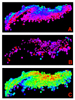
adequate at shallow depths (Figure 2a),
it may not be deeper (Figure 2b). A plot
of the valid samples for each trace (Figure
2c) may help the user choose the best compromise: using too
large a distance rapidly increases the computation effort and may
give the impression of reliable information where there is none; and
using too short a distance leaves large gaps in the data volume.
-
How far should we
interpolate or extrapolate vertically? Wells are often missing log
data from part of their depth range, and sand properties may be
missing over a depth range simply because there is no sand for
several hundred feet. The well database is carefully constructed to
leave gaps where data is missing, but by producing traces on a
regular grid we always generate values where there are no data. How
far do we want to carry this process?
-
What vertical sample
interval should be used? The wells are sampled at a fixed interval,
but there is no reason why the volume generated should use the same
interval. A closer interval will give a smoother transition in areas
where there are abrupt changes in properties with depth. The volume
could also be generated in reflection time, to match seismic data,
if desired. In most cases there will be adequate velocity control
from the well information alone to do this.
-
What depth range
should we use for the data volume? So far, we have generated volumes
with a sea-floor datum, typically starting close to the sea floor,
and going to the depth of the deeper wells in the area. There is no
point in going shallower than the shallowest data, or deeper than
the deepest data, and there is little point in generating samples to
a depth reached by only a very small number of wells or logs.
-
Should the area of
the volume be limited (by a lease line, for example, or to restrict
extrapolation into areas of no interest or little data, as in
Figure 3)?
When
these questions are answered, the volume is generated. The process
follows these steps for each trace:
-
Compute the location
of the trace in map projection X and Y, using the specified grid:
origin, orientation, and spacing along inlines and crosslines.
-
Convert the location
to latitude and longitude (the only uniform location information in
the well database for all wells is the geographic location: the map
projection used for X and Y coordinates varies with state and zone).
-
Check that the trace
is within the area of interest (if defined by a limiting polygon).
-
Identify all wells
within the specified extrapolation distance.
-
For each sample:
-
Search the
identified wells for data within the vertical interpolation
distance specified.
-
Compute a
weighted average value of the desired rock property, weighting
the well data inversely with distance, and inversely with
difference in depth from the depth of the sample.
As each
trace is completed, it is written in 32-bit floating point format to a
standard SEG Y format file (Barry et al., 1975) which can be loaded into
any seismic-interpretation system.
The
generation of these volumes takes time, so we generate graphical
progress reports (updated every 1000 traces), allowing the user to check
that the values used for interpolation and limits on the area covered
are realistic without waiting for the job to finish. These plots are of
two forms: maps (Figures 1,
2, 3a-c) and
sections (Figure 3d).
Results
The
data volumes are loaded into standard seismic-interpretation systems (in
this example, the Halliburton Landmark SeisWorks application), where
they can be manipulated in the same way as ordinary seismic data.
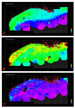
Figure 4a shows the P-wave velocity of
water-filled sand in the western Gulf of Mexico (Texas to Alabama) at a
depth 11,900 ft (3630 m) below the sea floor. The patches of background
color left of the middle of the figure indicate areas where there is no
well data available to this depth. The arcuate edges of data along the
southern limits come from the distance limit on extrapolation from
widely separated wells.
Figure
4b shows a section through the same data volume, running from the middle
of the Green Canyon area on the left to the Sabine Pass area on the
right. The gaps in the bottom of the section mark areas with no deep
wells (or no deep logs). The missing data at the top of the section at
the left is where velocity logs were not available at depths less than
7500 ft (2290 m) below water bottom (the last 5% of the section depends
on a single well). The white line marks the depth of geopressure as
interpreted by examination of each well.
Uses for the Volumes
These
volumes have great potential for increasing an explorationist’s
productivity and for defining more closely the risk of a prospect.
Suppose, for example, you have identified a potential prospect on an OCS
block in the Gulf, miles from the nearest existing well, and want to
know whether the AVO anomaly associated with the prospect is what would
be expected in that location at that depth, for either oil or gas. The
usual solution is to model the AVO response. But the modeling program
requires values for shale P-wave velocity (Figure
5a) and density (Figure 6b), sand P-wave
velocity (Figure 3c,
4), sand density (Figure 1) and
thickness, as well as depth (which can be determined from the seismic
interpretation), mud weight (Figure 3),
temperature (Figure 6a), gas density, oil
density, gas-oil ratio, salinity and water saturation: a total of twelve
unknowns. The new tool can provide a data volume derived from well data
for six of those unknowns, so values can be extracted almost instantly.
Only gas and oil density, gas-oil ratio, salinity, water saturation, and
sand thickness remain, and hydrocarbon densities, gas-oil ratio, and
salinity tend to vary relatively slowly from region to region. The
interpreter can now concentrate on varying sand thickness and water
saturation in the model, looking for a match to the observed AVO
response.
The
variability of rock properties is important in estimating the
probability of success for a prospect. Figure 6c
shows the standard deviation of water-filled-sand velocities at 10,000
ft (3050 m) below the sea floor. This is one indicator of the
variability of sand properties at this depth. Similar volumes can give
actual measurements of the variability of other properties used for
estimating probable reserves for a prospect.
At a
simpler level, the interpreter may need to know whether an observed
change in amplitude at an apparent fluid contact is compatible with a
change from water to oil. This question could be answered by comparing
the difference in values from an oil sand reflectivity volume and a wet
sand reflectivity model with the change in amplitude observed in the
real seismic data in an intercept stack volume. This would be a
deterministic solution analogous to the probabilistic solution described
by Denham and Johnson (2006).
On an
even more basic level, a gross overview can be quickly accessed, with
mud weight (Figures 3a and 3b), for example,
showing regional variations in geopressure at any depth.
Conclusions
By
combining two universally-used exploration tools – well logs as actual
measurements of rock properties, and workstations for viewing
three-dimensional data volumes – the explorationist can improve
productivity and reduce risk by making better use of existing data. The
missing link between the two tools is the uniformly-sampled data volume
in a standard format, generated from irregularly-scattered well data.
References
Barry, K.M., Cavers, D.A., and Kneale, C.W., 1975, Report
on recommended standards for digital tape formats: Geophysics, v. 40,
no. 2, p. 344–352.
Denham, L.R., and Johnson, D., 2006, Estimating
probability of hydrocarbon content from seismic amplitude anomalies:
Soc. Explor. Geoph. 76th Annual Meeting, INT3.3.
Gassmann, F., 1951, Elastic waves through a packing of
spheres: Geophysics, v. 16, no. 4, p. 673–685.
Greenberg, M.L., and Castagna, J.P., 1992, Shear-wave
velocity estimation in porous rocks: Theoretical formulation,
preliminary verification and applications: Geophys. Prosp., v. 40, no.
2, p. 195–210.
Hilterman, F., Sherwood, J.W.C., Schellhorn, R.,
Bankhead, B., and DeVault, B., 1998, Identification of lithology in the
Gulf of Mexico: The Leading Edge, v. 17, no. 2, p. 215–222.
Hilterman, F., Verm, R., Wilson, M., and Liang, L., 1999,
Calibration of rock properties for deepwater seismic: 69th Ann. Internat.
Mtg, p. 65–68.
Hilterman, F., 1990, Is AVO the seismic signature of lithology ? A case
history of Ship Shoal-south addition: The Leading Edge, v. 9, no. 6, p.
15–22. ? A case
history of Ship Shoal-south addition: The Leading Edge, v. 9, no. 6, p.
15–22.
Return to top.
|

 Print this page
 Click to view article in PDF format.