Print this page
 Click to view article in PDF format (~2.6 mb).
 Salt
Salt Geology and New Plays in
Deep-Water Gulf of Mexico*
Geology and New Plays in
Deep-Water Gulf of Mexico*
By
Abu Chowdhury1 and Laura Borton1
Search and Discovery Article #10132 (2007)
Posted August 25, 2007
*Adapted from extended abstract prepared for AAPG Annual Convention, Long Beach, California, April 1-4, 2007
1TGS-NOPEC Geophysical Company, Houston, TX ([email protected])
In
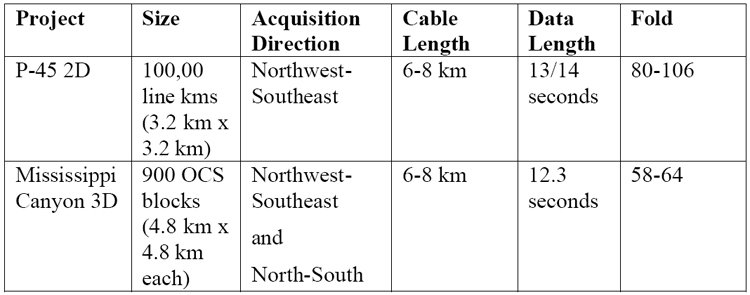
deep-water Gulf of Mexico, two pre-stack depth migration projects were
undertaken recently to better image the deep-water salt and sub-salt geology.
The Phase 45 Too (P-45) survey area, stretching from Corpus Christi/Port Isabel
in the west to Atwater Valley in the east, comprises approximately 100,000 line
kilometers of 2D seismic data. It was pre-stack depth migrated and is currently
being used for a deep-water interpretation project integrating approximately
1100 wells, including 300 biostratigrahic wells. In the Mississippi Canyon area,
approximately 900 OCS blocks (4.8 km x 4.8 km each) of 3D seismic data were
pre-stack depth migrated. More than 80 salt penetration wells were integrated in
the Mississippi Canyon salt model interpretation project. The pre-stack depth
migrated data identify autochthonous and allochthonous salt and associated
archetypes. The autochthonous Jurassic Louann (mother) Salt, Jurassic sediments,
and the overlying Cretaceous and Paleogene sequences are well manifested in the
data sets. The new Lower Tertiary play is typically characterized by broad
rollover structures created by the loading of sediments, deflation and
withdrawal of the mother salt, and subsequent collapse of the sediments. The
good imaging of the sedimentary section and folded structure below the salt
helps delineate the new Lower Tertiary play, which has proven successful in many
parts of the P-45 area, and can possibly be tested in Mississippi Canyon.
|
|
This deepwater regional study extends from the Corpus Christi/Port Isabel protraction areas in the west, eastward to the Mississippi Canyon protraction area, northward to the shelf/slope break and southward to the US-Mexico border.
Two seismic pre-stack depth migrated data
sets (Figure 1) were used to better understand the deep-water
In both the P-45 and Mississippi Canyon
projects, the top and base of
1. Sediment velocity model created by
converting PSTM velocities to depth and removing 2. Pre-processed gathers migrated with sediment velocity model.
3. Top of
4.
5. Pre-processed gathers migrated with
7. Final velocity model created by
overlaying the top and base of 8. Final migration. 9. Post-processing.
To aid in picking top and base of
In P-45, eight sequence boundaries from
the lower Pliocene down to the Cretaceous were also mapped to
decipher the geology. The sequence boundaries were picked based on
the integrated
Regional
Geology of Deep-Water
The
The key regional structural elements,
namely, the Perdido fold belt, Sigsbee
The east-northeast trending
Mississippi/Atwater fold belt lies in and around the Atwater Valley
protraction area and is composed of folded Upper Jurassic to Miocene
sediments. Like the Perdido fold belt, the rocks are underlain by
Louann
Exploration in offshore Gulf of Mexico has
advanced from amplitude plays in the shelf/slope environment to
The sequences from the Pliocene (SA)
(approximately 7 million years old) to the Mesozoic/Cretaceous (MZ)
(approximately 70 million years old) are annotated on the section.
Starting on the slope at Garden Banks on the left hand side of the
section, four successful mini-basin discoveries (Auger, Macaroni,
Magnolia, and Red Hawk) and their associated block and well numbers
are shown. Continuing across the
The varying Figure 3 is a pre-stack depth migrated strike line across Walker Ridge and Atwater Valley that again shows the Lower Tertiary play and a Lower Miocene discovery. The sequences are the same as Figure 2. However, note on this section the Mesozoic/Cretaceous boundary is annotated with a “K”. Starting in Walker Ridge on the left hand side of the section (Figure 3), St. Malo is displayed, as it is in Figure 2. Crossing the Sigsbee escarpment, Chinook and Cascade, two successful Lower Tertiary prospects, are shown. Arriving in Atwater Valley, Neptune in the Atwater/Mississippi fold belt exhibits a Lower Miocene success. The recent discoveries, Jack #2 in Walker Ridge and Kaskida in Keathley Canyon, have proven the Lower Tertiary play to be continuous across the deep-water Gulf of Mexico from Alaminos Canyon in the west (e.g., Trident and Great White) to Walker Ridge in the east (e.g., Cascade and St. Malo). The pre-stack depth migrated seismic section in Figure 4 shows the Jack prospect. The sequence annotations are similar to those in Figures 2 and 3. The discovery and test wells and the frontier play between the Paleocene (P) and Eocene (E) geologic horizons are noted.
The four Lower Tertiary wells, St. Malo,
Cascade, Chinook, and Jack (Figures 2,
3, and 4) have each found
significant amounts of oil. The reservoirs are the Wilcox sands in
the Paleocene (PA/P) that are sandwiched between the
Mesozoic/Cretaceous (MZ/K/M) and the Eocene (EO/E) sequences, and
the closures are associated with Although most literature has the eastern Lower Tertiary discovery boundary around Walker Ridge, data from Mississippi Canyon suggests that it may extend farther (Figure 5). This pre-stack depth migrated section shows the area around the Thunder Horse prospect and the BP well drilled to the Lower Miocene/Upper Oligocene. A rollover structure below total depth of the well is shown, and it is possible that the Lower Tertiary play that has been tested and proven to the west exists here.
The pre-stack seismic data used in this
study clearly images Mississippi Canyon wells that have tested and produced from the Lower Miocene/Upper Oligocene reservoirs may have the potential for Lower Tertiary discoveries as well.
Suggested References Fiduk, Joseph C., Weimer, Paul, Trudgill, Bruce D., Rowan, Mark G., Gale, Peter, G., Gafford, William, T., Geneva R., Lowe, Roger, and Queffelec, Thomas, A., 1999, The Perdido Fold Belt, northwestern deep Gulf of Mexico: Part 2. Stratigraphy and petroleum systems: AAPG Bulletin, v. 83 p. 578-610. Meyer, Dave, Zarra, Larry, Rains, David, Meltz, Bob and Hall, Tom, 2005, Emergence of the Lower Tertiary Wilcox trend in the deepwater Gulf of Mexico: World Oil, May 2005, p. 72-77. Trudgill, Bruce D., Rowan, Mark G., Fiduk, Joseph C., Weimer, Paul, Gale, Peter E., Korn, Bryant E., Phair, Ronald L., Gafford, William T., Roberts, Geneva, R, and Dobbs, Steven W., 1999, The Perdido Fold Belt, northwestern deep Gulf of Mexico: Part 1. Structural geometry, evolution and regional implications: AAPG Bulletin, v. 83, p. 88-113.
We would like to thank TGS-NOPEC management for their support and
permission to publish this paper. We also thank Ray Martin who has
significant contribution to the |