Print this page
 Click to view poster in PDF format.
PS Shale
Shale Gas Reservoir Systems: Insights from North of the Border*
By
Daniel John Kerridge Ross1 and R. Marc Bustin1
Search and Discovery Article #10129 (2007)
Posted July 25, 2007
*Adapted from poster presentation at AAPG Annual Convention, Long Beach, California, April 1-4, 2007.
Permission of the authors is required for copying or downloading this article or any part of it.
1University of British Columbia, Vancouver, BC ( [email protected] )
Organic-rich Devonian and Jurassic strata are considered to be excellent
candidates for gas shales in Western Canada. These strata have TOC contents
ranging between 1-40 wt%, thermal maturities into the dry-gas window, and
thicknesses in places over 1700 m. The ratio of total organic carbon (TOC) to
gas sorption varies markedly from unit to unit depending on pore-structure,
thermal maturation, moisture and inorganic composition. For low maturity shales,
surface areas and micropore volumes are low, ranging from 0.23-0.64 cc/100g CO2
monolayer volume despite TOC values up to 38 wt%. The increased sorption of
methane with increasing TOC, independent of microporosity and surface area,
implies gas is primarily stored through solution in the bituminite fraction.
Thermally mature shales have greater micropore volumes (0.3-1.2 cc/100g)
associated with the organics, resulting in more gas adsorbed per wt% TOC.
Structural transformation of the bituminite during maturation-induced diagenesis
plays a key role in the creation of adsorption sites.
The inorganic
component is also important to gas capacities. Carbonate-rich samples often have
lower organic carbon contents and porosity hence potentially lower sorbed and
free-gas capacities. Highly mature Devonian shales are both silica and TOC-rich
(up to 85% quartz and 5 wt% TOC) and as such, deemed excellent potential shale
gas reservoirs because they are both brittle (fracable) and have high sorbed gas
capacities. However the lower porosity of silica-rich mudrocks implies potential
frac-zones may not provide optimum gas capacities.
|
|
As the exploration frontier of
With the development of
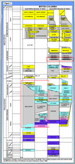
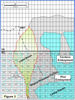
The Jurassic and Devonian strata in northern BC consists of shales, mudrocks, marlstones and carbonates (Pelzer, 1966; Ross and Bustin, in press). Organic-rich sediments of the Gordondale (Jurassic) and Muskwa/Besa River (D-M) were deposited to the west of a carbonate platform (Figure 3) under variably dysoxic-anoxic bottom waters (Ross and Bustin, in press; Ross and Bustin, in prep). In the Peace River district (Jurassic study area), the Gordondale Member attains thicknesses of 25-30 m with TOC contents between 0.8 and 40 wt% (Ross and Bustin, in press).
Prospective D-M
TOC and Sorbed
Jurassic and D-M shales have sorbed
As evident from Figure 4, the ratio of
Low pressure CO2 analyses of D-M shales show microporosity increasing with TOC and sorption capacity (Figure 5), highlighting the greater overlapping potential energy of pore walls in smaller pores (Burggraaf, 1999).
Jurassic shales are organically-richer than D-M samples but do not
have an associated increase in surface area with TOC. The ratio of
micropore surface area to TOC is lower for Jurassic shales,
averaging 4.2 compared to 8.6 for D-M shales (Table
1). Thus despite the relative importance of organic carbon to
sorption capacity (as illustrated by Figure
4), the influence of TOC on micropore structure is not as
apparent in Jurassic samples. In these cases, matrix bituminite,
which is the dominant organic matter type in the Jurassic samples,
may store Different surface area:TOC ratios between D-M and Jurassic shales may be a result of thermal maturation. Jurassic strata have equivalent vitrinite reflectances (%Ro) typically <1.2%Ro (Ross and Bustin, in press) whilst D-M shales have vitrinite reflectance values ranging between 1.6 and 4.5%Ro (Morrow et al., 1993; Potter et al., 2000). At greater thermal maturity, diagenesis may structurally transform organic matter, creating more microporosity (Figure 5A; Laxminarayana and Crosdale, 1999).
Solute
A solute
The potential importance of clays to
Importantly, it highlights inorganic factors which can influence the
relationship between
The extent to which microporous materials can sorb methane is
affected not only by the pore structure, but also by temperature
(Yee et al., 1993). Temperature dependence of
Temperature increase from 30-50°C lowers sorbed D-M strata in northern BC are buried to more than 3 km depth and reservoir temperatures range between 120-155°C (geothermal gradient of 40°C/km). In most cases, adsorption capacities do not significantly change following Langmuir extrapolation to reservoir pressures (up to 35 MPa) (Figure 8A). With high reservoir temperatures and low levels of adsorption, the plateau of the isotherm occurs at relatively low pressures, often in the range of 10-15 MPa.
Due to the exothermic nature of
Free
Similar to tight Quartz-rich mudrocks display similar pore properties as chert (Figure 9C) – low total pore volumes and tight-rock characteristics (pore diamters in the 10,000nm + range (Figure 9C).
As suggested by tight pore-structure characteristics of silica-rich
mudrocks (Figure 9B),
Evaluating Silica Distribution: Excess SiO2 Concentrations Jurassic and D-M sediments are characterized by high Si/Al ratios. Excess silica contents, which are SiO2 levels above 'normal' detrital background, were calculated using the formula:
Elementxs = elementsample [(element/Al)background x Alsample]
A Si/Al ratio of 3.11 is used for AS (Wedepohl, 1971). Up to 91% of
the SiO2 in Jurassic sediments and up to 70% SiO2
in D-M sediments cannot be accounted for by the aluminosilicate
phase. Although a detrital source of the silica cannot be completely
discounted (e.g., silt-sized quartz), excess Si is attributed to
biogenic sources because: 1) TOC contents are high (up to 21 wt%) (Figure
10B) and; 2) Ti concentrations are close to ‘average
The effect of
Significance of Pore Structure for Resource Evaluation
To predict
The Bigger Picture: Regional Resource Assessment
Both Jurassic and Devonian strata have excellent
For comparison, the areal extent of the Fort Worth Basin is also
shown in Figure 13B, highlighting the
significant resource potential of Devonian strata - all of which is
beyond the oil window and into the dry-
The
The data presented here accounts for only some of the physical
properties of
The results of this research highlight the difficulty to predict
sorbed
Producibility (permeability) is fundamental to economic
Financial support was provided by NSERC grant (Dr R.M. Bustin), EnCana and CBM Solutions.
Brown, S., 2006, Shales require creative approaches: AAPG Explorer, November, p. 6, 8, 10. Brunauer, S. L.S. Deming, W.S. Deming, and E. Teller, 1940, On a theory of van der Walls adsorption of gases: The Journal of the Chemical Society, v. 62, p. 1723-1732.
Burggraaf, A.J., 1999, Single
Bustin, R.M., 2005, Duffy, J.R., N.O. Smith, and B. Nagy, 1961, Solubility of natural gases in aqueous salt solutions: Liquidus surfaces in the system CH4-H20-NaCl2-CaLl2 at room temperatures and at pressures below 1000 psia: Geochimica et Cosmochimica Acta, v. 24, p. 23-31. Laxminarayana, C., and P.J. Crosdale, 1999, Role of coal type and rank on methane sorption characteristics of Bowen Basin, Australia Coals: International Journal of Coal Geology, v. 40, p. 309-325.
Montgomery, S.L., D.M. Jarvie, K.A. Bowker, and R.M.
Pollastro, 2005, Mississippian Barnett Morrow, D.W., J. Potter, B. Richards, and F. Goodarzi, 1993, Paleozoic burial and organic maturation in the Liard Basin Region, northern Canada: Bulletin of Canadian Petroleum Geology, v. 41, P. 1731. Potter, J., F. Goodarzi, D.W. Morrow, B.C. Richards, and L.R. Snowdon, 2000, Organic petrology, thermal maturity, and Rock-Eval/TOC data for Upper Paleozoic strata from selected wells between 60o and 61 oN and 122 oW and 123 o30’W, district of Mackenzie: Geological Survey of Canada Open File Report 3925.
Ross, D.J.K., and R.M. Bustin, Ross, D.J.K., and R.M. Bustin, Sediment geochemistry of the Lower Jurassic Gordondale Member, northeastern British Columbia: Bulletin of Canadian Petroleum Geology, in preparation. Teichmuller, M., 1986, Organic petrology of source rocks, history and state of the art: Organic Geochemistry, v. 10, p. 581-599.
Yee, D.,
J.P. Seidle, and W.B. Hanson, 1993, |