Print this page
 Click to view presentation in PDF format.
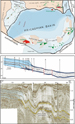
Regional Late Paleozoic Tectono-Stratigraphic Settings and Perspectives for Discoveries at the Pricaspian Basin's Northwestern Margin, Russia*
By
Yuri Nikitin1, Sergei Ostapenko2 and John Dolson3
Search and Discovery Article #10127 (2007)
Posted June 20, 2007
*Adapted from oral presentation at AAPG Annual Convention, Long Beach, California, April 1-4, 2007
1Tyumen Petroleum Research Center, Tyumen, Russia ([email protected])
2TNK-BP, Moscow, Russia ([email protected])
3TNK-BP, Moscow, Russia ([email protected])
The northwestern
margin of the Pricaspian Basin intersects the Ryazano-Saratov Trough to the west
and to the southeast, platform carbonate and clastic deposits grade to deep
water. This trough has created strong controls on deposition in the deep basin.
Carbonate platform slopes change from several degrees in the Devonian to up to
45o in the lower Permian. Unlike the southeastern portion of the
Pricaspian basin where the giant Tengiz and Kashagan carbonate buildups overlie
older basement highs, steady, strong tectonic subsidence in the north did not
favor development of isolated carbonate platforms. During sea level lowstands,
clastics by-passed the shelf into the deep basin. Fluvial and  deltaic
 systems
entered the basin during Early Visean and Middle Carboniferous along the
Ryazano-Saratov Trough, feeding shelf edge deltas and deep water deposits to the
east. The largest Middle Carboniferous deltaic deposits cover more then 2500 km2
and reach thickness of 1.5-1.7 km. Seismic anomalies at the base of the basinal
clinoforms are probably submarine fans. In the late Carboniferous, major
unconformities associated with at least one sea level lowering or tectonic
uplift created paleo- relief in excess of 600 meters. The Upper Carboniferous
carbonate platform was exposed and karsted. Along the shelf margin and around
isolated carbonate banks, waves created additional erosion. In contrast, mud and
shale deposits were transported into deep water from south to north from the
Karpinsky fold belt. Only a few wells penetrate these deep water sands and
shales in the interior of Pricaspian Basin. This deep-water clastic play may
hold promising commercial oil-gas deposits at depths between 5200 and 5800
meters.
systems
entered the basin during Early Visean and Middle Carboniferous along the
Ryazano-Saratov Trough, feeding shelf edge deltas and deep water deposits to the
east. The largest Middle Carboniferous deltaic deposits cover more then 2500 km2
and reach thickness of 1.5-1.7 km. Seismic anomalies at the base of the basinal
clinoforms are probably submarine fans. In the late Carboniferous, major
unconformities associated with at least one sea level lowering or tectonic
uplift created paleo- relief in excess of 600 meters. The Upper Carboniferous
carbonate platform was exposed and karsted. Along the shelf margin and around
isolated carbonate banks, waves created additional erosion. In contrast, mud and
shale deposits were transported into deep water from south to north from the
Karpinsky fold belt. Only a few wells penetrate these deep water sands and
shales in the interior of Pricaspian Basin. This deep-water clastic play may
hold promising commercial oil-gas deposits at depths between 5200 and 5800
meters.
|
|
Figures with Comments
Al-Zhadi, R.A., 2004, The Pricaspian Basin – The most important oil-and-gas bearing basin of the North-Western Mediterranean: Almaty, Neft i gas, no. 1, p. 15-23. Feodorov, D.L., 1979, Sub-salt Paleozoic formations and oil-and-gas content of the East-European platform’s marginal basins: Moscow, Nedra, 171 p. Feodorov, D.L., 2003, Structure of the basement surface in the Pricaspian Basin. Razvedka i okhrana nedr, no. 2, p. 11-12. Khutoskyi, M.D., Antipov, M.P., Volozh, Yu.A., and Polyak, B.G., 2004, Temperature field and 3D geothermal model of the Pricaspian Basin: Geotectonica, no. 1, p. 63-72. (Map used in slide 1 was prepared by Yu. Volozh) Myers, K.J., and Milton, N.J., 2004, Concepts and principles of sequence stratigraphy, in Sequence Stratigraphy, D. Emery and K.J.Myers, eds., Blackwell Science. p. 11-41. Nikitin, Yu. I., 1992, Seismic-geological zonation of the Pricaspian Basin North-Western part: Nedra Povolzhya i Pricaspiya, Issue 3, Nizhne-Volzhskyi Institute of Geology and Geophysics, Saratov. p. 7-16. O’Hearn, T., Elliott, S., and Samsonov, A., 2003, Karachaganak Field, Northern Pre-Caspian Basin, Northwestern Kazakhstan. in Giant Oil and Gas Fields of the Decade 1990-1999, Michel T. Halbouty, ed.: AAPG Memoir 78. Tulsa, Oklahoma, USA. Sheglov, V.B., Yatskevich, S.V., Merkulov, O.I., Mamulina, V.D., and Umnova, L.N., 2005, Reservoir properties of the dubsalt oil-and-gas bearing complexes around Russian sector of the Pricaspian Basin: Nedra Povolzhya i Pricaspiya, Issue 44, Nizhne-Volzhskyi Institute of Geology and Geophysics, Saratov, p. 3-22. Solovyov, B.A., Ivanov, Yu. A., and Kondratyev, A.N., 2002, Middle Carboniferous clastic complex of the Pricaspian Basin West – Possible object for big oil-and-gas fields exploration: Geologiya nefti I gaza (Oil and Gas Geology), no. 5., p. 2-7. Yatskevich, S.V., Nikitin, Yu. I., Klimashin, V.P., Shebaldin, V.P., and Postnova, E.V., 1999, Prognostic Models of the Middle Carboniferous – Lower Permian hydrocarbon traps around the Pricaspian Basin North-Western part: Nedra Povolzhya i Pricaspiya, Issue 18, Nizhne-Volzhskyi Institute of Geology and Geophysics, Saratov, p. 17-28. Zamaryonov, A.K., Shebaldina, M.K., Feodorov, D.L., Yugai T.A., and Yatskevich S.V., 1986, The sedimentation models of the Pricaspian Basin subsalt oil-and-gas bearing complexes: Moscow, Nedra, 137 p.
|