Print this page
 Click to view posters in PDF format.
Poster 1 (2.3 mb) Poster 2 (0.5 mb) Poster 3 (0.5 mb)
Poster 4 (2.7 mb) Poster 5 (0.4 mb)
Right click on poster to save.
PSPrediction of Sub-seismic Sealing Faults Using Simple Numerical Simulation Models*
By
R.C. Bain1, K.H. MacIvor1, B.E. Holt1, and D.S. Beaty1
Search and Discovery Article #40242
Posted May 28, 2007
*Adapted from poster presentation at AAPG Annual Convention, Long Beach, California, April 1-4, 2007
1Chevron North America Upstream, Houston, Texas ([email protected])
In order to
justify development drilling in a partly-depleted, highly faulted gas reservoir
in which untapped higher- pressure
 compartments may exist, convincing evidence
for fault separation from existing producing wells must be provided, either by
obvious fault breaks on 3-D seismic or by missing section due to a fault
encountered in a well. Lacking such evidence, it is difficult to state with
certainty that prospect reserves will be incremental, as opposed to
acceleration, even when volumetric analysis suggests that existing wells will
not capture all of the producible reserves in a reservoir.
compartments may exist, convincing evidence
for fault separation from existing producing wells must be provided, either by
obvious fault breaks on 3-D seismic or by missing section due to a fault
encountered in a well. Lacking such evidence, it is difficult to state with
certainty that prospect reserves will be incremental, as opposed to
acceleration, even when volumetric analysis suggests that existing wells will
not capture all of the producible reserves in a reservoir.
The Mid-Continent Business Unit of Chevron North America Exploration and
Production has had success in the Lobo Trend of Webb and Zapata Counties, South
Texas, using simple, "fit-for-purpose" 3D-earth models and numerical simulation
models that provide a level of confidence sufficient to predict the location and
expected reservoir conditions of remaining incremental reserves in a
partly-developed reservoir. These models have proven to be very useful in their
ability to provide quick results with limited geologic and reservoir data. The
key factor in their success is the proper integration of flowing pressure data
with observed production decline curves. Static reservoir pressure measurements
are typically unavailable and also give misleading results when used for P/Z
volumetric analysis in compartmentalized reservoirs.
In the first example, a simple simulation model predicted the presence of
sub-seismic faulting that provided a seal for the objective reservoir. The
proposed location was in a syncline between two wells that had already produced
large volumes of gas and were producing at very low bottom-hole pressures. An
iterative approach involving the seismic interpreter and the reservoir engineer
resulted in a geologic model that was supported by the seismic data and agreed
with the history matching efforts. The well, which would not have been approved
without the model to support it, encountered near-virgin reservoir conditions.
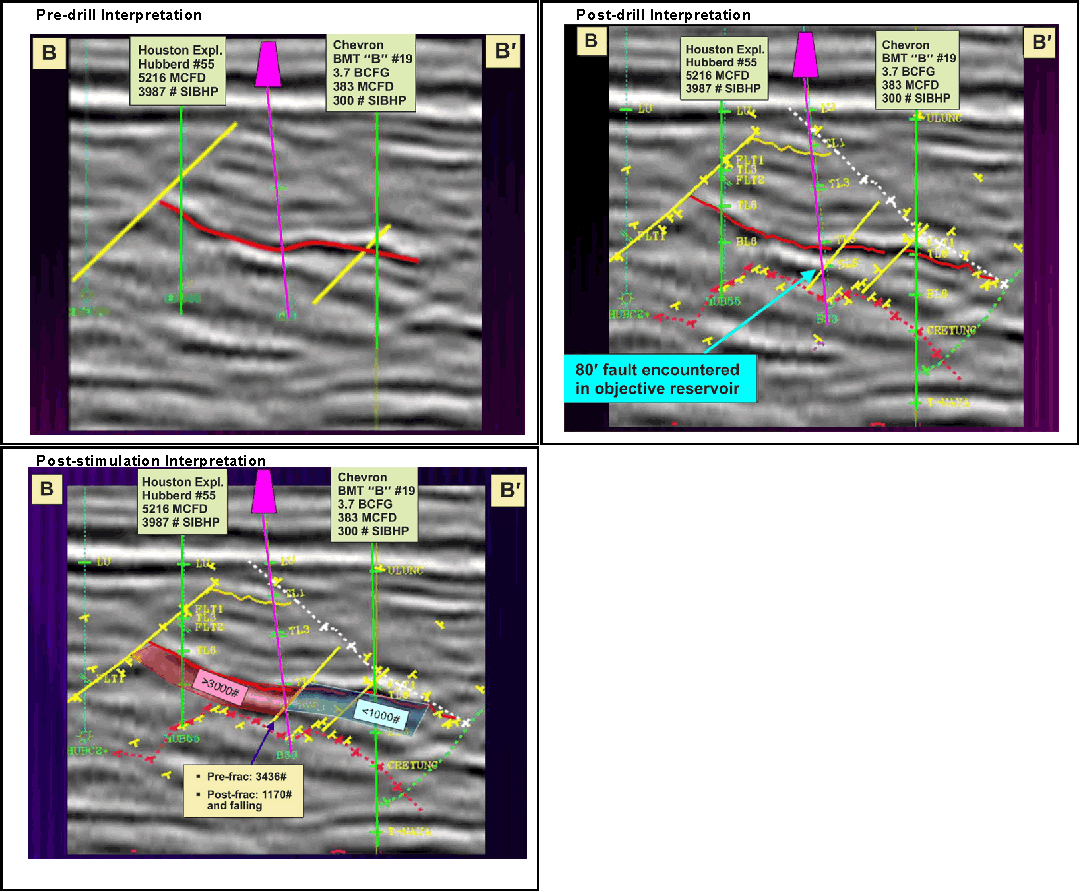
The second example provides a lesson learned, demonstrating a reservoir in which
the reservoir simulation and history match correctly predicted the presence of a
sealing fault, but incorrectly predicted which of several faults was the sealing
one. The sealing fault was penetrated by the wellbore and the seal was ruptured
when the well was fracture stimulated.
Quickly demonstrating the accuracy and applicability of simple numerical models in an environment where rig moves are rapid and reservoir data is sparse has generated a new interest in a tool that was heretofore thought too complex and too time consuming to apply. Asset Team Earth Scientists are now working more closely with the reservoir simulation engineers and are using the results from these simple models to help in their interpretation of subsurface geology, especially in highly faulted environments. In some cases, successful wells are being drilled where they otherwise would not have been.
|
|
Poster 1: The Problem, Geologic Setting, and Reservoir Simulation Basics Volumetric calculations indicate that two wells producing from the same gas reservoir have not drained all of the producible reserves in a 200-acre fault block. The challenge is to identify economic drill locations despite the fact that the existing wells appear to be depleted.
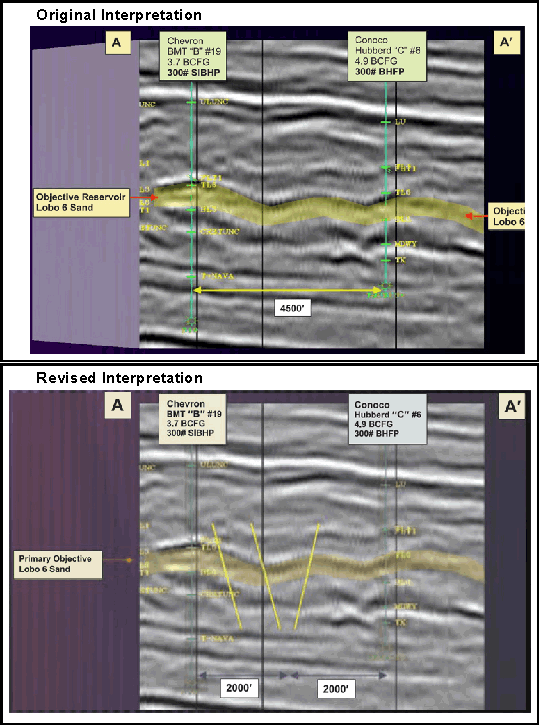
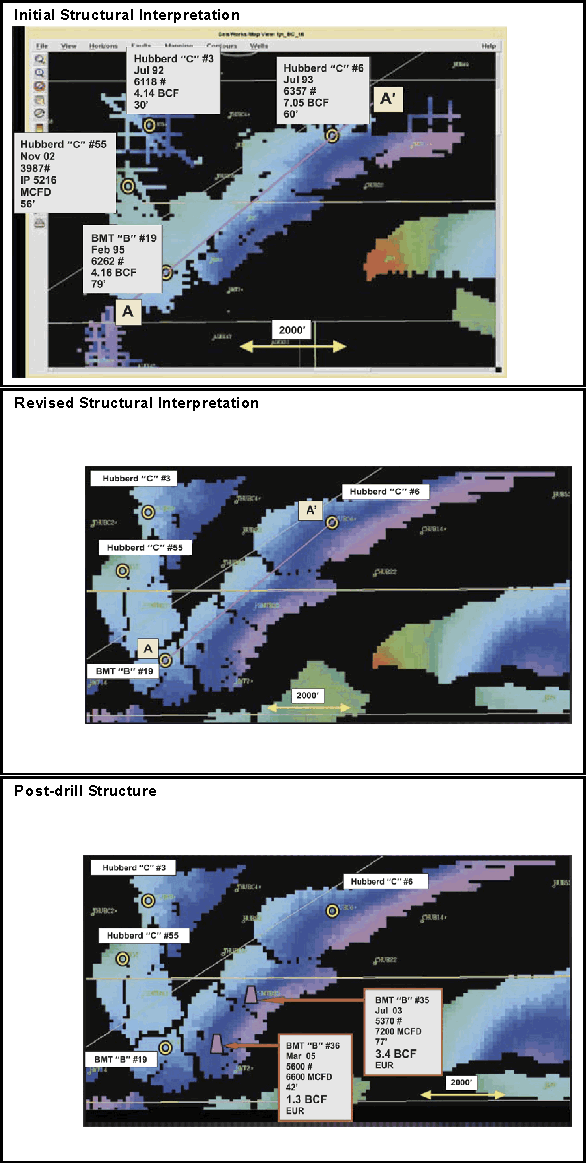
Posters 2 and 3: Case Study #1 A 3-D
seismic interpretation of the fault block described above was converted
to a GOCAD model and assigned reservoir properties. A 3-D cellular model
was then constructed. History matching of the actual well performance to
the numerical simulation indicated that internal boundaries were
required to adequately explain the By
interpreting tiny offsets of flexures in seismic events as possible
faults, the seismic interpreter was able to segment the objective
reservoir into four blocks (see Line A-A’). The 3-D cellular model was
revised to incorporate the new barriers, and the simulation was run
again. This time the
Poster 4: Case Study #2 In a
different part of the model created in Case Study #1, a well was
proposed to offset a competitive drainage situation in a 60-acre fault
block. The proposed well was expected to encounter similar
Flowing
tubing
Return to |