Print this page
 Click to view article in PDF format.
GCP-P
and P-SV  Seismic
 Wave Modes at Salt Boundaries*
By
Bob Hardage1, Diana Sava1, Michael DeAngelo1, and Randy Remington1
Search and Discovery Article # 40237 (2007)
Posted May 8, 2007
*Adapted from the Geophysical
Corner column, prepared by the authors, in AAPG Explorer, April, 2007, and
entitled “Which Seismic Wave Mode is Best?”. Seismic examples were provided by
WesternGeco. Editor of Geophysical Corner is Bob A. Hardage. Managing Editor of
AAPG Explorer is Vern Stefanic; Larry Nation is Communications Director.
1Bureau of Economic Geology, The University of Texas at Austin ([email protected] )
General Statement
Salt-sediment
boundaries are common seismic imaging targets that exist at many depths across
several basins. Some of these boundaries are salt-sand interfaces; others are
salt-shale interfaces. In this article we consider the reflectivity behavior of
P-P and P-SV wavefields at salt-sediment interfaces in marine environments, to
determine if one seismic wave mode (P-P or P-SV) has an imaging advantage over
the other for studying deep salt-related traps.
uGeneral statementuFigure captionsuTwo ModelsuExamplesuConclusion
uGeneral statementuFigure captionsuTwo ModelsuExamplesuConclusion
uGeneral statementuFigure captionsuTwo ModelsuExamplesuConclusion
|
Two Models
This
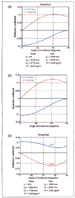
1) In the first model, the bottom layer was salt (with properties VP = 4550 m/s, VS= 2630 m/s, and r = 2.16 gm/cm3), and the top layer was sandstone (with properties f = 10 percent, VP = 4679 m/s, VS = 2840 m/s, and r = 2.476 gm/cm3). 2) In the second model, the lower layer was this same salt, but the upper layer was first defined to be a “soft” shale (with properties f = 20 percent, VP = 3400 m/s, VS = 1754 m/s, and r = 2.316 gm/cm3) and then was changed to a “hard” shale (with properties f =5 percent, VP = 4700 m/s, VS= 2775 m/s, and r = 2.536 gm/cm3).
In our terminology, a “hard” shale has velocities greater than salt, whereas a “soft” shale has velocities less than salt. Our modeled reflectivity behaviors are displayed as Figure 1. The P-P and P-SV reflectivities for a salt-sandstone interface (Figure 1a) are almost identical to the reflectivities for the interface between salt and soft shale (Figure 1b). Two important principles are defined by these reflectivity functions: 1) P-P reflectivity is large and P-SV reflectivity is small for small angles of incidence. 2) The opposite is true for large angles of incidence where P-SV reflectivity is large and P-P reflectivity is small.
For many source-receiver offsets, this reflectivity physics means that in situations where the dip of a salt-sediment interface is small, the P-P mode should be a better choice than the P-SV mode for imaging that interface. In contrast, if a salt-sediment interface has a large dip angle, the P-SV mode should image the interface better than does the P-P mode.
Examples
Examples of these
reflectivity behaviors are demonstrated by the events near the base of
|