Print this page
 Click to view article in PDF format.
Himalayan Frontal Fold-Thrust
Belt, NW India: Geometry,  Structural
 Evolution, and Hydrocarbon Prospects*
By
Dilip K. Mukhopadhyay1 and Premanand Mishra2
Search and Discovery Article #10122 (2007)
Posted March 3, 2007
*Adapted from extended abstract prepared for presentation at AAPG 2006 International Conference and Exhibition, Perth, Australia, November 5-8, 2006
1Department of Earth Sciences, Indian Institute of Technology, Roorkee 247667, UA, India ([email protected])
2Premier Oil, New Delhi, India
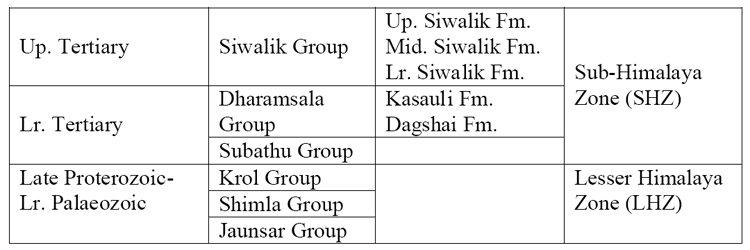
The frontal part of the 2400 km-long and arcuate Himalayan Mountain belt is traditionally divided into three lithotectonic zones (Figure 1). From north to south, these are: (1) High Himalaya Crystalline Zone (HHCZ) composed of highly deformed and metamorphosed rocks of Precambrian age, (2) Lesser Himalaya Zone (LHZ) with a sequence of Upper Proterozoic to Lower Palaeozoic sedimentary rocks, and (3) Sub-Himalaya Zone (SHZ) consisting of Tertiary sedimentary rocks deposited in front of the rising mountain front. Each of these lithotectonic zones are bound on either side by longitudinally continuous and supposedly intracontinental thrusts, such as Main Frontal Thrust (MFT), Main Boundary Thrust (MBT), and Main Cental Thrust (MCT) (Figure 1). These thrusts are thought to be splays from a gently dipping detachment. Several oil/gas fields have been discovered during the last 125 years in the Himalayan FTB in Pakistan and Assam-Arakan FTB in northeastern India. However, no commercial oil/gas discovery has been made in the intervening areas in India, Nepal, and Bhutan. This is intriguing, particularly for the NW Himalayas, where many oil and gas seeps are known since historical times. We have undertaken a serial balanced
cross section approach in
a sector in the NW Himalayas to understand the subsurface structural geometry
and evolution of the FTB. The Nahan salient, focus of the present study, is
flanked by Kangra and Dehra Dun re-entrants in the NW Himalayas. We have
constructed three serial balanced cross sections in the Nahan salient. In
addition, one balanced cross section each on the flanking re-entrants have also
been constructed (not described here). In this article, we describe the
structural details in the Nahan salient. We expect that this and similar studies
may help us to identify structural plays for detailed hydrocarbon exploration in
the Himalayan frontal FTB.
|
|
Figure Captions
A simplified geological map of the Nahan
salient and the locations of the lines of
It is generally considered that the three rock groups; i.e., LHZ, lower SHZ (i.e., Subathu- Dharamsala), and upper SHZ (i.e., Siwalik), are completely separated from each other by tectonic surfaces on the surface as well as in the subsurface. However, the geological map shows that this is not strictly true. Siwalik rocks occur within lower SHZ, and lower Tertiary rocks occur within LHZ. In addition to the two regionally important thrusts, viz., MFT and MBT mentioned above, a large number of map-scale thrusts are present in the frontal FTB. A number of large-scale anticlines and synclines are also present. The surface traces of thrusts and axial traces of folds are approximately parallel to each other. Statistical analyses of dips of bedding planes and axial planes of small-scale folds suggest that the rocks of both the SHZ and LHZ were deformed under a single, continuous deformation episode. For these reasons, we place the LHZ along with the SHZ rocks in the cover sequence and consider the crystalline rocks of the HHCZ as the basement. Therefore, the SHZ and LHZ together constitute the frontal fold-thrust belt (FTB) in the Himalayas. The deformation pattern in this belt is characteristic of thin-skinned tectonic setting, although LHZ is made up of Proterozoic sedimentary sequence.
The balanced
Both forward and inverse modelling were
carried out during section construction. For each thrust, several
fault-related fold models were constructed using dip-domain data in
order to generate admissible structures (forward modelling).
Several
The three
From the foregoing description it is obvious
that the frontal FTB can be partitioned into three segments occupied
dominantly by Siwalik, Subathu-Dharamsala, and LHZ rocks, occurring
successively away from the foreland. These three segments show distinct
The overall
In an area with such
Play type I: Ramp anticlines (fault-bend or fault-propagation folds)
Play type II: Stratigraphic pinchouts/wedgeouts
Play type III: Roof sequences of buried duplexes
Play type IV: Subthrust
|