
 Print this page
 Click to view article in PDF format.
Stochastic Monte-Carlo simulations of overpressure probability distribution in the Halten Terrace area*
By
Ane Lothe1 and Are Tømmerås1
Search and Discovery Article #40232 (2007)
Posted February 11, 2007
*Adapted from extended abstract prepared for presentation at AAPG 2006 International Conference and Exhibition, Perth, Australia, November 5-8, 2006
1SINTEF Petroleum Research, S.P. Andersens vei 15B, N-7465 Trondheim, Norway
Quantifying the uncertainties in pore pressure
simulations at basin scale is a challenge. This is mainly because the geological
processes that control pressure generation and dissipation and the lateral  fluid
fluid flow in a sedimentary basin are still not well understood. Stochastic
Monte-Carlo simulation of overpressures is an approach that can be used to
quantify the uncertainties related to some of the calculated processes. The
technique presented here can provide important guidelines when planning drilling
operations in new parts of a basin.
flow in a sedimentary basin are still not well understood. Stochastic
Monte-Carlo simulation of overpressures is an approach that can be used to
quantify the uncertainties related to some of the calculated processes. The
technique presented here can provide important guidelines when planning drilling
operations in new parts of a basin.
Study Area and Regional Geology
The
study area is located in the Halten Terrace, offshore Mid-Norway (Figure
1). The Halten Terrace is highly block-faulted, due to major extensional
activity during the Late Jurassic to Early Cretaceous (Blystad et al., 1995).
The Halten Terrace area has undergone continuous subsidence since Paleozoic. The
subsidence history suggests moderate to high sedimentation rates during the
Mesozoic and very high rates in the Late Pleistocene (Dalland et al., 1988).
Today, the reservoir rocks (Garn Formation, Fangst Group) are buried to depths
between 2.0 and 3.5 km in the western part of the terrace. The rapid, late
burial led to increased pressure in the western part of the area. The pressure
generation was highly influenced by increased quartz cementation in the Fangst
Group.
|
|
The pressure simulator named PRESSIM is used
to do the pressure modelling. The simulator is developed to calculate
pressure build-up and dissipitation on geological time scale in
sedimentary basins (Borge, 2000, Lothe, 2004;
Figure 2). The fault traces mapped at the top reservoir level
delineates the lateral extent of the pressure compartments that are used
in the simulator. The lateral Darcy flow of The geo-mechanical properties for the caprock are allowed to vary through time with changing burial depths (Lothe et al., 2004). Isotropic horizontal stresses are assumed, and the minimum horizontal stress is estimated using an empirical formula (Grauls, 1998). The vertical stress versus time varies depending on sedimentary loading and fault permeability; it is modelled as depth dependent. The fault transmissibility depends on the burial depth, the length, width, and the dip-slip displacement of the faults, thickness of the reservoir layers, and the permeability inside the fault block (Borge and Sylta, 1998). The Griffith-Coulomb failure criterion and the frictional sliding criterion are used to simulate hydraulic fracturing from the overpressured compartments.
Depth maps of the different stratigraphic
units were used to compute the decompacted subsidence history for the
Jurassic Garn
As outlined in Krogstad and Sylta (1996),
Sylta and Krogstad (2003) and Sylta (2004), hydrocarbon 3D basin
simulations can be carried out with Monte Carlo simulation loop. The
same
Sylta and Krogstad (2003) used a probabilistic
description of the key input parameters; e.g., thickness of source rock
unit as the sum of a) a map grid of the most likely values and b) a
standard deviation from the most likely values. This can also be used in
our case, where the most important input variables can be described with
a probability distribution. The calibration of the model consists of
finding a set of input variables and their values that result in a match
to present-day
The simulation results can be weighted,
depending on the measured
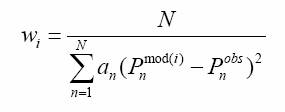
where wi is the weight of simulation run number ‘i’, N is the total number of calibration depths, an is a weight of importance of applied to each calibration depth, ‘n’ refers to well depth , Pn mod(i) is the modelled overpressure for depth ‘n’ in run ‘i’ , and Pn obs is the measured (observed) overpressures for calibration well for depth ‘n’. When the average difference between the modelled and measured overpressures increases, the weight of the simulations will decrease. An estimator for the most likely predicted pressure is (rewritten from Sylta and Krogstad, 2003):
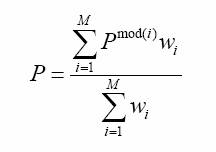
where ‘M’ is the total number of simulations runs used.
To assess the uncertainties, more than 3000
runs with stochastic Monte-Carlo approach has been carried out. First,
the results for the Monte-Carlo simulations where analysed without using
any knowledge of the pressure distribution and magnitude in the area. As
may be expected, a large uncertainty was observed for the simulated
Secondly, we weighted simulated Monte-Carlo
results versus measured
Monte-Carlo simulations can be a very useful
tool to predict and quantify uncertainties in pressure simulations on a
basin scale. Probability maps that show the calculated uncertainty of
the
Baldwin, B., and C.O. Butler, 1985, Compaction curves: AAPG Bulletin, v. 69, no. 4, p. 622-662. Blystad, P., et al., 1995, Structural elements of the Norwegian continental shelf, Part II. The Norwegian Sea Region: Norwegian Petroleum Directorate Bulletin, v. 8. Borge, H., 2000, Fault controlled pressure modelling in sedimentary basins, in Department of Mathematical Sciences: Norwegian University of Science and Technology, Trondheim. p. 148. Borge, H., and Ø. Sylta, 1998, 3D modelling of fault bounded pressure compartments in the North Viking Graben: Energy, Exploration and Exploitation, v. 16, p. 301-323. Dallmann, W.K., 1998, The structure of the Berzeliustinden area: Evidence for thrust wedge tectonics in the Tertiary fold-and-thrust belt of Spitsbergen: Polar Research, v. 6, p. 141-154. Grauls, D., 1998, Overpressure assessment using a minimum principal stress approach. in Overpressures in petroleum exploration; Proc. Workshop: Bull. Centre Rech. Elf Explor. Prod., Pau, France. Krogstad, W., and Ø. Sylta, 1996, Risk assessment using volumetrics from secondary migration modelling: Aassessing uncertainties in source rock yields and trapped hydrocarbons, in Quantification and Prediction of Petroleum Resources, A.G. Dore and R. Sinding-Larsen, eds., Elsevier: Amsterdam. p. 219-235. Lothe, A. E., 2004, Simulations of hydraulic fracturing and leakage in sedimentary basins: Ph.D. dissertation, 2004, University of Bergen, p.184. Lothe, A.E., H. Borge, and R.H. Gabrielsen, 2004, Modelling of hydraulic leakage by pressure and stress simulations: An example from the Halten Terrace area, offshore Mid-Norway: Petroleum Geoscience, v. 10, no. 3, p. 199-213. Sylta, Ø., 2004, A probabilistic approach to improved geological knowledge and reduced exploration risks using hydrocarbon migration modeling: Petroleum Geoscience, v. 10, p. 187-198.
Sylta, Ø., and W. Krokstad,
2003, Estimation of oil and gas column heights in prospects using
probabilistic basin modelling Walderhaug, O., 1996, Kinetic modelling of quartz cementation and porosity loss in deeply buried sandstone reservoirs: AAPG Bulletin, v. 89, no. 5, p. 731-745.
|


