Print this page
 Click to view article in PDF format.
GCTake Your Pick: Skeptic or Proponent*
By
Bob A. Hardage1, Khaled Fouad1, and Glenn Winters2
Search and Discovery Article #40228 (2006)
Posted December 22, 2006
*Adapted from the Geophysical Corner column, prepared by the authors, in AAPG Explorer, December, 2006. Editor of Geophysical Corner is Bob A. Hardage. Managing Editor of AAPG Explorer is Vern Stefanic; Larry Nation is Communications Director.
1Bureau of Economic Geology, Austin, Texas ([email protected] )
2Fasken Oil and Ranch, Midland, Texas
Intriguing seismic examples are being developed in multi-component seismic research at the Bureau of Economic Geology, specifically examples documenting which one of the S-wave seismic modes images a key geologic feature better than does the P-wave mode -- the only seismic mode many explorationists have ever used. One of those examples is illustrated here.
|
uGeneral commentuFigure captionsuExampleuPP and PS modesuAmplitude attributeuResultsuAcknowledgment
uGeneral commentuFigure captionsuExampleuPP and PS modesuAmplitude attributeuResultsuAcknowledgment
uGeneral commentuFigure captionsuExampleuPP and PS modesuAmplitude attributeuResultsuAcknowledgment
|
The prospect is a carbonate Strawn play in
West Texas. Traditional P-wave seismic data in the area are good
quality, produce accurate At this particular prospect, the Strawn play is stratigraphic, not structural, and traditional P-wave data were having limited success in predicting optimal drill sites. A modest-size 3C3D seismic survey was acquired to determine the value of multi-component seismic data for prospect evaluation.
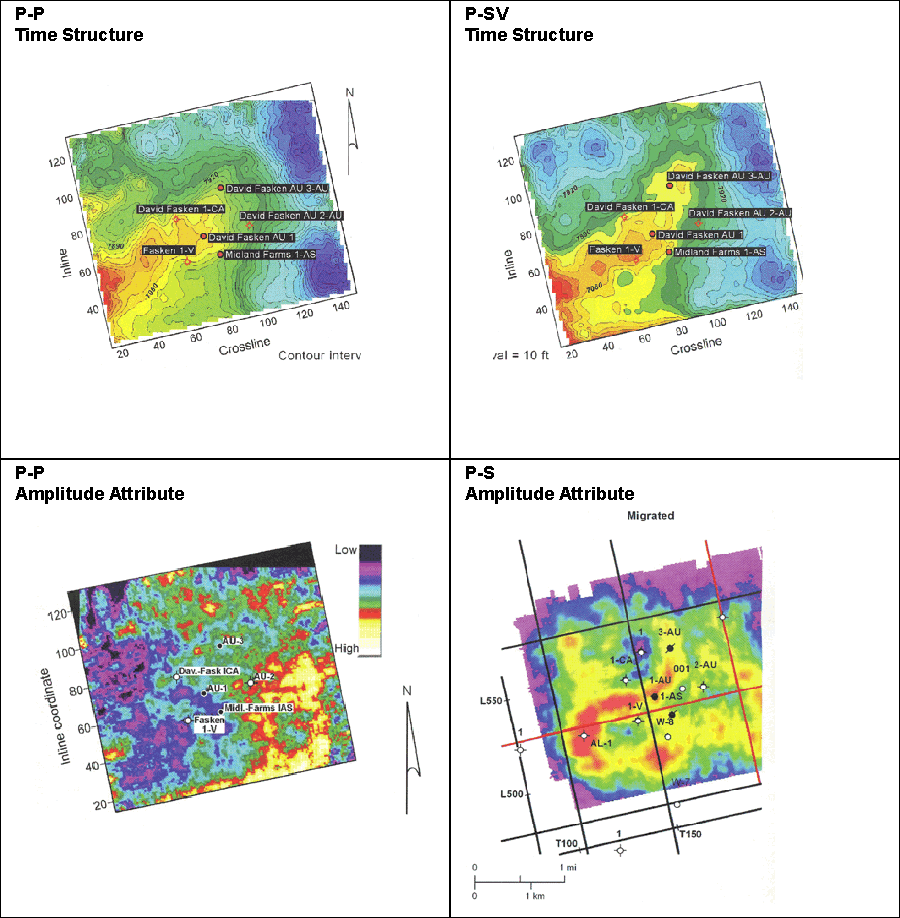
Compressional Mode vs. Converted Shear Mode Figure 1 shows
The equivalence of the structural geometry
shown by these two
Figure 2 shows one amplitude attribute (rms amplitude) extracted from narrow windows spanning the reservoir interval across the PP and PS data volumes. In other areas, PP amplitude attributes have successfully delineated productive carbonate reservoirs in the Strawn; here, PP reflectivity is not definitive, as an inspection of Figure 2a shows. PP reflection amplitudes are random in nature, and amplitudes at non-producer wells look like PP amplitudes at producing wells. In contrast, PS reflection amplitude appears to react to productive and non-productive reservoir conditions (Figure 2b). The PS data show a sinuous, high-amplitude anomaly (yellow/red) that reasonably segregates producing wells from non-producers. This reservoir facies is a low-porosity carbonate unit; porosity ranges from 1 to 7 percent across the prospect, and minimum productive porosity is 4 percent. Detecting the narrow porosity range between non-productive facies (1 to 3 percent) and productive facies (4 to 7 percent) is beyond seismic sensitivity for both the PP mode and the PS mode. Rather than using seismic data to segregate areas of productive porosity from areas of nonproductive porosity, interpreters try instead to use seismic attributes to find maximum reservoir thickness. They then cross their fingers and hope that zones of favorable porosity will be found across intervals where there is maximum unit thickness.
In this instance, the predictive value of PS
reflection amplitude was tested by drilling well AL-1, labeled on the PS
map (Figure 2b). This well found the
thickest reservoir facies (122 feet) of all the wells shown on the From the standpoint of reservoir thickness, this project supports the use of multi-component seismic technology for carbonate stratigraphic-trap exploration because the PS data defined a maximum-thickness reservoir interval when conventional PP seismic data could not. However, even though well AL-1 penetrated a maximum-thickness reservoir unit, insufficient productive porosity occurred across the interval to make the well commercial. This AL-1 well falls into that famous category many call “technical success but economic failure.” Skeptics can say that multi-component seismic data did not yield a productive well. Proponents can say that the PS mode delivered exactly what was needed -- a definition of the maximum thickness of the reservoir. Take your pick: skeptic or proponent. The real message is that at this prospect, the PS mode provided vital reservoir information that the PP mode could not.
This research was funded by DOE/NETL. |