
 Print this page
Click to view poster in PDF format.
PSBasement
and  Crustal
 Controls on Hydrocarbons Maturation on the Exmouth Plateau, North
West Australian Margin*
Controls on Hydrocarbons Maturation on the Exmouth Plateau, North
West Australian Margin*
By
A. Goncharov1, I. Deighton2, L. Duffy3, S. McLaren4, M.Tischer5, and C.Heine6
Search and Discovery Article #10119 (2006)
Posted December 15, 2006
*Adapted from poster presentation at AAPG 2006 International Conference and Exhibition, Perth, Australia, November 5-8, 2006
1Geoscience Australia, Canberra ([email protected]; www.ga.gov.au)
2Burytech Pty Ltd
3Aceca UK Ltd
4School of Earth Sciences, University of Melbourne
5Lamont-Doherty Earth Observatory of Columbia University
6School of Geosciences, The University of Sydney
Introduction
Advanced burial and thermal geohistory modelling carried out on the Exmouth Plateau is an extension of similar work undertaken earlier in the Bremer Sub-basin (Goncharov et al., 2006). This work is a further step in developing new generation of tectonically constrained geohistory, paleotemperature, and HC maturation models. As in the Bremer Sub-basin, the Exmouth Plateau modelling was carried out without relying on default values (such as heat flow or geothermal gradient) commonly used in basin modelling. This modelling was conducted using Fobos Pro v3.2 finite element 1-D basin modelling software developed by Aceca Ltd (www.aceca.co.uk).
The tectonic elements of the Exmouth Plateau (Figure 1) developed as a result of several phases of rift tectonics initiated in Palaeozoic and continuing until the Late Jurassic, preceding the final continental separation of Greater India from Australia. The Carnarvon Basin is believed to contain up to 18 km of Palaeozoic to Recent sedimentary infill (Figures 2, 3, and 4).
|
|
Figures 1-4
Data IntegrationFigures 5-9
All available OBS
and sonobuoy velocity models were integrated to provide estimate of
Heat ProductionMeasurements of radioactive elements contents in rock samples taken from outcrops of Pilbara Craton (see Figure 5 for the location of samples) allowed estimation of heat production in the Exmouth basement and crust below it. Original data for heat production calculations were sourced from Geoscience Australia’s database OZCHEM. Anomalous values in some groupings are due to a few highly enriched rocks in the grouping, particularly for U or Th contents. These anomalies were excluded from further analysis due to their limited spatial extent, and due to the close spatial association of these samples with rock samples of more ‘normal’ heat production. An interesting outcome of this analysis is that Exmouth basement appears to be colder and less diverse in heat production compared to Bremer basement where 0.5 – 4.0 μw/m3 range was used for sensitivity tests (Goncharov et al., 2006).
Geohistory Model Data and methodologyFigures 10-11
Initial geohistory models for Jupiter 1 and Brigadier 1 were created using available stratigraphic interpretations with sub-TD interpretation based on Geoscience Australia/IKODA (2002) regional seismic interpretation (Figure 10). These are the J-0 and B-0 models presented below, involving thick Triassic. On the temperature depth calibration models data shown include undifferentiated log derived bottom hole temperatures and Horner plot estimates from the GA database RESFACS. This data is considered variable, and in the study the only requirement was that the predicted model be at or higher than all temperature data at all depths. Maturity depth data used for this study is from the Geoscience Australia’s database ORGCHEM, with analyst indicated where possible, except the VIRF (Newman, 2006, pers.comm.). Lack of reliability in conventional vitrinite reflectance is well known and is usually due to misidentification of suppressed vitrinite as normal (e.g., Kaiko, 2002). Newman et al (2000) discusses the VIRF methodology which uses fluorescence to determine true vitrinite from suppressed. VIRF data was only available for Jupiter 1 and thus the Brigadier 1 thermal interpretation has followed that of Jupiter 1. Mantle lithosphere thickness (depth to 1300ºC) was set at 100 km, giving a total lithosphere thickness of 132 km, consistent with results from Simons and van der Hilst (2002) for the western Pilbara craton (Figure 11).
The starting
model for timing of
Sensitivity to Triassic ThicknessFigures 12-17, Table 1
First tests of the starting model indicated that ‘thick Triassic’ seismic interpretation is hard to reconcile with subsidence predicted by the model, particularly in wells on the shelf (Gorgon 1, Robot 1). Extreme stretching rates would be required to match subsidence observed in ‘thick Triassic’ scenario. So, testing sensitivity of the results to Triassic thickness has become the first priority. Further test models were created by reducing depth to base Triassic in 1-2 km increments, and moving deeper horizons (including basement) up accordingly. Thus, J-1, J-2, B-2, then J-4, B-4 models, etc. were generated. Stretching rates were then adjusted in each model to match total basement subsidence. As a result, total stretching rate is less for the thinner Triassic models (Table 1). Figures 12 and 13 show that at the well depth, above TD, present day temperature and maturity are not sensitive to major changes in Triassic thickness. However, there are significant changes below TD. For example, the Locker Shale at the bottom of Triassic sequence at present may generate oil in the ‘thin Triassic’ scenario (J-6), but is in the dry gas zone in the thick Triassic’ (J-0) scenario. Similarly significant variation will apply to earlier stages of subsidence history and thus time of oil generation and expulsion in the thick Triassic models. Figure 14 shows that palaeo-temperature at the TD in each well is not sensitive to major changes in Triassic thickness. However, from Figure 15, palaeo-temperature at basement depth is sensitive to the change. Note that the thickest Triassic models produce the higher palaeo-temperatures at basement due to higher stretching rate and greater burial depth. The reason that TD level palaeo-temperature are not sensitive to Triassic thickness, while basement palaeo-temperatures are, is clear from Figures 16 and 17. Basement heat flow is sensitive to depth to basement, because of the variation in stretching required. However, sediment radioactivity above basement compensates for the reduced stretching so there is much less variation in surface heat flow and that at TD. J-0 present day basement temperature is almost 70ºC higher than J-6. However, at TD temperature is actually lower for J-0 compared to J-6 by ~10ºC. So, hotter basement at greater depth scenario transfigures into colder TD. This leads to higher temperatures at TD in the shallow basement scenario. However, the simple proximity of heat sources in the basement to TD is not the explanation of this phenomenon, which results from a more complex combination of reasons. The interplay between heat production above and below basement emerges as the main driver of model temperature prediction, particularly when heat generation in basement is low and sediments above it are thick.
Sensitivity to
|



|
|
|
|
|
Figure 19. Jupiter 1 (J-4): Temperature sensitivity to basement composition. |
|
|
Figure 20. Jupiter 1 (J-4): Vitrinite reflectance sensitivity to basement composition. |


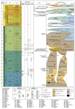
Using a mid range model (J-4 and B-4), sensitivity of temperature and maturity to upper crust composition was analyzed. The J-4 and B-4 models were selected because they gave the best fit to the VIRF data in Jupiter 1. Models of thicker Triassic require greater stretching (above 2.5). According to McKenzie (1978) this should lead to significant dyke intrusion and volcanism. Although some sill intrusions are present, they are limited and we prefer models that require lesser stretching. Heat generation and density vary widely in basement rocks, but hotter rocks are generally lighter and cooler rocks are denser. Figure 18 shows the modelled trend of density/heat generation variation with some examples of approximate equivalent rock types. Like in the previous tests, stretching was varied to match total basement subsidence for each change in upper crust density.
Although shown in
Figure 18, a basic or “gabbroic” composition upper crust was not
modelled as it was not possible to stretch the model enough to produce
the observed thickness. This is because the density of the crust
approaches that of the mantle (3.3 g/cm3) and lighter
sediment finds it increasingly difficult to displace the heavier
basement during stretching. The high rate of Carboniferous stretching
required for the basic crustal model means that the thickness at the
time of Triassic stretching is less than 18 km. McKenzie (1978) noted
that for normal density crust and lithosphere (2.8 and 3.33 g/cm3
respectively), and lithosphere of 125 km thickness, any amount of
stretching of crust thinner than 18 km will produce uplift. Dewey (1982)
noted that a key parameter in determining ease of subsidence (or lack of
relative uplift) was the ratio of crust to lithosphere thickness.
However, from this study another important parameter controlling
subsidence is the relative density of crust (including sediments) to
mantle lithosphere. Sensitivity to crustal composition is illustrated in
Figures 19 and 20.
Sensitivity to Crustal
Thickness
Figures 21-28, Table 2


The J-4/B-4/granodiorite
models were chosen to estimate sensitivity of temperature and maturation
predictions to variation in crustal thickness, again because of the best
fit to the VIRF data in Jupiter-1. Upper crust thickness was varied in 2
km increments. Stretching was again varied to match total geohistory
subsidence. Sensitivity to crustal thickness is illustrated in Figures
21 and 22.
Predicted crustal thicknesses for the various models are shown in
Table 2. The final preferred models,
selected on the basis of best fit to VIRF data and to OBS derived
crustal thickness, are the models with 16 km thick upper crust at the
onset of rifting (Figure 23). The predicted
tectonic, thermal and maturity results for Jupiter-1 model are shown in
Figures 24, 25,
26, 27, and
28.
Future Directions
Figure 29

Results presented
above allow accounting for geohistory/subsidence/HC maturation effects
related to: heat production in sediments as they are being added in the
process of basin formation, blanketing effect of sediments, heat
production in crust of varying composition, whole lithosphere parameters
of radiogenic heat and thermal conductivity through time, isostatic
subsidence, tectonic subsidence related to stretching of the crust
during and after rift formation. However, one significant component of
subsidence and related thermal effects possibly is not accounted for in
our methodology yet: that is so-called ‘anomalous subsidence’ related to
mantle induced dynamic topography. It is very likely that the dynamic
topography component is also present in the subsidence history of basins
forming on continental margins. In that case exact matching of
subsidence that we targeted (and reasonably well achieved
- see above)
in our models is methodologically not quite correct. However, due to the
overprinting of vertical crustal motions due to rifting/block faulting
and thermal subsidence, only qualitative statements about the relative
vertical motions can be made up to this date. Comparison of dynamic
topography curves for Jupiter well and Pilbara craton (Figure
29) suggests that the time interval ~45 to 60 Ma is the only one
where differential vertical movements between two locations due to
mantle convection processes are noticeable. If our estimates are
correct, then subsidence in our models should be ‘over-done’ for this
time interval. In other words, our model should probably include some
additional crustal stretching during 45 to 60 Ma to produce up to 150 m
of excessive subsidence that is counter-fitted by Jupiter uplift
relative to Pilbara during this time. We do not expect Brigadier/Pilbara
residual dynamic topography to demonstrate substantially different
trend. However, we are seeing some diversion between modeled and
observed subsidence in Brigadier well, but not in Jupiter 1; causes of
this effect require further research. Proper integration of dynamic
topography in our methodology will, as we hope, take us one important
step further towards development of holistic approach to geohistory and
HC maturation modeling.
Conclusions
Thick Triassic
section of up to 13 km thick in the study area is unlikely. Seismic
interpretation of deep basins stratigraphy and structure should be
carried out interactively with quantitative analysis of possible basin
formation mechanisms. Some very significant changes in variables tested
are not differentiable by observable parameters in wells above TD, but
there are significant changes below TD; deeper wells (?), new and better
geophysical data are needed to better constrain subsidence and
maturation models for Triassic and deeper section. Enhanced maturity
studies, such as VIRF, are necessary to remove analyst bias in vitrinite
reflectance determination. Basement heat flow is sensitive to depth to
basement, because of the variation in stretching required. However,
sediment radioactivity above basement compensates for the reduced
stretching so there is much less variation in surface heat flow and that
at TD. Interplay between heat production above and below basement
emerges as the main driver of model temperature prediction, particularly
when heat generation in basement is low and sediments above it are
thick. A key parameter determining ease of subsidence (or lack of
relative uplift) is the relative density of crust (including sediments)
to mantle lithosphere, alongside with earlier reported ratio of crust to
lithosphere thickness. There are some indications of possible
underplating in the lower crust of the Exmouth Plateau, particularly in
the western part of the study area. Effect of underplating on subsidence
and hydrocarbon maturation requires further research.
References
Dewey J. 1982, Plate tectonics and the evolution of the British Isles: Journal Geol.Soc.London, v. 139, p. 371-412.
Fomin,
T., Goncharov, A., Symonds, P., and Collins, C., 2000, Acoustic
structure and seismic velocities in the Carnarvon Basin, Australian
North West Shelf: Towards an integrated study: Exploration Geophysics,
v. 31, no. 4, p. 579-583.
Goncharov, A., Deighton, I., Petkovic, P., Tassell, H., McLaren, S., and
Ryan, D., 2006, Basement and crustal controls on hydrocarbon maturation:
Lessons from Bremer Sub-Basin for other frontier exploration areas: The
APPEA Journal, v. 46, part 1, p. 237-259.
Goncharov, A., 2004, Basement and crustal structure of the Bonaparte and
Browse basins, Australian northwest margin, in Ellis, G.K.,
Baillie, P.W., and Munson, T.J., eds., Timor Sea petroleum geoscience.
Proceedings of the Timor Sea symposium, Darwin, Northern Territory,
19-20 June, 2003, Northern Territory Geological Survey, Special
Publication 1. [CD-ROM]
of the Bonaparte and
Browse basins, Australian northwest margin, in Ellis, G.K.,
Baillie, P.W., and Munson, T.J., eds., Timor Sea petroleum geoscience.
Proceedings of the Timor Sea symposium, Darwin, Northern Territory,
19-20 June, 2003, Northern Territory Geological Survey, Special
Publication 1. [CD-ROM]
Kaiko, A.R., 2002, Application of combined fluorescence and reflectance (CFR) analysis to thermal maturity assessment in the Barrow and Dampier sub-basins. The sedimentary basins of Western Australia, in Keep,M., and Moss. S., eds., Proceedings Western Australian basins symposium, v. 3, Pet. Expl. Soc. Aust., p. 599-616.
Karner, G.D., and Driscoll, N.W., 1999, Style, timing and distribution of tectonic deformation across the Exmouth Plateau, northwest Australia, determined from stratal architecture and quantitative basin modeling, in Mac Niocaill, C., and Ryan, P.D., Continental tectonics: The Geological Society of London, p. 271-311.
Kusznir, N. J., Hunsdale, R., Roberts, A. M., and ISIMM Team, 2005. Norwegian margin depth-dependent stretching, in Dore, A.G., and Vining, B.A., eds., Petroleum geology: North- West Europe and global perspectives: Proceedings of the 6th Petroleum Geology Conference, p. 767–783.
Longley, I.M., Buessenschuett, C., Clydsdale, L., Cubitt, C.J., Davis, R.C., Johnson, M.K., Marshall, N.M., Murray, A.P., Somerville, R., Spry, T.B., and Thompson, N.B., 2002, The North West Shelf of Australia - a Woodside Perspective, The sedimentary basins of Western Australia, in Keep, M., and Moss, S., eds. Proceedings Western Australian basins symposium v. 3, Pet. Expl. Soc. Aust., Perth, p. 28-88.
McKenzie, D.P., 1978. Some remarks on the development of sedimentary basins: Earth and Planetary Science Letters, v. 40, p. 25-32.
Newman, J., Eckersley, K.M., Francis, D.A., and Moore, N.A. 2000. Application of vitrinite-inertinite reflectance and fluorescence to maturity assessment in the East Coast and Canterbury basins of New Zealand: New Zealand petroleum conference preprint.
Simons, F.J., and Van Der Hilst, R.D., 2002, Age-dependent seismic thickness and mechanical strength of the Australian lithosphere: Geophysical Research Letters, v. 29, no. 11, 10.1029/2002GL014962.
Stagg, H.M.W., and Colwell, J.B., 1994, The structural foundations of the Northern Carnarvon Basin, in Purcell, P.G., and R.R., eds. The sedimentary basins of Western Australia: Proceedings of the Petroleum Exploration Society of Australia Symposium, Perth, WA, p. 349–364.
John Kennard, Angus Ruddock, Alex Maftei, John Gorter, Dietmar Müller, Howard Stagg, German Leitchenkov provided useful advice on various aspects of this work. John Kennard suggested the idea of testing sensitivity of temperature and maturation predictions to total subsidence. Silvio Mezzomo designed illustrations for this poster under extreme deadline pressure.