Print this page
 Click
to view article in PDF format.
Click
to view article in PDF format.
GCS-Wave Analysis of Fracture Systems*
By
Bob A. Hardage1 and Michael V. DeAngelo1
Search and Discovery Article #40227 (2006)
Posted December 6, 2006
*Adapted from the Geophysical Corner columns, prepared by the authors, in AAPG Explorer, October and November, 2006. Title of column in October, Part 1 here, is the same as that given above; title of column in November, Part 2 here, is “S-Waves and Fractured Reservoirs.” Editor of Geophysical Corner is Bob A. Hardage. Managing Editor of AAPG Explorer is Vern Stefanic; Larry Nation is Communications Director.
1Bureau of Economic Geology, Austin, Texas ([email protected] )
Most rocks are
anisotropic, meaning that their elastic properties are different when measured
in different directions. For example, elastic moduli measured perpendicular to
bedding differ from elastic moduli measured parallel to bedding – and moduli
measured parallel to elongated and aligned grains differ from moduli measured
perpendicular to that grain axis. Because elastic moduli affect  seismic
 propagation velocity, seismic wave modes react to rock anisotropy by exhibiting
direction-dependent velocity, which in turn creates direction-dependent
reflectivity. Repeated tests by numerous people have shown shear (S) waves have
greater sensitivity to rock anisotropy than do compressional (P) waves.
propagation velocity, seismic wave modes react to rock anisotropy by exhibiting
direction-dependent velocity, which in turn creates direction-dependent
reflectivity. Repeated tests by numerous people have shown shear (S) waves have
greater sensitivity to rock anisotropy than do compressional (P) waves.
Slowly the important role of S-waves for evaluating fracture systems, one of the most common types of rock anisotropy, is moving from the research arena into actual use across fracture prospects. Examples of S-wave technology being used to determine fracture orientation have been published by Gaiser (2004) and Gaiser and Van Dok (2005), for example. It seems timely to introduce one more example
.
|
Part1uGeneral StatementuFigures 1 & 2uExampleuConclusionuCommentuAcknowledgmentuReferencesPart 2uGeneral statementuFigure 3uExampleuLocal differenceuLocal variationsuProofuAcknowledgment
Part1uGeneral StatementuFigures 1 & 2uExampleuConclusionuCommentuAcknowledgmentuReferencesPart 2uGeneral statementuFigure 3uExampleuLocal differenceuLocal variationsuProofuAcknowledgment
Part1uGeneral StatementuFigures 1 & 2uExampleuConclusionuCommentuAcknowledgmentuReferencesPart 2uGeneral statementuFigure 3uExampleuLocal differenceuLocal variationsuProofuAcknowledgment
Part1uGeneral StatementuFigures 1 & 2uExampleuConclusionuCommentuAcknowledgmentuReferencesPart 2uGeneral statementuFigure 3uExampleuLocal differenceuLocal variationsuProofuAcknowledgment
Part1uGeneral StatementuFigures 1 & 2uExampleuConclusionuCommentuAcknowledgmentuReferencesPart 2uGeneral statementuFigure 3uExampleuLocal differenceuLocal variationsuProofuAcknowledgment
Part1uGeneral StatementuFigures 1 & 2uExampleuConclusionuCommentuAcknowledgmentuReferencesPart 2uGeneral statementuFigure 3uExampleuLocal differenceuLocal variationsuProofuAcknowledgment
|
The prospect considered here involves two
fractured carbonate intervals at a depth of a little more than 1800
meters (6000 feet). A small 5.75-km2 (2.25-mi2)
three-component 3-D Figure 1 shows a
PP and PS azimuth-dependent
Inspection of these azimuth-dependent · PS waves arrive earliest in the azimuth corridor centered 50° east of north (the fast-S mode, S1) and latest in an azimuth direction 140° east of north (the slow-S mode, S2). · PS waves exhibit a greater variation in arrival times and amplitudes than do their companion PP waves. For example, PP reflectivity from interval A is practically constant in all azimuth directions, whereas PS reflectivity varies significantly with azimuth. Likewise, PP arrival time of event A changes by only 4 ms between azimuth directions 50° and 140°, but PS arrival times change by almost 50 ms, an order of magnitude greater than the variation in PP arrival times.
Azimuth-dependent trace gathers like these
were created at many locations across the On the basis of this close correspondence
between FMI and S-wave estimates of fracture orientation, the operator
used S-wave estimates across the total
We conclude that application of S-wave
This particular horizontal well was not placed in production – even though the well bore intersected a high population of fractures trending perpendicular to the well axis – because too many of the fractures were plugged with cement. That problem sets the stage for a subsequent article, in which we will describe S-wave attributes that can be used to indicate fracture intensity and openness.
This research was funded by sponsors of the Exploration Geophysics Laboratory at the Bureau of Economic Geology.
Gaiser, James E., 2004, PS-Wave Azimuthal Anisotropy: Benefits for Fractured Reservoir Management: Search and Discovery Article #40120 (2004).
Gaiser, James E., and Richard R. Van Dok, 2005, Converted
Shear-Wave
S-Waves and Fractured ReservoirsGeneral StatementIn Part 1, we show that fracture orientation across fractured-reservoir intervals can be determined by azimuth-based analyses of S-wave velocities and reflection amplitudes. In Part 2, we return to the same 3C3D In
Figure 1 we show that in a fractured medium, a converted-S wavefield
segregates into a fast-S mode and a slow-S mode, and that the azimuth
directions in which these fast-S and slow-S modes orient their polarized
displacement vectors differ by 90 degrees. Knowing the polarization
directions of these two S-wave modes across this particular study area,
we processed the 3C3D (The procedures used to segregate S-wave
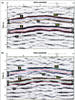
We show here in
Figure 3 a vertical slice from the fast-S volume and the
corresponding vertical slice from the slow-S volume. The two fractured
carbonate intervals A and B are labeled on each
Differences between these fast-S and slow-S images include:
Some of these relative time-thickness changes are difficult to see by visual inspection of Figure 3, but numerical analyses of the isochron intervals between interpreted horizons show numerous examples of such behavior. Two locations where the time thickness of a reflection wavelet expands more in slow-S image space than in fast-S image space are labeled T1 and T2.
Local Difference: ReflectivityThe units bounding fracture intervals A and B
have Fast-S and slow-S reflectivities across targets A and B are controlled by the magnitude of the differences in impedances across the top and bottom boundaries of A and B. When fracture intensity and fracture openness increase locally, the difference between slow-S and fast-S velocities increases. Fast-S velocity changes little (usually not at all) when fracture intensity increases, but slow-S velocity decreases and becomes closer to the magnitude of the S-wave velocity of its lower-impedance bounding unit. As a result, slow-S reflectivity diminishes, but fast-S reflectivity does not when fracture intensity increases. To define locations where relative fracture intensity increases, we thus search the fast-S and slow-S volumes to find coordinates where S-wave reflection amplitudes diminish, but fast-S amplitudes change little or not at all. Two image coordinates where this type of reflectivity behavior occurs in Figure 3 are labeled SR1 and SR2. The common interpretation of these differences in fast-S and slow-S reflectivities is that a relative increase in fracture intensity and/or fracture openness occurs at locations SR1 and SR2. Local Variations: Interval-Time ThicknessWhen the slow-S interval-time between horizons aa and cc increases (Figure 3b).), two possible explanations are that (1) the thickness of reservoir A has increased or (2) reservoir A has a constant thickness, but slow-S velocity has lowered because of an increase in fracture intensity.
Other arguments may be proposed in different geological settings, but in this case, these two explanations were the most plausible. · Option 1 can be verified by measuring fast-S interval time between horizons aa and cc (Figure 3a). If the reservoir interval thickens, fast-S interval time should increase. · If fast-S interval time changes little, or not at all, then option 2 (increased fracture intensity) is accepted as the explanation for the increase in slow-S time thickness.
Two image coordinates where slow-S time thickness increases more than does fast-S time thickness are labeled T1 and T2. Increased fracture intensity is expected at each of these locations. Prove It!What we have demonstrated is that comparisons of fast-S and slow-S reflectivities and time thicknesses across fractured intervals allow locations of relative increases in fracture intensity and openness to be identified. These S-wave behaviors indicate only qualitative variations in fracture intensity, not quantitative variations. Proving the validity of predictions of
fracture intensity requires extensive calibration of fast-S and slow-S
attributes with reliable fracture maps across prospects. Such
investigations are ongoing and will be reported in time. For the
present, we show you here the latest logic that seems to allow
long-range,
This research was funded by sponsors of the Exploration Geophysics Laboratory at the Bureau of Economic Geology. |