Print this page
PSExploring for Deepwater Petroleum Systems with SAR (Synthetic Aperture Radar) – Fact or Fiction?: Comparing Results from Two of Today’s Hot-Spots (Congo Fan and Santos) with Two of Tomorrow’s (Campeche and Cariaco)*
By
Alan K. Williams1, Geoffrey M. Lawrence2, and Michael King3
Search and Discovery Article #10113 (2006)
Posted September 30, 2006
*Adapted from poster presentation at AAPG Annual Convention, Houston, Texas, April 9-12, 2006
Click to view posters in PDF format (right mouse-click, "save target as" to download).
Poster 1 (~5.6 mb) Poster 2 (~14.8 mb) Poster 3 (~12.5 mb)
1Nigel Press Associates, Edenbridge, United Kingdom ([email protected]).
2TreicoL, Knebworth, Hertfordshire, United Kingdom
3NPA Group, Edenbridge, Kent, United Kingdom
Abstract
SAR (Synthetic Aperture Radar) seep detection has now
become a technique of choice for many major players seeking a low cost,
non-invasive, offshore basin screening tool, combining advantages over optical
remote sensing methods of being operational both night and day and through heavy
cloud cover. The commercial SAR archives (primarily ESA and Radarsat) now
contain an invaluable resource of multiple pass data over many of the world's
current deep-water hot-spots that give the explorer an opportunity for  reducing
 (or eliminating) source risk at an early stage in the exploration cycle.
As the result of screening over 75% of the worlds' sedimentary basins with SAR, regional seep distribution patterns have now been revealed which, in many cases, relate closely to both the basin style and the established seepage patterns from known producing basins. When such data have been followed-up by other low cost data-sets such as multi-beam bathymetry, gravity and shallow coring, significant competitive advantages in acquiring key acreage have resulted.
Recently integrated satellite seep data from two
undrilled frontier basins, Cariaco basin, Venezuela, and deep-water Campeche,
Mexico, will be compared with similar data from two present-day exploration hot
spots, deep-water Congo Fan, Angola and the Santos Basin, Brazil. In these
basins, where major new discoveries are now being made, positive results from
early SAR seep screening studies in the mid 90's gave the first indications that
deep-water petroleum systems were present.
hot
spots, deep-water Congo Fan, Angola and the Santos Basin, Brazil. In these
basins, where major new discoveries are now being made, positive results from
early SAR seep screening studies in the mid 90's gave the first indications that
deep-water petroleum systems were present.
Selected Figures
|
|
|
|
|
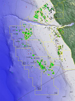
Congo basin, showing bathymetry, seepage slicks, wells, and fields. |
|
|
Santos basin, showing bathymetry, seepage slicks, wells, and fields. |
|
|
Deepwater Campeche basin, showing bathymetry and seep results. |
 |