|
uGeneral
statement
uFigure
captions
uType-producing
areas
u Production Production controls
uBibliography
uGeneral
statement
uFigure
captions
uType-producing
areas
uProduction
controls
uBibliography
uGeneral
statement
uFigure
captions
uType-producing
areas
uProduction
controls
uBibliography
uGeneral
statement
uFigure
captions
uType-producing
areas
uProduction
controls
uBibliography
uGeneral
statement
uFigure
captions
uType-producing
areas
uProduction
controls
uBibliography
|
Figure Captions
Return to top.
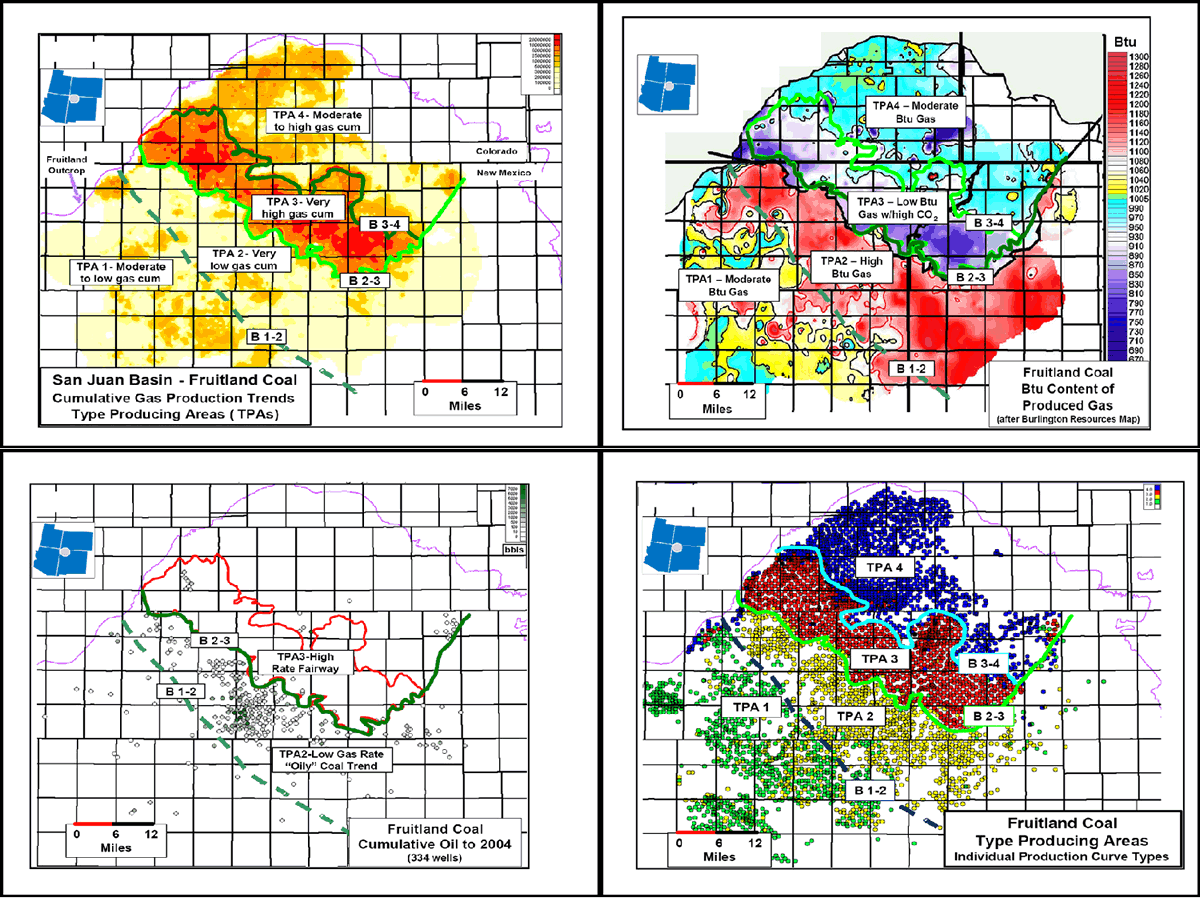
Four NW-SE trending “type producing areas” (TPAs) can be delineated
within the field, based upon similarities in reservoir characteristics
and production behavior, which are broadly consistent within each TPA,
but change dramatically across three internal field boundaries which
separate the TPAs (Figure 1). Production
parameters useful for delineating the TPAs and their boundaries include:
-
Cumulative gas
production (Figure 1)
-
Peak gas producing
rate
-
Current gas producing
rate
-
Cumulative water
production
-
Gas to water ratio
-
Composition of
produced gas (Figure 2)
-
Cumulative oil
production (see Figure 7)
Within each TPA, wells tend to exhibit certain distinctive
characteristics in their production behavior through time, as
illustrated in the “Type Production History Curves” that have been
developed using selected wells from each of the four areas (Figures
3, 4,
5, and 6). Some
key characteristics of the type curves and production from each TPA are:
TPA1: Initial Production: 150 MCFGD, 25 BWPD, Peak gas rate: 350
MCFGD, reached after 7 years of incline; Cumulative after 12 years: 1
BCFG, 37 mbbl (water); Gas/water ratio: >20; Gas quality: 900-1100 Btu.
TPA2: IP: 200 MCFGD, 0.2 BWPD; Gas rate declines rapidly then
stabilizes at 75 MCFGD, low gas and water rates throughout well life;
Cumulative after 12 years: 270 MMCFG, 1 mbbl (water); G/W ratio:>200.
Gas quality: 1100-1300 Btu; low CO2, some oil production.
Many of these wells produce no water. Most of the wells (80%) reporting
oil production are in this area.
TPA3: (a.k.a. “The High Rate Fairway”) IP:1000 MCFGD, 275 BWPD;
Gas rate inclines quickly, reaching a peak rate of 3700 MCFGD within 1
year; Water rate declines to 30 BWPD within 3 years; Cumulative after 12
years: 13 BCFG, 227 mbbl (water); G/W ratio: 20-200; Gas quality:
650-900 Btu, >10% CO2.
TPA4: IP: 200 MCFGD, 250 BWPD; Peak gas rate of 700 MCFGD is
attained after 12 years of incline; Cumulative after 12 years: 2.2 BCF,
845 mbbl (water); G/W ratio: <20; Gas quality: 900-1100 Btu.
Using these type profiles, each of the wells in the Fruitland Coal gas
field was classified into one of these four type categories, based on
its individual production history. A color-coded map showing the
distribution of wells in each category aids in the delineation of the
TPA boundaries (Figure 8). Companies
operating gas production wells in the field have used different
drilling, completion, and operation methods to optimize production,
dependent upon the reservoir characteristics of the portion of the field
in which the well is located.
Variations in production behavior can be linked to underlying geological
controls, especially thermal maturity, coal thickness, organic
petrology, and hydrodynamics. These variables affect many of the primary
characteristics of the reservoir, such as hydrocarbon (oil and gas)
content and composition, fluid pressure, isotherm shape, water
saturation, and cleat permeability. Interpretation of these
interrelationships is complex, as the effects of multiple controls may
be overprinted at any given location. Thermal maturity clearly has the
greatest impact on reservoir quality. Coal rank increases from south to
north, ranging from 0.45 Ro,vit (subA) in TPA1 to 1.6 Ro,vit (mv) in
TPA4. The highest gas production rates occur within TPA3 (a.k.a. “The
High Rate Fairway”). The sinuous, but sharp, southern boundary of TPA3
(B2/3) is associated with a coal rank transition occurring around 0.75 –
0.80% Ro,vit. South of B2/3 (within TPA2), the reservoir is
underpressured, permeability and production rates are low, and wells
produce wet gases (rich in C2+) with little or no water. Most
of the wells that report oil production from the Fruitland Coal are also
located in this area (Figure 7). North of
B2/3 (within TPA3) the reservoir is overpressured (although now depleted
in many areas), permeability is high, and wells produce dry CH4
together with up to10% (or more) CO2 and large volumes of
water. Peak gas rates increase 10-100X across the B2/3 boundary.
Overpressuring within TPA3 has been interpreted as a relict of thermal
maturation and hydrocarbon generation (Meek and Bowser, 1993).
Boundary B1/2 may also be related to maturity, but if so, the effect is
more subtle. The location of B1/2 is less sharp than B2/3 but is roughly
coincident with a 0.60% Ro,vit contour, which corresponds approximately
to the entry of coal into the window of oil expulsion. The presence of a
distinct oil phase in the fracture network in TPA2 may impede the flow
of gas and water to the production well; this could account for the
generally low gas production rates. Moreover, occluded oil in the
organic matrix suppresses the methane sorption capacity; this decreases
gas content (Levine, 1991). Gas and water production rates tend to be
significantly higher in TPA1 than TPA2, indicating higher permeability.
Coal thickness trends and the stratigraphic pinchout of major coal seams
in the lower Fruitland have a strong impact on B3/4. A protracted
stillstand of the Pictured Cliffs shoreline in the predominantly
regressive facies sequence resulted in a vertical aggradation of the
beach and marginal marine sands (Pictured Cliffs Formation) and
associated back-barrier peat-forming environments (Fruitland Formation)
near B3/4 (Fassett, 2001). Toward the southwest, on the landward side of
B3/4, the net coal isopach reaches its greatest value in the basin,
~80-100 feet. Northeast of B3/4, the net coal isopach thins
dramatically, due to the seaward pinchout of several major coal seams in
the lower part of the Fruitland Formation. Stratigraphic pinchout of the
lower Fruitland coals is interpreted as the primary control on the B3/4
boundary.
The influence of hydrogeology is greatest in TPA4 but is minor
elsewhere. Wells in TPA4 have very low gas to water ratios, many being
less than 1 (mcf of gas per bbl water). Some of the wells near the coal
outcrop have produced over 6 million barrels of water and have g/w
ratios as low as 0.2. The proximity of these wells to the outcrop and
their very long dewatering times indicates that there is a probable
connection of the coal gas reservoir to the outcrop where meteoric
recharge is taking place. Published water chemistry data support a
meteoric recharge model for coals in TPA4 (Kaiser and Swartz., 1990).
Wells in TPA3 dewater relatively quickly and, based on production
history data, appear to be hydrologically isolated from TPA4. B3/4 is
inferred to be a hydrodynamic boundary that isolates the lower Fruitland
coals in TPA3 from the coals in the northern part of the field and
therefore from connection to the recharging aquifer.
Structural geology has little discernible influence on reservoir
behavior in the Fruitland Coal field, except along the northwestern
basin margin, where beds are dipping at high angles toward the basin
center. Previously published interpretations that gas production rates
are influenced by tectonically induced fracture trends, hingelines, or
other structural features are difficult to substantiate. Although other
authors have implied that regional production trends may be influenced
by structural features, none has convincingly made the case.
Stratigraphic variations, including coal rank related variations, and
coal thickness trends created during deposition appear to be the primary
controls on the regional scale production trends.
Fassett, J.E., 1988, Geometry and depositional
environment of Fruitland Formation coal beds, San Juan basin, New Mexico
and Colorado: anatomy of a giant coal-bed methane deposit, in J.E.
Fassett, ed., Geology and coalbed methane resources of the northern San
Juan basin, Colorado and New Mexico: Denver, Rocky Mountain Association
of Geologists, p. 23-38.
Fassett, J.E., 2001,Competing models for the Fruitland
Formation coal and coal-bed methane system of the San Juan Basin, New
Mexico and Colorado (abstract): GSA Abstracts with Programs, v. 33, no.
6, p. 57.
Kaiser, W.R., and T.E. Swartz, 1990, Hydrology of the
Upper Cretaceous Fruitland Formation and the producibility of coal-bed
methane, San Juan Basin, Colorado and New Mexico (abstract): AAPG
Bulletin, v. 74, p. 690.
Kaiser, W.R., T.E. Swartz, and G.J. Hawkins, 1991a,
Hydrology of the Fruitland Formation, San Juan basin, in W.B.
Ayers Jr. et al., Geologic and hydrologic controls on the occurrence and
producibility of coalbed methane, Fruitland Formation, San Juan basin:
Chicago, Gas Research Institute Topical Report GRI-91/0072, p. 195-241.
Kaiser, W.R., W.R., W.B. Ayers Jr., W.A. Ambrose, S.E.
Laubach, A.R. Scott, and C.M. Tremain, 1991b, Geologic and hydrologic
characterization of coalbed methane production, Fruitland Formation, San
Juan basin, in W.B. Ayers Jr. et al., Geologic and hydrologic controls
on the occurrence and producibility of coalbed methane, Fruitland
Formation, San Juan basin: Chicago, Gas Research Institute Topical
Report GRI-91/0072, p. 273-301.
Kaiser, W.R., and W.B. Ayers Jr., 1994, Coalbed methane
production , Fruitland Formation, San Juan basin: geologic and hydrologic
controls, in W.B. Ayers, Jr. and W.R. Kaiser, eds., Coalbed
methane in the Upper Cretaceous Fruitland Formation, San Juan basin, New
Mexico and Colorado: University of Texas at Austin, Bureau of Economic
Geology Report of Investigations 218, p. 187-207. , Fruitland Formation, San Juan basin: geologic and hydrologic
controls, in W.B. Ayers, Jr. and W.R. Kaiser, eds., Coalbed
methane in the Upper Cretaceous Fruitland Formation, San Juan basin, New
Mexico and Colorado: University of Texas at Austin, Bureau of Economic
Geology Report of Investigations 218, p. 187-207.
Kaiser, W.R., T.E. Swartz, and G.J. Hawkins, 1994,
Hydrologic framework of the Fruitland Formation, San Juan basin, in
W.B. Ayers Jr. and W.R. Kaiser, eds., Coalbed methane in the Upper
Cretaceous Fruitland Formation, San Juan basin, New Mexico and Colorado:
University of Texas at Austin, Bureau of Economic Geology Report of
Investigations 218, p. 133-163.
Levine, J., 1991, Coal petrology with applications to
Coalbed methane R & D, Short Course Note, Coalbed Methane Symposium,
Tuscaloosa, Alabama.
Meek. R.H.,
and P.D. Bowser, 1993, The transition between the low-rate and high-rate
producing areas of the Fruitland coal, San Juan basin, New Mexico
(abstract): AAPG Bulletin, v. 65, p. 1455.
Return to top.
|

 Print this page
 Click
to article in PDF format.
Click
to article in PDF format.