Print this page
 Click
to article in PDF format.
Click
to article in PDF format.
The Carbonate Analogs Through Time (CATT) Hypothesis – A Systematic and Predictive Look at Phanerozoic Carbonate Reservoirs:
Extended Abstract*
By
James R. Markello1, Richard B. Koepnick2, and Lowell E. Waite3
Search and Discovery Article #40185 (2006)
Posted February 6, 2006
*Editorial Note: Modified from extended abstract prepared for presentation at
AAPG Annual Convention,
1ExxonMobil Upstream Research Company, Houston, TX ([email protected])
2Qatar Petroleum, Doha, Qatar ([email protected])
3Pioneer Natural Resources USA, Inc., Dallas, TX ([email protected])
 Introduction
The Carbonate Analogs Through Time (CATT) Hypothesis defines an approach for developing systematic evaluations and predictive models of Phanerozoic carbonate systems and reservoirs for use in upstream exploration, development, and production businesses. Three applications are illustrated in this extended abstract: 1. age-based pattern development, 2. comparative reservoir analysis, and 3. analog selection.
Exploration geoscientists employ a host of established and successful concepts, tools, and data to develop predictive models for field/reservoir occurrence and quality. However, as exploration successes decrease, alternative approaches are needed to refresh the exploration mindset. We present the CATT approach as a hypothesis and as an alternative mindset for carbonate reservoir exploration. The geologic age-based concepts and products provide thought-provoking perspectives on known carbonate reservoir occurrences and offer a different way of thinking about predicting where undiscovered carbonate reservoirs may exist. At the very least, our Carbonate Analogs Through Time hypothesis provides a framework or context within which to insightfully and schematically organize all of the concepts, facts, and carbonate reservoir case studies/examples one encounters throughout a career, and it can be used as an approach for comparative analysis of systems. Reservoir engineers require detailed geologic-based reservoir parameters for simulations of reservoir/field performance. Such simulations form the bases for field development/depletion plans that invoke huge capital and operating expenses. Thus, it is imperative to provide the best possible input to simulation so that capex and opex investments are optimal. Typically, the input, if not derived directly from data collected within a field under development, has been gathered or derived from “analog” fields. Thus, choosing the most appropriate analog is a critical task. We contend that the CATT approach provides the conceptual basis for choosing the most appropriate analogs.
|
|
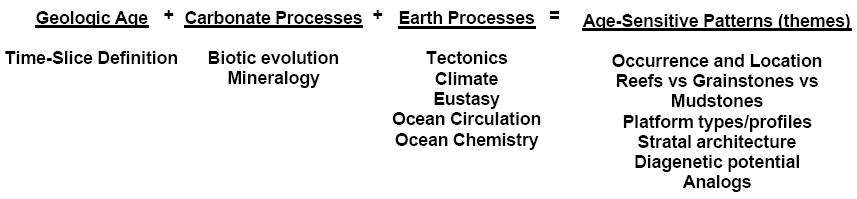
CATT HypothesisThe CATT hypothesis simply stated is:
“Insightful, high-confidence, age-specific predictive models for
carbonate systems and reservoir occurrence, composition, stratal
attributes, and reservoir properties can be developed by summing the
ambient conditions of the carbonate processes and
The hypothesis is built upon the cumulative body of knowledge that
demonstrates carbonate and
Age-Based Pattern Development
An example of developing an “age-sensitive pattern” or “time-based
theme” is when the map-view configuration and spatial relationships of
carbonate systems depicted on a paleogeographic map are convolved with
the ambient states of the carbonate and
Comparative Reservoir Analysis
Sometimes there are significant differences between carbonate systems
and reservoirs within a geologic time period or age. We propose that the
CATT Hypothesis and the Atlas products (paleogeographic, paleoclimate
and paleo-oceanographic maps) provide an approach for comparative
analysis between systems within a geologic age that gives meaningful
understanding for the causes of the differences. Since 2003, we have
developed additional maps of paleoclimate and paleo-oceanography based
on recent publications from National Geographic for each of the 29
Phanerozoic time slices. These maps were empirically developed based on
present-day trends. Another ExxonMobil in-house project completed
parametric
Analog SelectionDemonstration of the utility of these tools for analog selection is illustrated by explaining the heritage-Mobil example of farming-into Tengiz Field in the mid-1990’s. Farming into or buying equity in a field under development requires knowledge of field value (working-interest EUR) and some measure of investment return. Typically, these numbers are derived by simulation. Thus, we were consulted by Mobil engineers as to the best analog for data to input into a Tengiz simulation. Would Arun Field in Indonesia be okay? Our answer was absolutely not! Based on our CATT approach, the best analogs would be age-equivalent fields nearby in the Volga-Ural trend or in North America (either Pennsylvanian-age Salt Creek Field, Permian Basin, or the Devonian fields in western Canada) (Figure 5). Our rationale was that better similarities existed between age equivalent systems due to similar biota, mineralogy, long term climate (Late Devonian greenhouse to Mississippian transitional to Pennsylvanian icehouse), carbonate factory and profiles – isolated platforms, and diagenesis – exposure meteoric processes rather than overwhelming dolomitization. Although Arun is a Miocene (icehouse climate) isolated platform, it consists of Neogene scleractinian-dominated framework biota, with abundant microporosity. Also, reservoir fluids are gas-condensate. Tengiz is also an isolated platform, but is Mid-Late Paleozoic (greenhouse to icehouse conditions) and consists of tabulate, rugosan corals and stromatoporoids, similar to the Late Devonian reservoirs in Caroline and the Rainbow fields of western Canada. The Lower Pennsylvanian section contains abundant ooids with moldic porosity. This is very similar to the Salt Creek Field. Although Tengiz Field has some karst porosity, it does not appear to be as extensive as the Mid Cretaceous Golden Lane Field of Mexico. Further, greenhouse Cretaceous rudist communities and associated grainstones typically have very different stratigraphic architecture from icehouse Carboniferous systems. Walker Creek and Jay fields are greenhouse attached ramp systems in the Gulf of Mexico with well developed oomoldic porosity; however the strata are extensively dolomitized unlike the Tengiz feature. Slaughter Field is Late Permian age and is located on the attached Northwest Shelf of the Permian basin. The reservoir units in the San Andres formation are totally dolomitized and have very different pore structures and rock properties.
Research IdeaThis research idea was conceived in 1991 at Mobil Research. Many Mobil geoscientists contributed to the maturing of the idea and to the development of the CATT products, especially the Mobil Global Themes Project team (detailed Global Paleogeographic Time-Slice maps), and members of the MEPTEC Carbonate Research Team. The project completed in late 1999 just before the ExxonMobil merger in 2000 . |