Print this page
 Click
to article in PDF format.
Click
to article in PDF format.
The Carbonate Analogs Through Time (CATT) Hypothesis – A Systematic and Predictive Look at Phanerozoic Carbonate Reservoirs:
Extended Abstract*
By
James R. Markello1, Richard B. Koepnick2, and Lowell E. Waite3
Search and Discovery Article #40185 (2006)
Posted February 6, 2006
*Editorial Note: Modified from extended abstract prepared for presentation at
AAPG Annual Convention,
1ExxonMobil Upstream Research Company, Houston, TX ([email protected])
2Qatar Petroleum, Doha, Qatar ([email protected])
3Pioneer Natural Resources USA, Inc., Dallas, TX ([email protected])
Introduction
The Carbonate Analogs Through Time (CATT) Hypothesis defines an approach for
developing systematic evaluations and predictive models of Phanerozoic carbonate
systems and reservoirs for use in upstream exploration, development, and
production businesses. Three applications are illustrated in this extended
abstract: 1.  age
age -based pattern development, 2. comparative reservoir analysis,
and 3. analog selection.
-based pattern development, 2. comparative reservoir analysis,
and 3. analog selection.
Exploration
geoscientists employ a host of established and successful concepts, tools, and
data to develop predictive models for field/reservoir occurrence and quality.
However, as exploration successes decrease, alternative approaches are needed to
refresh the exploration mindset. We present the CATT approach as a hypothesis
and as an alternative mindset for carbonate reservoir exploration. The geologic
age-based concepts and products provide thought-provoking perspectives on known
carbonate reservoir occurrences and offer a different way of thinking about
predicting where undiscovered carbonate reservoirs may exist. At the very least,
our Carbonate Analogs Through Time hypothesis provides a framework or context
within which to insightfully and schematically organize all of the concepts,
facts, and carbonate reservoir case studies/examples one encounters throughout a
career, and it can be used as an approach for comparative analysis of systems.
Reservoir engineers require detailed geologic-based reservoir parameters for
simulations of reservoir/field performance. Such simulations form the bases for
field development/depletion plans that invoke huge capital and operating
expenses. Thus, it is imperative to provide the best possible input to
simulation so that capex and opex investments are optimal. Typically, the input,
if not derived directly from data collected within a field under development,
has been gathered or derived from “analog” fields. Thus, choosing the most
appropriate analog is a critical task. We contend that the CATT approach
provides the conceptual basis for choosing the most appropriate analogs.
|
|
CATT HypothesisThe CATT hypothesis simply stated is:
“Insightful, high-confidence,
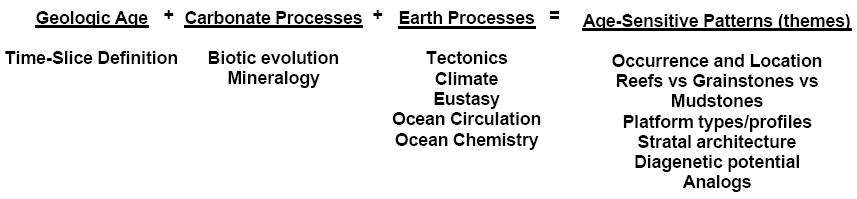
The hypothesis is built upon the cumulative body of knowledge that
demonstrates carbonate and Earth processes have differentially varied
throughout Phanerozoic time. These carbonate and Earth processes
include: 1) ecologic, oceanographic, sedimentologic process-based
controls on carbonate-factory development; 2) stratigraphic and
accommodation-process-based controls on carbonate stratal architecture;
3) secular trends of evolution, grain mineralogy, tectonics, climate,
eustasy, ocean circulation, and ocean chemistry; 4) the stratigraphic
hierarchy and the constraint that first- and second-order Phanerozoic
stratigraphic successions (Sloss Sequences) are
|