Print this page
 Click
to article in PDF format.
Click
to article in PDF format.
GCMulticomponent
 Seismic
 : A Pragmatist's Primer*
By
Chris Thompson1
Search and Discovery Article #40155 (2005)
Posted June 10, 2005
*Adapted from the
Geophysical Corner column, prepared by the author and entitled “Multi-C
Survey Cost May be Value,” in AAPG Explorer,
June, 2005. Appreciation is expressed to Alistair Brown, editor of Geophysical
Corner, and to Larry Nation, AAPG Communications Director, for their support of
this online version.
14C Exploration Ltd. ([email protected])
Among the many acronyms in the oil industry, we now have "3C" and "4C" and even
"9C" seismic data. The "C" stands for "component." Onshore, three-component data
have one vertical and two horizontal geophones and are used to record the entire
seismic waveform, both compressional (P) wave particle motion and the less
familiar shear (S) wave particle motion.
Offshore, a hydrophone is added to the three-component geophone to create a "4C" receiver. Here the hydrophone records accelerations while the geophones record velocity; the difference in response is used to stack out surface multiples.
The least common
of the acronyms is "9C" seismic, which is available only onshore. Here a
controlled polarization shear and compressional source and three-component
geophones yield a three-by-three matrix of source-receiver orientation
combinations.
|
|
Recording, Processing, and InterpretationShear waves do not propagate through water; so at sea we must place the receivers on the seabed. We then rely on mode conversion from P-energy to S-energy at the water bottom and at other geological interfaces. These shear waves are then known as "converted shear waves."
Dramatic
improvements in recording hardware and in data processing have brought
multicomponent · Most multicomponent receivers now in use exhibit good vector fidelity (they respond equally to motion in any direction) and broadband frequency response. · Some receivers, such as I/O's VectorSeis and Sercel's DSU3, actually are solid-state accelerometers, where a digital signal is generated directly at the receiver, thereby eliminating analog instrument noise. · Processing algorithms have matured to the point where prestack time migration of converted shear waves is part of a typical processing flow. This has made significant improvements to the quality of the final product. · Commercial software (ProMC from Hampson Russell) is now available to help the interpreter with the task of correlating and measuring the relative responses from the different multicomponent modes.
Gas Clouds
The
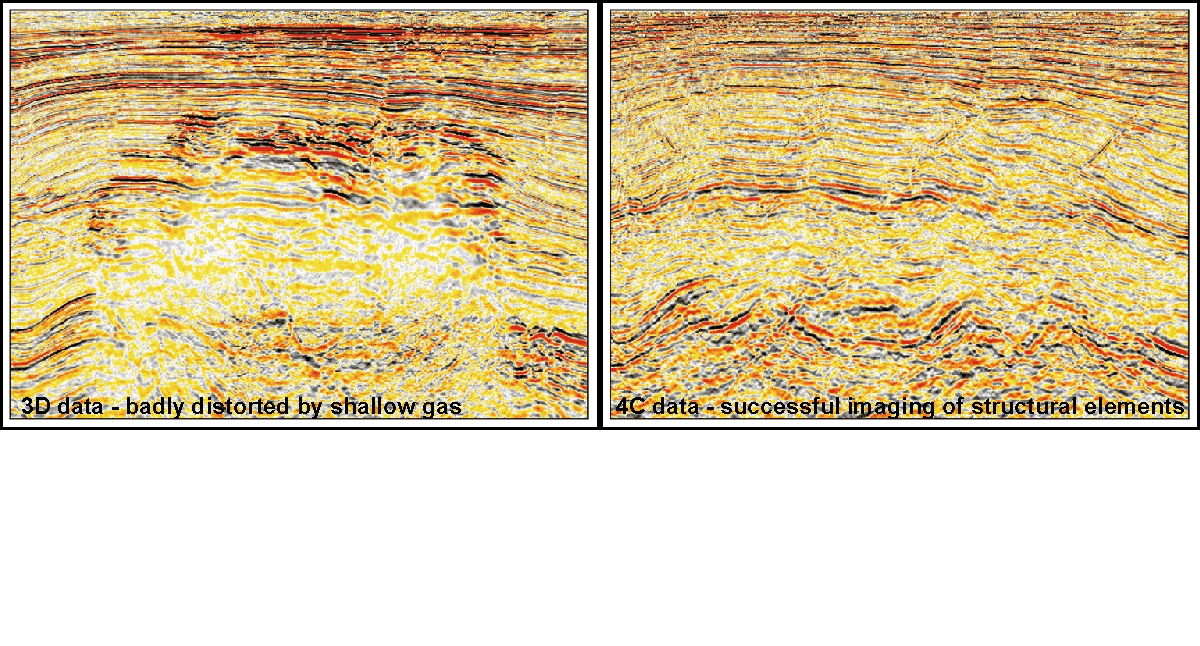
primary application of multicomponent An example from Indonesia is shown in Figure 1; the deeper part of the P-wave section is badly degraded by a shallow gas reservoir, but the PS converted wave section gives a nice crisp image of the offending shallow gas layer, the local faults, and the underlying structure. Geophysicists have had good success with imaging through gas clouds and shallow gas in cases all over the world. Indeed, a full consensus of multi-component experts at the 2000 SEG Summer Workshop deemed gas clouds to be the "slam-dunk" of multicomponent applications.
Table 1 shows that all 65 experts thought
it "very likely" that a
The second
most important application of multicomponent
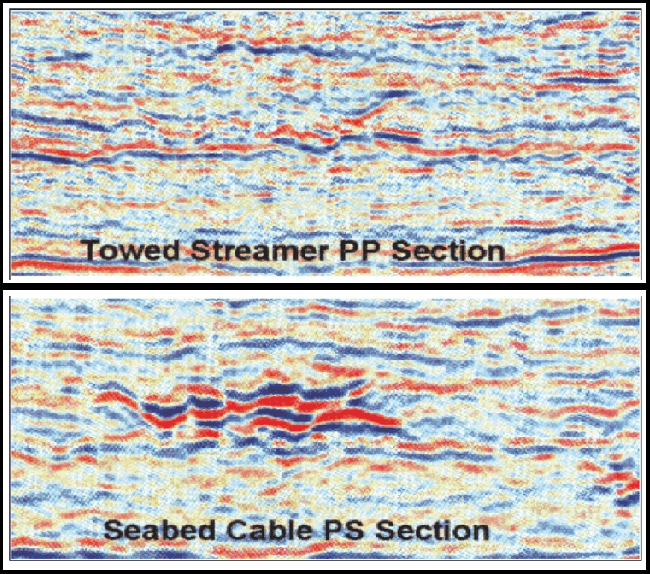
A 3-D 4C
This example is not an isolated success story -- several other turbidite plays have similar petrophysics and are similarly amenable to converted-wave imaging. This probably includes the Miocene deep gas play on the Gulf of Mexico Shelf.
So the
enabling technologies are mature and available. The question then is an
economic one -- does the risked value of the multi-component data exceed
the cost of the
Very
often, the answer is yes. There are several capable crews available, and
competition is generally a good thing. Onshore, a 3-D 3C
Nine-C
surveys require costly oriented-shear sources, which tend to drive the
price up relative to normal 3-D, but the expense may be justified in
some cases. Offshore, a seabed receiver
However,
for many surveys the expense is well worth it, particularly when the
prize is large. In an area congested by facilities, it may not even be
possible to collect a high quality long-offset streamer
References
Battie, J.E., M. Bennett, and I. Gimse, 2000, 4 Component
MacLeod, et al., 1999a, EAGE Meeting Abstracts (1999).
MacLeod, M.K.,
R.A. Hanson, and C.R. Bell, 1999b, The Alba Field ocean bottom cable
|