

 Print this page
Impacts and Issues of Refining on Regional Groundwater, Los Angeles Coastal Plain, California*
By
Stephen M. Testa1
Search and Discovery Article #50011 (2005)
Posted August 22, 2005
*Oral presentation at AAPG Annual Convention, Calgary, Alberta, June 19-22, 2005.
 Click to view presentation in PDF format.
1Testa Environmental Corporation, Mokelumne Hill, CA ([email protected])
Abstract
The Los Angeles coastal plain was a
prime location for the construction of numerous petroleum-handling facilities
during the 1920s, notably, in the area along the Newport Inglewood Structural
Zone (NISZ). Numerous light non-aqueous phase liquid (LNAPL) hydrocarbon pools
and associated dissolved hydrocarbon plumes occur beneath these facilities.
Extensive pools occur in the Carson-Long Beach area, within the West Coast
Basin. These pools occur as isolated perched zones of limited lateral extent,
and relatively large pools encompassing tens to hundreds of acres in lateral
extent. The cumulative estimated volume is on the order of millions of barrels.
LNAPL recovery efforts were initiated in the late 1970s, and by the mid-1980s
all major petroleum handling facilities implemented LNAPL recovery and
groundwater quality and behavior monitoring programs. The Carson Regional
Groundwater Group (CRGG), a consortium of facility owners in the Carson-Long
Beach area, was established in 1990 to coordinate pool and plume delineation,
LNAPL recoverability, and overall synchronized monitoring of fluid levels. Over
the past decade, the lateral on- and off-site extent of LNAPL pools have been
delineated, individual LNAPL pools further characterized via forensic
fingerprinting, dissolved plumes further delineated, groundwater quality within
the primary water-bearing zones assessed, and models developed to evaluate
regional groundwater behavior. In addition, over a million barrels of LNAPL has
cumulatively been recovered. A decade later, however, questions  relating
 to
larger regional issues remain uncertain. These issues include plume(s)
containment, adversely impacted upper Gage aquifer, potential adverse impact on
the intervening Lynwood (guardian) aquifer, hydraulic impacts associated with
groundwater withdrawal from the lower and heavily utilized Silverado aquifer and
barrier projects, hydraulic communication between aquifers, potential impact of
those constituents of relatively higher solubility within underlying
water-bearing zones, and source(s) identification.
to
larger regional issues remain uncertain. These issues include plume(s)
containment, adversely impacted upper Gage aquifer, potential adverse impact on
the intervening Lynwood (guardian) aquifer, hydraulic impacts associated with
groundwater withdrawal from the lower and heavily utilized Silverado aquifer and
barrier projects, hydraulic communication between aquifers, potential impact of
those constituents of relatively higher solubility within underlying
water-bearing zones, and source(s) identification.
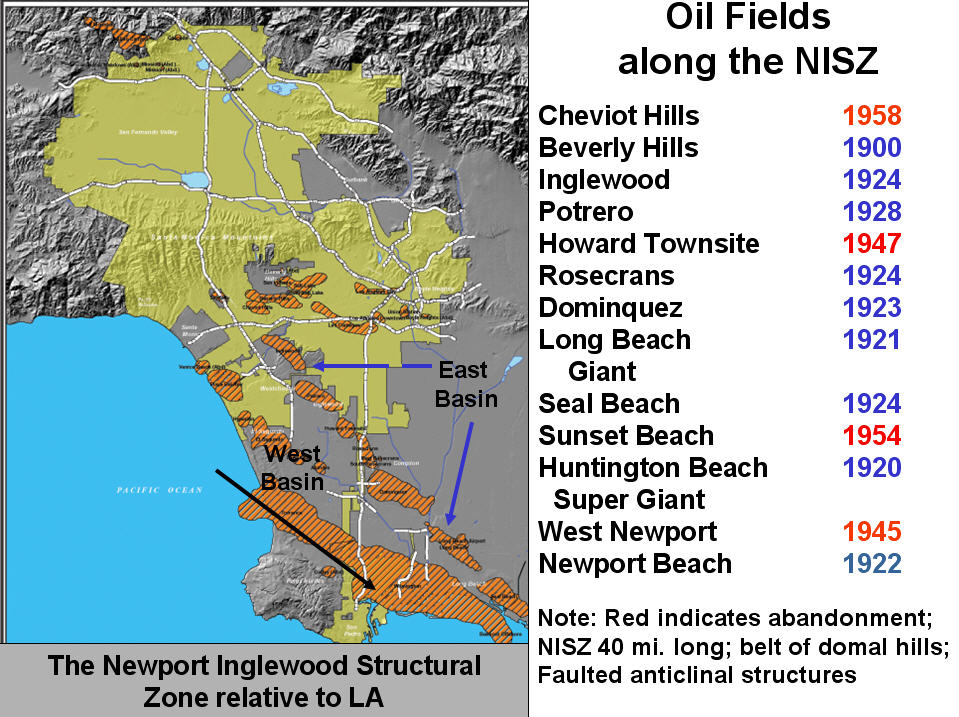
Oil fields along the Newport-Inglewood Structural Zone (NISZ)