
 Print this page
Tectonics and  Hydrocarbon
 Systems
of the East Gobi Basin, Mongolia*
Systems
of the East Gobi Basin, Mongolia*
By
Gary L. Prost 1
Search and Discovery Article #10090 (2005)
Posted September 3, 2005
*Oral presentation at AAPG Annual Convention, Calgary, Alberta, June 19-22, 2005
 Click
to view presentation in PDF format.
Click
to view presentation in PDF format.
1ConocoPhillips Canada, Calgary, AB ([email protected])
Abstract
Mapping and seismic data in
the East Gobi basin reveal a structural and burial history for basins adjacent
to the Zuunbayan and Tsagaan Els oil fields. The tectonic framework was combined
with available well and outcrop data to model the timing and magnitude of
hydrocarbon generation.
Five structural episodes are
recognized: 1) pre-Jurassic northeast-directed shortening that formed the
tectonic fabric; 2) Middle Jurassic to Early Cretaceous rifting along northeast
trends that formed the sub-basins of the East Gobi basin; 3) late Early
Cretaceous north-south shortening and inversion on existing normal faults;
shortening caused left-lateral and reverse displacements on northeast-trending
faults; 4) middle Cretaceous uplift and erosion, followed by 5) east-west
shortening and right-lateral movement on northeast faults. Folds formed by
inversion over Late Jurassic-Early Cretaceous normal faults.
Modeling suggests that the
bituminous member of the Zuunbayan Formation should be mature over large areas.
Oil migrated from mature source areas toward several traps, including the
Zuunbayan and Tsagaan Els fields. Modeling suggests that early oil was generated
in the Zuunbayan and Tsagaan Els area because of Cretaceous burial. Although
generation began in Early Cretaceous, peak generation occurred between 100-90
Ma. Generation continued at a decreasing rate to the present. Kerogen maturity
suggests that oil is the most likely product. Calculations of hydrocarbon
volumes generated indicate that the Unegt basin may have generated up to 86
billion BOE.
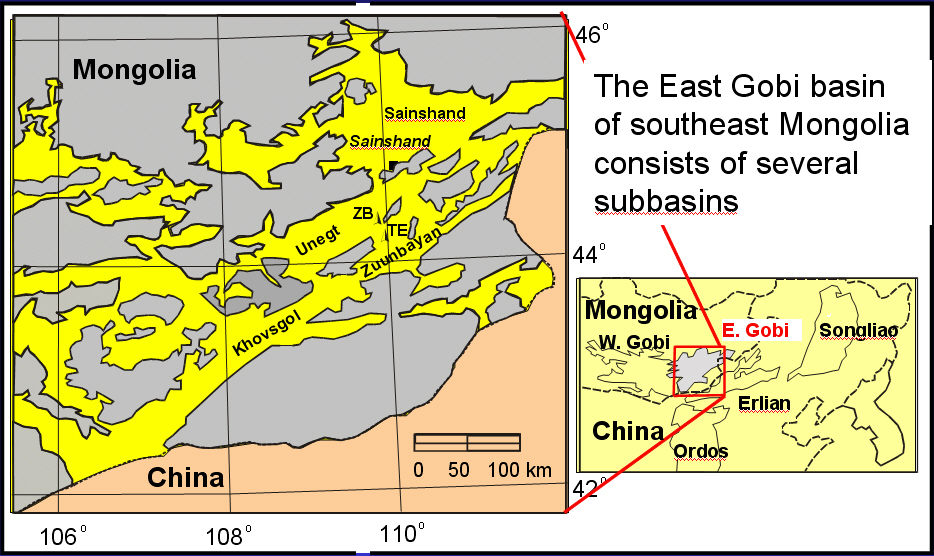
Location map, East Gobi Basin
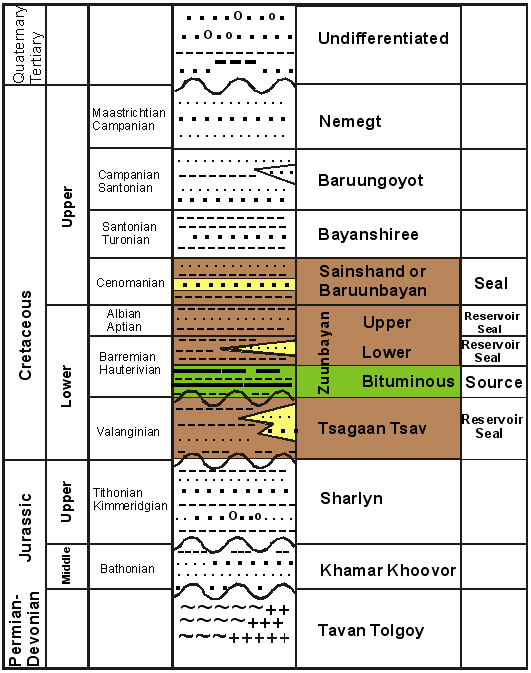
Stratigraphy, East Gobi Basin
Conclusions
Five structural episodes are recognized:
1. Pre-Jurassic NE shortening
2. Mid-Jurassic to Early Cretaceous rifting on NE trends
3. Late Early Cretaceous N-S shortening
4. Middle Cretaceous uplift and erosion
5. E-W shortening and right-lateral offset on NE faults
Imagery identifies light-colored intrusives that may serve as a source of high-quality reservoir.
The bituminous member of the Zuunbayan Formation should be mature over much of the deep Unegt and Zuunbayan subbasins.
Oil generation began at
110 Ma, peaked 100-90 Ma, and continues to present.
began at
110 Ma, peaked 100-90 Ma, and continues to present.
As much as 86 BBOE may have been generated; least 650 MMBO accumulated (156 MMBO discovered).