Print this page
 Click
to article in PDF format.
Click
to article in PDF format.
Sequence Stratigraphy and Basin Evolution of the Foz do Amazonas Basin, Brazil*
By
Mark A. Pasley1, David B. Shepherd1, David T. Pocknall1, Kevin P. Boyd1, Vander Andrade2, and Jorge Picanço De Figueiredo3
Search and Discovery Article #10082 (2005)
Posted May 26, 2005
*Adapted from extended abstract, prepared by the authors for presentation at AAPG International Conference & Exhibition, Cancun, Mexico, October 24- 27, 2004.
1BP America Inc., Houston, TX USA
2BP Brasil, Ltda., Rio de Janeiro, Brasil
3Petróleo Brasileiro S.A., Rio de Janeiro, Brasil
Introduction
The Foz do Amazonas Basin is located offshore of the states of Amapá and Pará in northernmost Brazil (Figure 1). The basin lies entirely offshore and is bounded in the updip areas by the Amapá, and Pará platforms.
The Foz do Amazonas is a conjugate basin to offshore Liberia in West Africa and was separated from the African continent during the opening of the Equatorial Atlantic Ocean. Rifting along the Atlantic margin in this area began around 120 Ma and continued into the Albian (ca. 100 Ma). Nonmarine, syn-rift sediments in the Caciporé Formation are encountered in half-graben settings on the updip margin of the deepwater basin, particularly under the Amapá Platform and in the Caciporé Graben to the northwest.
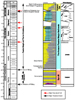
At the end of rifting (ca. 100 Ma.), thermal subsidence brought about the incursion of marine conditions and a deep marine basin formed by the end of Cenomanian time. Uppermost Albian shallow-marine sediments may have been the first deposited in the post-rift section, but these were quickly onlapped and overwhelmed by transgressive marine shales in the Cenomanian and Turonian. The basin fill history from syn-rift to post-rift, passive margin can be seen in the stratigraphic chart originally produced by Brandão and Feijó (1994) and modified here as Figure 2.
The post-rift, or passive margin, section in Figure 2 can be subdivided into two intervals: 1) pre-Amazon, and 2) Amazon Fan. The pre-Amazon section is Cenomanian through middle Miocene in age and represents deposition in the basin prior to the establishment of the Amazon River as a major, continental-scale drainage system. The predominantly clastic, pre-Amazon sediments that were deposited in the Late Cretaceous through late Paleocene are named the Limoeiro Formation. Pre-Amazon sediments deposited from the late Paleocene through the middle Miocene are lithostratigraphically classified as Marajó Formation (nonmarine and proximal shallow-marine clastics), Amapá Formation (shallow-marine carbonate shelf), or Travosas Formation (distal fine-grained sediments) (see Brandão and Feijó, 1994).
As
can be seen in Figure
2,
the Late Cretaceous and Paleocene history of basin fill was dominated by clastic
infilling on the passive margin (Limoeiro Formation). Numerous  third
third -order
cycles exist within the Limoeiro section – the details of which await further
study. Following a sea-level fall in the late Paleocene, a long-duration
relative sea-level highstand persisted through the middle Miocene with a
significant interruption during the Oligocene (“mid-Oligocene sea-level fall”).
Shallow-marine carbonate shelfal sediments (Amapá Formation) were deposited
during the Eocene and early and middle Miocene highstands, and it is postulated
that significant clastic material (Travosas Formation) was delivered into the
basin during the Oligocene sea-level lowstand.
-order
cycles exist within the Limoeiro section – the details of which await further
study. Following a sea-level fall in the late Paleocene, a long-duration
relative sea-level highstand persisted through the middle Miocene with a
significant interruption during the Oligocene (“mid-Oligocene sea-level fall”).
Shallow-marine carbonate shelfal sediments (Amapá Formation) were deposited
during the Eocene and early and middle Miocene highstands, and it is postulated
that significant clastic material (Travosas Formation) was delivered into the
basin during the Oligocene sea-level lowstand.
|
|
Amazon Fan Sequence StratigraphyThe Amazon Fan section, which dates back to the Tortonian, was the main focus of the present study. Amazon Fan deposition resulted from the development of the Amazon River as a major drainage system during the late Miocene. This began with the continental-scale Andean orogenic events, which in turn led to the capture of significant Pacific and Caribbean drainage by the Amazon River that delivered these sediments to the Atlantic Margin. Coincident with this tectonic activity was a second-order sea-level fall in the late Miocene (Tortonian and Messinian). Shallow-water facies in the Foz do Amazonas basin record the change in both relative sea level and clastic sediment supply because carbonate platform sediments of the Amapá Formation were replaced by clastic sediments of the Pirarucu Formation (see Figure 2). Carbonate sedimentation ceased in the Foz do Amazonas with the arrival of the Amazon sediments although it continued into the Holocene with the Ilha de Santana Formation in the Pará-Maranhão Basin to the southeast (Brandão and Feijó, 1994). Clastic sediment supply for the Amazon Fan section came from the development of the Amazon River drainage related to Andean uplift during the Miocene, the Tocantins River to the south, and by the reworking of older clastic sediments along the basin margin, particularly in the Marajó Graben.
Integration of biostratigraphic and well log
data with regional seismic lines has identified 11
Lower Pliocene
The upper Pliocene to Recent
ReferencesBrandão, J.A.S.L., and Feijó, F.J., 1994, Bacia do Foz do Amazonas: Boletim de Geociências da Petrobrás (Rio de Janeiro), v. 8, no. 1, p. 91-100. Mello,M.R., R. Mosmann, S.R.P. Silva, R.R. Maciel, and F.P. Miranda, 2001, Foz do Amazonas area: The last frontier for elephant hydrocarbon accumulations in the South Atlantic realm, in M.W. Downey, J.C. Threet, and W.A. Morgan, eds., Petroleum provinces of the twenty-first century: AAPG Memoir 74, p. 403–414. Figueiredo, J.J.P, 2003, Orbital control on cyclic Pleistocenic sedimentation in the Amazon Mouth Basin, Paper presented at 3rd Latin American Congress of Sedimentology, Belém - Pará – Brazil, June 8 - 11, 2003 . |