Print this page
Uncertainty – Shale Pore  Pressure
 from Borehole Measurements*
By
Martin D. Matthews1
Search and Discovery Article #40163 (2005)
Posted July 30, 2005
*Presentation at AAPG Annual Convention, with SEPM, Calgary, Alberta, June 19-22, 2005.
 Click
to view presentation in PDF format.
Click
to view presentation in PDF format.
1Knowledge Systems Inc., Sugar Land, TX 77478 ([email protected])
Abstract
The degree of
certainty in pore pressure estimates from resistivity and sonic data is examined
through a case study interpreted by eight trained analysts. The relevant data
included resistivity, sonic travel time, gamma ray, density, and mud weight as a
function of depth. A shallow kick pressure and several deeper MDTs were provided
for calibration.
While the models
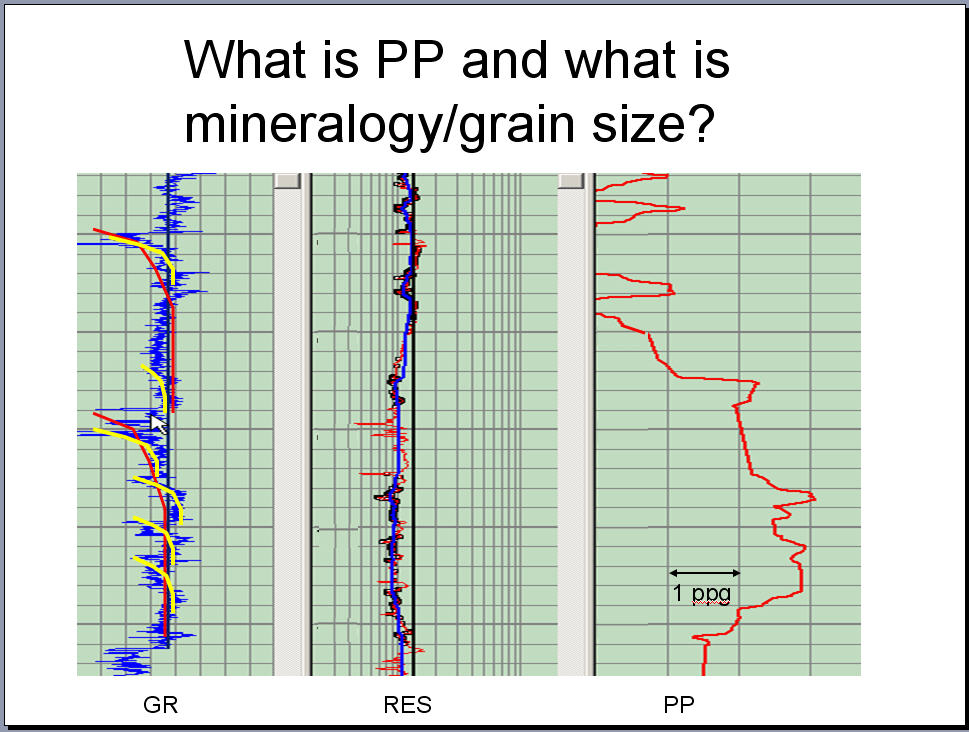
and tools are quite simple, the shale pressures are derived from several
measurements and decisions. The results of each analyst’s interpretation were
compiled and combined with some theoretical analysis to estimate the uncertainty
attached to components used to estimate shale pore pressure. Two sources of
variation dominate the uncertainty in estimating pore pressure from resistivity
and sonic logs:
-
trust that sand
pressure
calibration points are representative of shale pressures, and -
choice of the normal compaction trend.
Uncertainties in
shale pore pressure ranged as low as plus or minus 0.25 ppg to as much as plus
and minus 0.75 ppg depending on these decisions. Other factors accounted for
approximately less than 0.1 ppg in regions of good data. An approach for
minimizing and quantifying the impact they have on an analysis is discussed.
----------
MDT=modular formation dynamic tester
OBG=overburden
pressure gradient
NCTL=normal compaction trend line
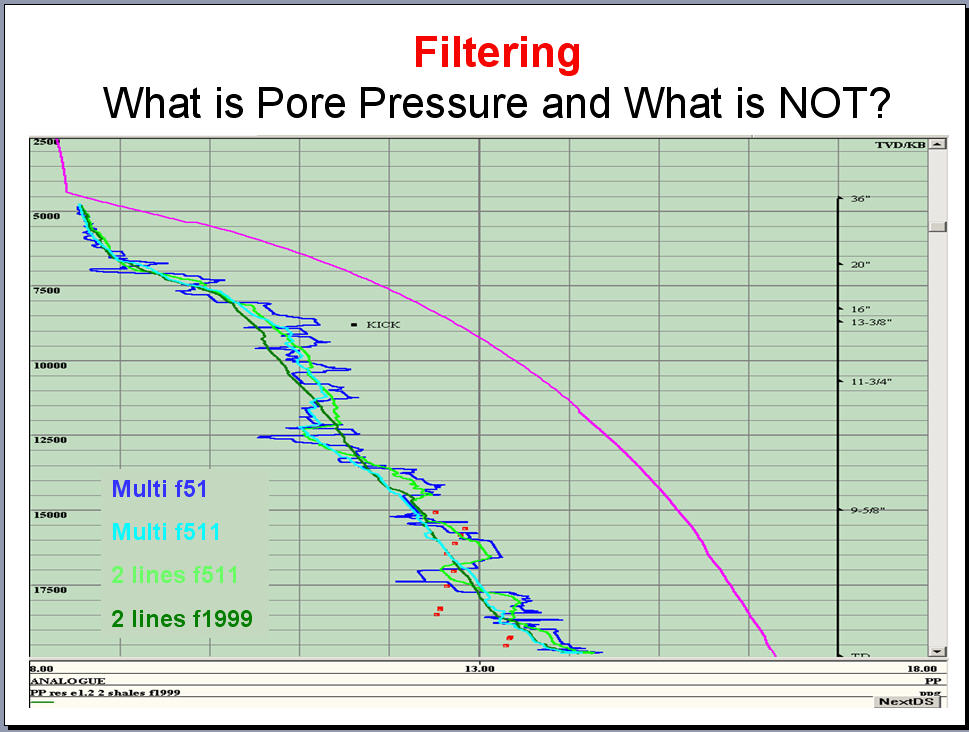
What is pore pressure and What is NOT?