Print this page
 Click
to article in PDF format.
Click
to article in PDF format.
Petroleum Mass-Balance of the Neuquén Basin, Argentina: A Comparative Assessment of the Productive Districts and Non-Productive Trends*
By
Leonardo Legarreta1, Carlos E. Cruz2, Gustavo Vergani3, Guillermo A. Laffitte4, and Héctor J. Villar5
Search and Discovery Article #10081 (2005)
Posted May 1, 2005
*Adapted from extended abstract prepared for presentation at AAPG International Conference & Exhibition, Cancun, Mexico, October 24-27, 2004.
1Patagonia Exploración, BsAs, Argentina
2Pluspetrol, BsAs, Argentina;
3Repsol YPF, BsAs, Argentina
4M&P System, BsAs, Argentina
5FCEyN-Dep. Cs.Geol., UBA-Conicet, BsAs, Argentina
Summary
The effort of eight decades of exploration and development in the Neuquén Basin (west-central Argentina) has identified a EUR of 9.7 BBOE, with a current daily production around 360 MBO and 2.6 BCFG. As result of the de-regularization and privatization process during the 90’s, the oil and gas reserves increased within the relatively mature productive tracts (Figure 1), where the known plays contain around 1.9 BBO and 17.5 TCFG of proven and probable reserves. Additional reserves are expected from testing new play concepts outside the areas under production, as well as from future activities in the under-explored fold belt and from the eastern margin of the basin (on the Pampean foreland).
|
|
Focus of StudyThis
work focuses on a quantitative comparison of the known productive
districts by analyzing the geological elements and the processes
involved in the charge, migration, accumulation, and
Geologic HistoryThe Jurassic and Cretaceous accumulation took place within a partially enclosed marine backarc depocenter that formed on the convergent western side of the South America plate, linked to the Pacific Ocean. Relative sea-level oscillations played a critical role in the development of sources, reservoirs, and seals, governed by an extensional tectonic regime. During relative highstands a relatively shallow sea, where organic-rich shales were deposited under sub-oxic to anoxic conditions, occupied the Neuquén embayment. Under shelfal-to-nearshore and fluvial environments, carbonate and clastic high-quality reservoirs accumulated (Figure 2). Relative low position of the base level resulted in a very restricted link through the magmatic arc or complete disconnection with the Pacific Ocean. Under this new scenario, the accumulation area dramatically shrank and the backarc depocenter became a realm prone to evaporite (seal) and fluvial and eolian sandstone (reservoir) accumulation (Figure 3). The effects of the Andean compressive deformation of the sedimentary pile started to be noticeable in latest Paleocene and became very strong during the Neogene (Figure 2). However, synsedimentary deformation related to old tectonic features, present in the Paleozoic substratum, resulted in the creation of structural and combined traps very early in the tectonic evolution of the Neuquén Basin.
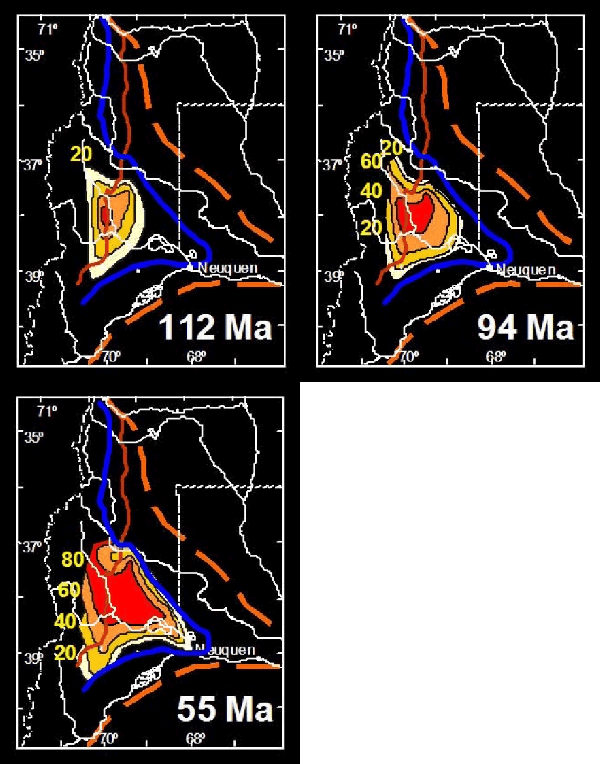
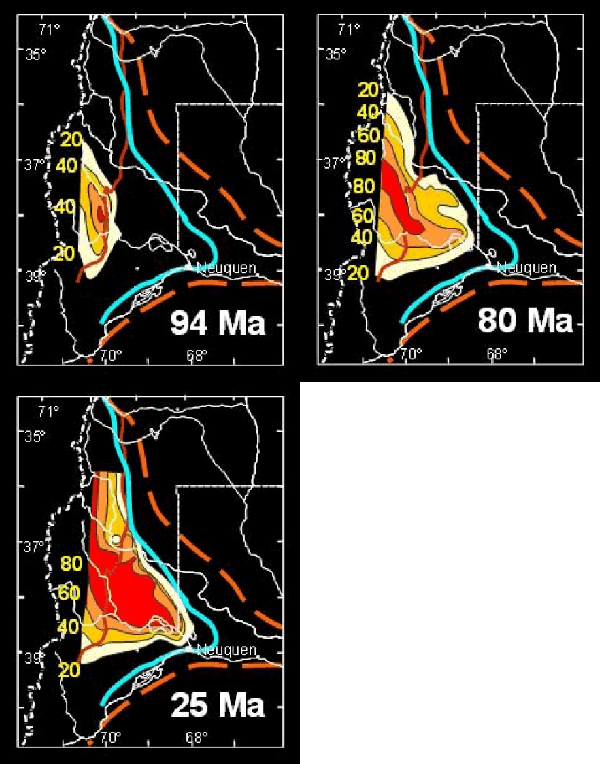
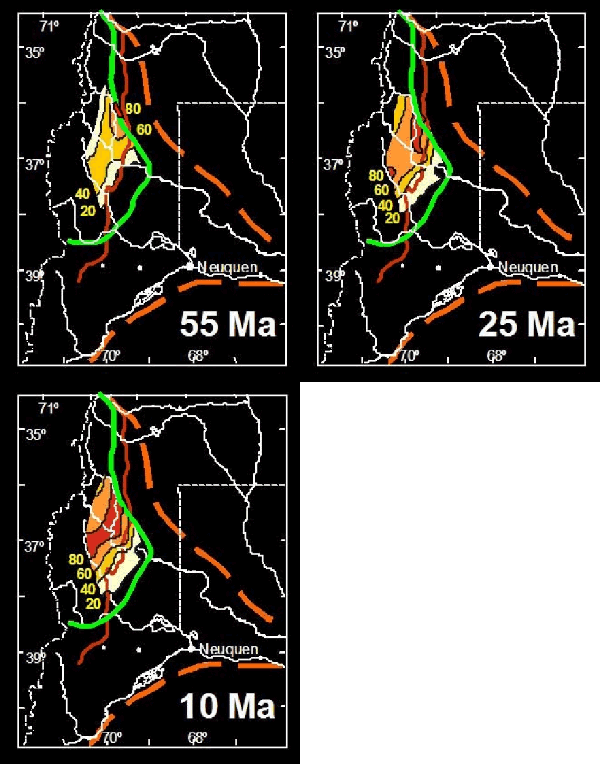
Source RocksThree high-quality and thick marine organic-rich intervals cover most of the basin (Figure 4). Additionally, a Lower-Middle Jurassic nonmarine source rock was deposited within anoxic lakes that developed within geographically restricted half-grabens (Figures 2 and 3). Modeling of the thermal evolution of the Jurassic and Cretaceous marine sources clearly indicates the existence of several episodes of hydrocarbon generation through geologic time, particularly along the west-central portion of the basin (Figures 4, 5, and 6). The overall pattern of the kerogen-transformation-ratio (TR) maps shown in Figures 4, 5, and 6 and the trends in Figure 7 depict the geographic location of the hydrocarbon kitchens of the source rocks through time and illustrate the final migration from the present deep positions to the basin margins. The
timing of the process critically affected the possibility of hydrocarbon
accumulation and
Mass Balance EstimationsOn a generalized basis and considering the total depositional area of the three source intervals, mass balance estimations are indicative of low generation-accumulation efficiencies at a basin scale. However, when evaluations are performed on the “fetch zone” of the productive districts, each charge system portrays improved efficiencies, in line with adequate timing of source rock maturation and trap availability. The
aforementioned low efficiency could indicate that most of the
hydrocarbons were lost (over 97%), or at least, not preserved within
commercially producible accumulations. When the analysis is performed
individually in each productive district, the obtained
Generation-Accumulation Efficiency (GAE) numbers show some Within
unexplored or under-explored areas, large pools could be provided by
additional future exploration of the less investigated plays, such as in
the western thrust belt, where post-mature gas generation may have
charged deep reservoirs in large structures. Also, hydrocarbon resources
can be envisioned within the practically unexplored deeply seated traps
and basin-center gas systems (Figure 8).
Finally, the potential occurrence of a heavy oil belt in the almost
unexplored eastern basin edge is a challenge for non-conventional
exploration (Figure 8). Besides the oil
type, difficulties along some portions of this trend are related to poor
or lack of information |