Print this page
From Ordovician Source Rock to Dolomitized Devonian Limestones:
A Promising Exploration Model in Gaspésie, Eastern Canada*
By
Jean-Sébastien Marcil1, Jean-Yves-Lavoie1, Valérie Lavoie1, and Virginie Lavoie1
Search and Discovery Article #10089 (2005)
Posted August 14, 2005
*Oral presentation at AAPG Annual Convention, with SEPM, Calgary, Alberta, June 19-22, 2005.
 Click
to view presentation in PDF format.
Click
to view presentation in PDF format.
1JUNEX Inc., 3075, Quatre-Bourgeois, Suite 103, Quebec City ([email protected])
Abstract
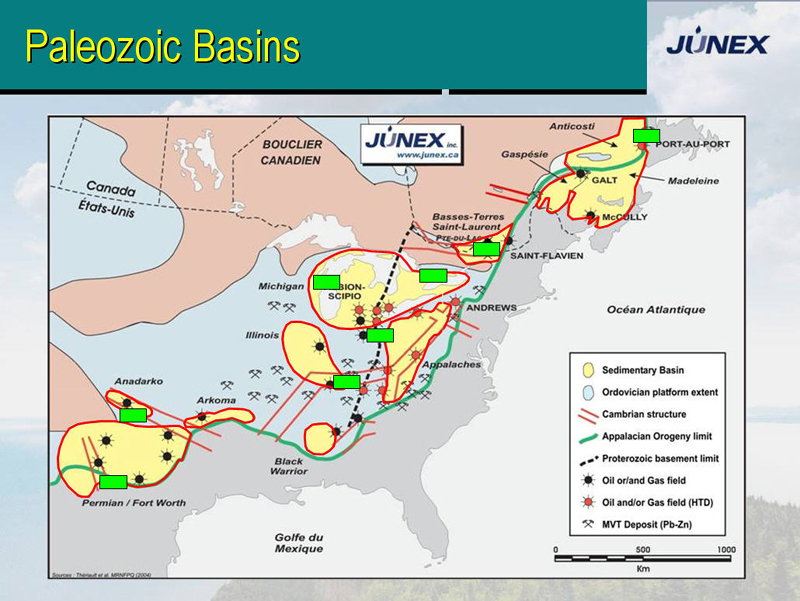
Gaspésie is a 20,000 km2 peninsula located in the southeastern part of Province of Quebec. Galt field is the only active hydrocarbon production but several seepages in the Devonian Sandstone are known. Recent exploration activities revealed a new potential for the area. JUNEX has been very active in the Peninsula and has been able to constrain an innovative exploration model.
Based on source
rocks and  thermal
 maturation
 studies, an Ordovician marine black-shales origin
is given for the oil found. Analysis yield values ranging from 4 to 10% TOC with
initial hydrocarbon potential up to 100 kg HC by ton of rock. This Ordovician
oil migrates along the regional extensional faults and feed the younger
reservoir zones.Surface core sampling and outcrop studies reveal a good
reservoir potential for Silurian reefs, hydrothermal breccias, and Devonian
sandstones. In the three wells completed by JUNEX : oil, gas, condensate and HTD
were discovered. According to the re-evaluation of the 2000 km seismic data
coverage, together with two high-resolution aeromagnetic surveys, new
exploration model focuses on the high potential of hydrothermal reservoir
related to strike-slip faulting over a Silurian-aged extensional basin and
shallow stratigraphic traps in the Devonian-aged deltaic fans or channels.
studies, an Ordovician marine black-shales origin
is given for the oil found. Analysis yield values ranging from 4 to 10% TOC with
initial hydrocarbon potential up to 100 kg HC by ton of rock. This Ordovician
oil migrates along the regional extensional faults and feed the younger
reservoir zones.Surface core sampling and outcrop studies reveal a good
reservoir potential for Silurian reefs, hydrothermal breccias, and Devonian
sandstones. In the three wells completed by JUNEX : oil, gas, condensate and HTD
were discovered. According to the re-evaluation of the 2000 km seismic data
coverage, together with two high-resolution aeromagnetic surveys, new
exploration model focuses on the high potential of hydrothermal reservoir
related to strike-slip faulting over a Silurian-aged extensional basin and
shallow stratigraphic traps in the Devonian-aged deltaic fans or channels.