
 Print this page
 Click
to view presentation in PDF format (18MB).
Click
to view presentation in PDF format (18MB).
Recommend--download to hard drive
1st Part 2nd Part 3rd Part 4th Part
Recommend--online viewing
Global Energy - The Next Decade and Beyond*
By
Arthur R. Green1
Search and Discovery Article #70013 (2005)
Posted February 3, 2005
*2004-05 AAPG Distinguished Lecture
Funded by the AAPG Foundation through the J. Ben Carsey Endowment
1Chief Geoscientist, ExxonMobil Exploration Company, Houston, TX, Retired; current address: Gig Harbor, WA ([email protected]).
|
uFactors driving global energy
uEight
phases of uFrom science to business ventures uEnergy, nations & mankind’s future uRealities & opinions of a geoscientist
uFactors driving global energy
uEight
phases of uFrom science to business ventures uEnergy, nations & mankind’s future uRealities & opinions of a geoscientist
uFactors driving global energy
uEight
phases of uFrom science to business ventures uEnergy, nations & mankind’s future uRealities & opinions of a geoscientist
uFactors driving global energy
uEight
phases of uFrom science to business ventures uEnergy, nations & mankind’s future uRealities & opinions of a geoscientist
uFactors driving global energy
uEight
phases of uFrom science to business ventures uEnergy, nations & mankind’s future uRealities & opinions of a geoscientist
uFactors driving global energy
uEight
phases of uFrom science to business ventures uEnergy, nations & mankind’s future uRealities & opinions of a geoscientist
uFactors driving global energy
uEight
phases of uFrom science to business ventures uEnergy, nations & mankind’s future uRealities & opinions of a geoscientist
uFactors driving global energy
uEight
phases of uFrom science to business ventures uEnergy, nations & mankind’s future uRealities & opinions of a geoscientist
uFactors driving global energy
uEight
phases of uFrom science to business ventures uEnergy, nations & mankind’s future uRealities & opinions of a geoscientist
uFactors driving global energy
uEight
phases of uFrom science to business ventures uEnergy, nations & mankind’s future uRealities & opinions of a geoscientist
uFactors driving global energy
uEight
phases of uFrom science to business ventures uEnergy, nations & mankind’s future uRealities & opinions of a geoscientist
uFactors driving global energy
uEight
phases of uFrom science to business ventures uEnergy, nations & mankind’s future uRealities & opinions of a geoscientist
uFactors driving global energy
uEight
phases of uFrom science to business ventures uEnergy, nations & mankind’s future uRealities & opinions of a geoscientist
uFactors driving global energy
uEight
phases of uFrom science to business ventures uEnergy, nations & mankind’s future uRealities & opinions of a geoscientist
uFactors driving global energy
uEight
phases of uFrom science to business ventures uEnergy, nations & mankind’s future uRealities & opinions of a geoscientist
uFactors driving global energy
uEight
phases of uFrom science to business ventures uEnergy, nations & mankind’s future uRealities & opinions of a geoscientist
uFactors driving global energy
uEight
phases of uFrom science to business ventures uEnergy, nations & mankind’s future uRealities & opinions of a geoscientist
uFactors driving global energy
uEight
phases of uFrom science to business ventures uEnergy, nations & mankind’s future uRealities & opinions of a geoscientist
uFactors driving global energy
uEight
phases of uFrom science to business ventures uEnergy, nations & mankind’s future uRealities & opinions of a geoscientist
|
ConclusionsMoving into the Next Phase of World Energy Modern civilization, a growing population and globalization will become increasingly more dependent on access to large volumes of oil, gas, coal, industrial materials and water at reasonable costs. Oil and gas supplies ~65% of the world’s energy (80 mb/d and 220 bcf/d gas; by the end of the decade it will be 90 mb/d and 280 bcf/d of gas). Renewable energy, excluding hydroelectric and nuclear, represent about 2% of production worldwide. The
geography and geopolitical setting of both production and consumption of
oil and gas and The peaking of conventional oil and gas production is sure to happen, and while the timing is uncertain, there are signs of change on the horizon. Enhanced oil recovery efforts and developing heavy oil and tar deposits will stretch supply. Increased gas production will become more important and the required transport and facilities infrastructure will require huge up front investment. The modern energy industry has experienced many discontinuities and has evolved to meet the challenges. The next stage of the energy business will be its greatest challenge as corporations try to meet the never ending demand for new sources of oil and gas as old fields are depleted. These changes in the global energy balance have the potential for geopolitical (Nations) environmental, economic and security disruptions worldwide. Recognizing and facing energy realities, learning from history and developing an integrated plan is critical for an industry that requires lead times of 10-15 years. Such a plan must include international relations - trade, global, economics, massive up front investment, innovative science and applied technology (Industry - Academic - Government). I am optimistic about our energy future and the leadership that will be furnished by science and creative technology in a world without walls. The plans and operations must be conducted within the context of the environment of our beautiful planet and its wealth of creatures large and small.
Factors Driving Global Energy(Figure 1) Energy Dynamics, Opportunities, and Challenges Speed, Volatility, Performance, Ethics, Networking, Wisdom
Global Geopolitical and Economic Environment Representative Governments Global Economy and Relations Trade - Regulations - Blocks Security - War - Terrorism Energy Consumption and World Banking and Investment
Business Operations Energy Discovery and Production Trade - Transport Refining to Products Job Creation Gross Domestic Product - GDP Company Vitality - Research and Investment
Science and Technology Knowledge Innovation - Creativity Information Systems - digital
People - Human Technology Education - Skills Population Demographics Prosperity vs. Poverty Emotional Maturity World Peace and a Sustainable Environment
Discontinuities in Energy: Past, Present, and Future— An Historical Perspective of Dealing with Change
The
Eight Phases of the
Roots of the
|
 Figure
1. Factors driving global energy.
Figure
1. Factors driving global energy.


|
|
|
|
|
Figure 12. Oil for a world at peace (from Oil for Victory, 1946). |
|
|
Figure 13. Theodore Link, legendary
|
|
|
Figure 14. Creole Field, Coast of Louisiana (from Wasson, 1948). |
|
|
|
|
|


Global Geopolitical & Economic Environment
Surge in Demand
US becomes Net Importer
Winds of Nationalization
Geopolitical Restructuring
State of Israel Formed and Colonies Fall
Marshall Plan
Cold War 1947 - Korean War 1950 - 1953
Stock Market (DOW) Reaches 500 Milestone in 1956
Population Inflection
Business Operations
Aggressive Global Search and Discovery
On-site Geologic and Engineering Investigations
Reestablishing Global Reach Limited to "The Western World"
Increasing Flow of Oil & Gas and Refined Products
ARAMCO Restructured
Companies Reorganized
Science - Technology - Knowledge
(Data - Information - Knowledge - Wisdom)
Revolutionary Advancements from War Years - High Octane Fuel, Butyl. Rubber, Lubricants
Direct and Indirect Impact of Technology
Technical Leadership in Academia, Government and Industry
Corporate Research Centers - Upstream and Downstream Enlarged
1st Offshore Drilling
Scouting - Global Information
Human Technology
"Experienced" Staff
Inventive "can do" Attitude
Global Maturity
Travel and Communication Advances
Training - Schools and Mentoring
(Figures 17, 18, 19, 20, 21, and 22)


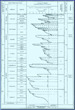

Global Geopolitical and Economic Environment
Nationalizations - Embargos (1973)
OPEC becomes a Major Force
Intense Cold War - Vietnam War Ends 1975
Oil Prices Increased 4x
Gasoline Shortages
Inflation Increased Sharply
Iran Hostage Crisis (1974)
Nixon Resigns (1974)
Stock Market Plunges (1974/75) Stagflation - GDP Dropped
Business Operations
Major Discoveries and Production come on line
New Global Offices Established by Industry
Oil & Gas Operations in USSR Surge
S.E. Asian Businesses Rise
Nationalization of oil properties
Science - Technology - Knowledge
Dynamic Earth Model - Applied (Regional) Projects
Research Centers merged (Carter- Humble)
Seismic Reflection, Stratigraphy and Attributes, 3-D
Seismic Data Processing
Sequence Stratigraphy
Micro - Paleo Develops Rapidly
Gravity and Magnetics
Satellite Imagery
Drilling begins move to Deep Water
Refining Advancements
Computers - Micro Chips
Human Technology
Staff Increases in Size and Experience
Extensive School System Develops at Research Lab.
Travel and Communication Surge
Integrated Regional Projects
Six Major Factors in Energy Planning
Only One Energy Event was Arguably a Real Crises
A Turning Point: THE 1973 OIL EMBARGO.
Some of What happened in the U.S. (from Robert L. Hirsch, Senior Energy Program Advisor, SAIC -- February, 2004) ([email protected]).
· Oil prices increased ~ 4.5 x (Saudi crude)
· Gasoline rationed (even / odd days)
· Gasoline lines and spot shortages
· GDP dropped two years in a row (recession)
· Interest rates spiked dramatically upward
· Inflation increased sharply
There was a huge wealth transfer to OPEC
U.S. Actions Resulting From the 1973 Oil Embargo (from Robert L. Hirsch, Senior Energy Program Advisor, SAIC -- February, 2004) ([email protected])
· Price controls enacted
· CAFÉ implemented
· Higher efficiency mandated in a variety of sectors
· National speed limit (55 mpg) enacted
· Domestic oil & gas exploration & production spiked upward
· Federal energy R & D dramatically increased
· A major effort in synthetic fuels initiated
· Windfall profit taxes levied
· U.S. government reorganized to form ERDA, FEA & FERC
· IEA formed
·
Strategic  Petroleum
 Reserve
established
Reserve
established
· Formulation of a coherent national energy policy initiated
· Foreign policy adjusted to new realities
Recent: 1995-2001 (Figure 23)
|
|
|
|
|
|
|
|
Figure 25. Merger acquisitions: deals closed / pending 1/1/98 to 2001, with estimated values. |
|
|
|
|
|
Figure 27. US
|


Global Geopolitical & Economic Environment
Major Mergers - Restructuring
Stock Market Surges (1995) and Falls (2001)
Globalization/Post cold war economy develops
Europe United - EU Currency
NGOs - Environment and Globalization
Balkans - Bombing (1999)
Oklahoma City Bombing 1995
World Trade Center and Pentagon Struck (2001)
Sanctions on Iran, Iraq, Libya
Business Operations
Major Corporations Develop from Mergers
Offshore West Africa Blooms
Caspian Sea North and South
Niger Delta and Equatorial Guinea
Indonesia and Sakhalin
Russian Industry Advances
Middle East Production Evolves /
Tensions rise
Science - Technology - Knowledge
Micro Chips and PCs Advance - Efficiency Surge
3-D Seismic and Attribute Analysis
Visualization
Communications - Cell Phones and Broad Band
Satellites - GPS, ICONOS, Interferometry, Geostat
Smart Materials
Robotics
Nano Technology Micro Machines
Human Genome Mapped
Medical Advances - Genes and Stem Cells
Cloning
Fuel Cells - Photo Voltaics and Combination Cars Advance
Climate Science Advances
Human Technology
Integrated Geoscience Emerges
Team Projects
Staff Matures
Hiring and Training Continue
The "New Economy" (Figure 24)
"How do we know when irrational exuberance has unduly escalated asset values, which then become subject to unexpected and prolonged contractions as they have in Japan over the past decade?"—Alan Greenspan, December 5, 1995 speech.
"Why did corporate governance check and balances that served us reasonably well in the past break down? . . An infectious greed seemed to grip much of our business community. . ."—Alan Greenspan, July16, 2002 speech.
Corporate Consolidation (Figures 25, 26, and 27)
Science and Technology
(Figures 28, 29, 30, 31, 32, 33, 34, 35, 36, 37, 38, 39, 40, 41, 42, 43, and 44)
Figures 28-44


Return to top.
Sedimentary Basin Systems: Models in Our Minds
Figures 45-47


The mental model of sedimentary basins envisioned here is that basins are complex, non-linear, self-organizing, dynamic natural systems. They are thrown in and out of thermodynamic and pressure equilibrium and experience both positive and negative feedback as they attempt to maintain equilibrium throughout their unique evolution.
The fluids (oil-gas-water) are the most unstable and mobile parameters of sedimentary basin systems and are the major agents in self organization on the maintenance of equilibrium.
Petroleum exploration is the science and art of envisioning multiphase
fluid and rock interactions envisioned through time in a high pressure
and temperature environment of the subsurface atmosphere.
A Forgiving
Influence: Salt in the Petroleum System (open-closed-chaos systems)
(Figures 45 and 46)
Salt and Shale
Diapirs: Catalytic - Self
Organizing Systems
Non-linear, Self-organizing Dynamic Systems Creates a "Subsurface Atmosphere."
-
Redistributes heat (conductive halite) and pressure
-
Fluids (gas-oil-water) move to equilibrate the system.
-
Mobile sediments move with fluids.
-
Alters basin chemistry NaCl) - Density flows
Molds the Shape of the Ocean Bottom
-
Withdrawal and fault subsidence
-
Forms itinerate basins - collects sands
Creates Traps
-
Forms structures - anticline and down-to-basin faults
-
Creates unconformities
-
Turtles
Creates Migration Pathways
-
Moves perpendicular to sedimentary layers
-
Breaks seals
-
Shale sheath conduits
-
Focus fluid flow
A Clue to Basin Dynamics and Compaction History
Direct and Indirect Oil and Gas Detection (Figure 47)
From Science to Business Ventures - Managing the Unknowable
(Figures 48, 49, 50, 51, 52, and 53)


Knowledge - Forever a Student (Figure 54)
 Figure
54. Group of geoscientists at AAPG International Conference, Istanbul,
Turkey, 2003 (left). Some of those geoscientists studying data presented
at the conference (right).
Figure
54. Group of geoscientists at AAPG International Conference, Istanbul,
Turkey, 2003 (left). Some of those geoscientists studying data presented
at the conference (right).
The
power of knowledge - the sustainable resource - geology of Asia
Learning in Istanbul
-
In the non-linear, free energy market environment of 2004 and beyond, science and technology must be the foundation of decision-making.
-
Learning is at the heart of our ability to adapt to changing energy environments.
-
We must all be teachers, students, and mentors at the same time in a world without walls.
 Figure
55. The human factor.
Figure
55. The human factor.
 Figure
56. Win/win human relations.
Figure
56. Win/win human relations.
Success (Figure 57)
 Figure
57. Marimba-1 (Angola) - Ocean Valent 1998 (ExxonMobil).
Figure
57. Marimba-1 (Angola) - Ocean Valent 1998 (ExxonMobil).
The Future to 2025 (Figure 58)


Global Political and Economic Environment
Increasing degree
of volatility and discontinuities - Afghanistan and Iraq
Increasing demand
for crude, natural gas, and petroleum products
The world of
declining petroleum resources
Intense competition for quality properties
Pressure on earnings growth - keeping costs - volumes up
Geopolitical awareness -NGOs environmental, and "Evil Doers"
Corporate reputation -performance
Public relations and safety
Embrace change -MAKE THE FUTURE
Business Operations
Performance and profitability
World basins continue to mature
Shifting center of growth for producing properties
Natural gas becomes a major player in the energy mix (LNG / GTL)
Increasingly complex high risk geologic opportunities
Increased
development of static petroleum resources
Business and scientific relationships
Partner of choice
High operational performance
Sound safety and environmental performance
Scientific and technical leadership
Ethics and global maturity
Doing the right thing right
Science - Technology - Knowledge
Genetic basin analysis
Complexity science - fundamental knowledge - fractals /patterns
Advanced subsurface fluid models - (Atmosphere) at all scales
Robust research - upstream and downstream
Interferometry
Earth tomography
Non-seismic geophysics
Nano-Technology - Micro Machines
Military research - satellite gravity - smart materials
Climate science
Advanced data and information systems
Human Technology
A learning organization
Adaptive self-organizing system - leadership
People network - Multi-cultural and evolving demographics
Congruency, integration, and communication
Innovation and creativity by all
World realities - Globalization, Advancing Technology, National Security
The confluence of change at the turn of the century has created a dynamic environment of opportunities, discontinuities, and challenges
-
Changing geopolitical climate - new markets and technologies drive economics.
-
Globalization creating an inter-connected world - geographies and virtual. Incomplete globalization debated (?). Shifts in employment and production capabilities. Trading blocks developing.
-
Mergers, buy-outs and consolidation occurring - backing oil and gas, defense, pharmaceuticals, biotechnology and high tech companies, antitrust suits common and regulations becoming global.
-
Volatile military operations worldwide - terrorist organizations evolving, religious unrest and separatist movements active. NGOs militant environmentalists and animal rights groups, etc. Nation building in Afghanistan and
Iraq. -
New technologies tools and scientific advancements (concepts) increasing rapidly - non-linear acceleration.
-
World population rising rapidly: 1804 - 1.06 billion, 1900 - 1.5 billion, 1960 - 3 billion, 2000 - 6 billion, 2050 - ~9.1 (?) billion.
-
Prosperity and active stock markets in some countries - confusion, lawlessness and poverty in others. The "New Economy" replaced by viable "corporate earnings." China and India GDP rising and thirst for energy and base metals increasing.
-
Vast new, global, digital interactive data sets available to all. Instant communications and transactions.
The Sage of the Federal Reserve
Comments at the conference on energy Security - Washington, D.C., April 27, 2004 - Wall Street Journal, April 28, 2004 (with quotations from Alan Greenspan, Federal Reserve Chairman):
The price of oil and gas contracts for delivery six years in the future indicates:
-
"The recent surge in oil and gas prices appear to be a long-lasting phenomenon, and could alter the magnitude and manner in which the United States consumes energy."
-
That the long term path of the US economy will be "significantly affected."
-
"A shift in expectations."
-
"The US must expand facilities for handling imported liquefied natural gas (LNG)."
-
"Higher gas prices in the US will prompt some gas-intensive industries such as petrochemicals and fertilizer manufacturers, to move facilities from the US to parts of the world where gas is less expensive.
The World’s Oil and Gas Endowment - Peak Oil
Next Big Thing: Peak Oil (from Williams, 2004—by Oil & Gas Journal Executive Editor)
". . . The last time this editor felt that kind of excite about a story with legs was the new wave of environmentalism sweeping the oil and gas industry that OGJ began tracking in the early 1980s and that exploded anew with the 1989 Exxon Valdez tanker spill.
"Next Big Thing
"The peak-oil debate is getting more polarized and more rancorous - and especially noteworthy, more politicized.
"So, here’s an immodest prediction: The peak-oil debate will be the Next Big Thing. The story with legs. The overarching them that will resonate throughout the oil and gas industry for decades to come. It will be propelled forward in the public consciousness not only by serious debate within the industry itself but also on the political hustings and antioil forces who can’t seem to pry Americans out of their sport utility vehicles even as war rages in the Middle East and Chicken Little lies sacrificed on the Kyoto altar.
"Iraq
and Saudi Arabia will figure largely in that debate. So will Russia and
the Caspian. And Orinoco oil and Athabasca tar sands. And reserves
accounting transparency.
"And alternate energy viability.
"That last one once looked like it had legs too, circa 1979-1985. So you’ll see more coverage of alternate energy in OGJ in the years ahead. . . ."
Energy Consumption (Figures 59, 60, and 61)
Oil (Figures 62, 63, 64, 65, 66, 67, 68, 69, 70, 71, and 72)
Figures 62-72


In Figure 62, Peak Ranges are 46 years (2021 to 2067) or 91 years (2021 to 2112); 900 billion barrels moves peak 10 years from 2047 to 2047. The table and chart do not include price feedback, political and geographic accessibility, geopolitical conditions or infrastructure.
Supplying oil and gas demand will require planning, technical skills and major up-front investment and risk (Figure 63).
The Era of Gas (Figures 73, 74, 75, 76, 77, and 78)
Figures 73-78
|
|
Figure 73. Conventional natural gas
endowment of the world. World |
|
|
|
|
|
|
|
|
Figure 76. Advanced gas conversion for the 21st century (AGC-21). |
|
|
Figure 77. Recoverable oil and gas resources (after M. Ray Thomasson, 2000). |
|
|


Unconventional Resources
"Beyond Petroleum"
Figures 79-90


Coal (Figures 79, 80, 81, and 82)
Hydroelectricity (Figures 83 and 84)
Nuclear Energy (Figure 85)
Wind Energy (Figure 86)
Solar Energy (Figure 87)
The diameter of the sun is 864,000 miles. Hydrogen and helium compose 95% of it. Energy is generated by thermonuclear fusion that converts hydrogen to helium. Solar flairs hurl radiation and particles into space. The plasma temperature is about 1million degrees. Bright region "sun spots" have higher density of coronal gas than dark regions.
Geothermal Energy (Figure 88)
Renewable Water Supply (Figure 89)
Efficiency and Conversation (Figure 90)
An Energy Scenario (Figure 91)
 Figure
91. Energy consumption and mix, 1860-2060, along with population growth.
Figure
91. Energy consumption and mix, 1860-2060, along with population growth.
A complex story of interacting variables and uncertain reserve figures
Assumptions
USGS 20000 World Resources
World GDD 2%
No major wars or economic collapses
Global free flow of energy products to consumers
Major construction of international transport and refining infrastructure
Globalization develops
Population increases
More nations prosper
New energy sources viable at end of period
Moderate conservation and efficiency increases
National oil companies and private companies cooperate.
Energy and Our Environment (Figure 92)
 Figure
92. Cover of a report by the Climate Change Science Program and the
Subcommittee on Global Change Research, July 2003.
Figure
92. Cover of a report by the Climate Change Science Program and the
Subcommittee on Global Change Research, July 2003.
Energy, Nations, and Mankind’s Future (Figures 93, 94, 95, and 96)
Figures 93-96
|
|
|
|
|
|
|
|
|
|
|


Realities and Opinions of a Geoscientist
Oil and gas supplies 65% of the world’s energy:
80 million bbls per day and 220 billion cfg per day
By 2010, 90 million bbls per day and 280 bcf per day
Critical chemicals, lubes and refined products
Unconventional resources will increasingly be exploited - tar, heavy oil, tight gas, etc.
Subsurface geologic knowledge
Innovative production and refining methods
Renewable energy, excluding hydroelectric plants and nuclear represent about 2% of energy production worldwide.
Prospective geographic areas with large new oil and gas potential are becoming difficult to find, and viable contractual agreements are a challenge.
By 2020 much of the oil and gas feeding the global economy will come from fields not yet online - the center of gravity for oil and gas production is shifting.
The world power structure is self-organizing, breaking into a spectrum off political, social and religious entities, and NGOs.
· The EU in Brussels is becoming a controlling influence in international business and regulations.
· The large the world economy, the more powerful its smallest members John Naisbitt, Megatrends).
Geoscience, concepts, tools, and technology are developing at an accelerated pace.
Advancements in drilling and logging capabilities and breakthroughs in fuel and chemical research will be needed to meet the world’s growing energy needs.
We are just on the edge of understanding the fundamental complex earth processes that operate within the Earth’s subsurface realm.
Massive streams of information and new technology have never been more abundant - and yet to transform them into global, economic and social gain, requires the intellect, passion, and genius of the individual human mind working in concert with sophisticated cross-discipline international teams.
Human
knowledge and experience - by 2015, 50% of the geoscientists and
petroleum engineers conduction our exploration and production operations
have not yet graduated from university.
The peaking of conventional oil and gas production is sure to happen, and while the timing is uncertain, there are signs of change on the horizon. Energy related projects are long term - ten to fifteen years leas time needed. Short term oversupply in the period leading up to peak production may result in complacency and inaction.
Meeting our energy needs in a world without walls is an essential prerequisite for a global transition to a more affluent work population, the growth of freedom and a sustainable environment for our beautiful blue planet.
Who is responsible for developing a workable energy program for the future? If not us - who is?
 Figure 97.
The earth.
Figure 97.
The earth.
**Other references are given with the text and figure captions.
Ahlbrandt,
T.S., and World Energy Assessment Team, 2001, World Petroleum Assessment
2000: Compiled Power Point Slides: U.S. Geological Survey Open-File
Report 99-50-Z, 112 p. (http://greenwood.cr.usgs.gov/energy/WorldEnergy/OF99-50Z/)
Bijwaard, H., W. Spakman, and E.R. Engdahl, 1998, Closing the gap between regional and global travel time tomography: Journal Geophysical Research, B, Solid Earth and Planets, v. 103, no. 12, p. 30,055-30,078.
Bilkadi, Zayn, 1995, Aramco World, January/February, 1995.
De’Ath, N., 1997, Oil companies exploration strategies in the 21st century: Bulletin of the Geological Society of Malaysia, no. 41, p. 5-11.
Energy Information Administration (EIA), 2003A, International Energy Annual 2001, DOE/EIA-0219 (2001), Washington, D.C., February, 2003.
Energy Information Administration (EIA), 2003B, System for the analysis of global energy markets.
International Petroleum Industry Environmental
Conservation Association (IPIECA), Climate Change Working Group, 2004,
Energy, development, and climate change: considerations in Asia and
Latin America: Oil & Gas Journal, v. 102.5 (February 2), p. 18-26.
International Energy Agency, 2002, World Agency Outlook, 2002.
Johnston, Nels, Carmen Revenga, and Jaime Echeverria., 2001, Managing water for people and nature: Science, v. 292, 11 May, p. 1071-1072.
Kellogg, Louise H., H. B. Hager, and R.D. van der Hilst, 1999, Compositional stratification in the deep mantle: Science, v. 283, no. 5409, p. 1881-1884.
Morse, S.A., 2001, Porous sediments at the top of earth’s core?: Science, v. 291, March 16, 2001.
Oil for Victory, McGraw-Hill Book Co., Inc., 1946.
Poruban, Steven, 2001, Oil and gas industry continues to grapple: Oil & Gas Journal, v. 99.29 (September 24), p. 22-28.
Read, Roger, 2002, North Sea evolution to track Gulf of Mexico Model: Oil & Gas Journal, v. 100.34 (August 26), p. 40-44.
Vail, P.R., 1987, Seismic stratigraphy interpretation
using sequence stratigraphy: part I: Seismic stratigraphy interpretation
procedure, in Atlas of seismic stratigraphy, v. 1, AAPG Studies
in Geology 27, p. 1-10.
U.S. Department of Energy, 2003, International energy outlook, May, 2003.
Wasson, Theron, 1948, Creole Field, Gulf of Mexico, Coast of Louisiana, in Structure of typical American oil fields, v. III, AAPG, p. 281-298.
Williams, Bob, 2003, Debate over peak-oil issue boiling over, with major implications for industry, society: Oil & Gas Journal, v. 101.27 (July 14), p. 18-29.
Williams, Bob, 2004, Next big thing: peak oil: Oil & Gas Journal, v. 102.15 (July 19), p. 15.