
 Print this page
Overview of a SAGD Reservoir
Characterization Strategy for Horizontal  Well
Well Placement and Ranking
Within the Surmont Lease, McMurray
Oilsands, Alberta*
Placement and Ranking
Within the Surmont Lease, McMurray
Oilsands, Alberta*
By
David Garner 1, TJ Wheeler 1, Emmanuel Mus 2, and Jean-François Richy 2
Search and Discovery Article #40166
Posted August 22, 2005
*Oral presentation at AAPG Annual Convention, Calgary, Alberta, June 19-22, 2005
 Click
to view presentation in PDF format.
Click
to view presentation in PDF format.
1ConocoPhillips Canada, Calgary, AB ([email protected])
2Total, seconded to ConocoPhillips Canada, Calgary, AB
Abstract
The McMurray Formation is a
highly heterogeneous Cretaceous clastic reservoir with thick, bitumen-saturated
sands. We applied a detailed quantitative workflow for integrating multi-scale
data, building a geological model, and managing uncertainties associated with
planning and controlling a steam chamber for SAGD bitumen extraction. Our main
goals in this study were to aid and improve the complex decision making for
vertical placement of horizontal wells, for optimizing expected performance, and
for ranking of the horizontal well pairs.
Let us consider that the
SAGD wells can be studied as individual reservoirs, with a drainage volume
surrounding each well pair. There is a line of sight (LOS) along the length of
the horizontal path or vertical plane and a width. Using the drainage volume and
LOS, we calculated parameters such as effective well length, net-to-gross,
facies proportions, producible volumes, and a vertical discount factor on
stranded volumes for each model realization. A comparison was made to the purely
deterministic geological approach.
The evaluation focused on
the uncertainties in the estimated or simulated reservoir parameters. To decide
on placement, post-processing of the detailed geostatistical simulations
provided uncertainty measures on the reservoir parameters as a function of
elevation. A probabilistic model was used to simulate well pair performance and
rank the well slots. The model used well placements, extracted reservoir
parameter distributions, SAGD operating conditions, and Butler theory in a Monte
Carlo framework.


Stratigraphic framework and typical heterogeneities
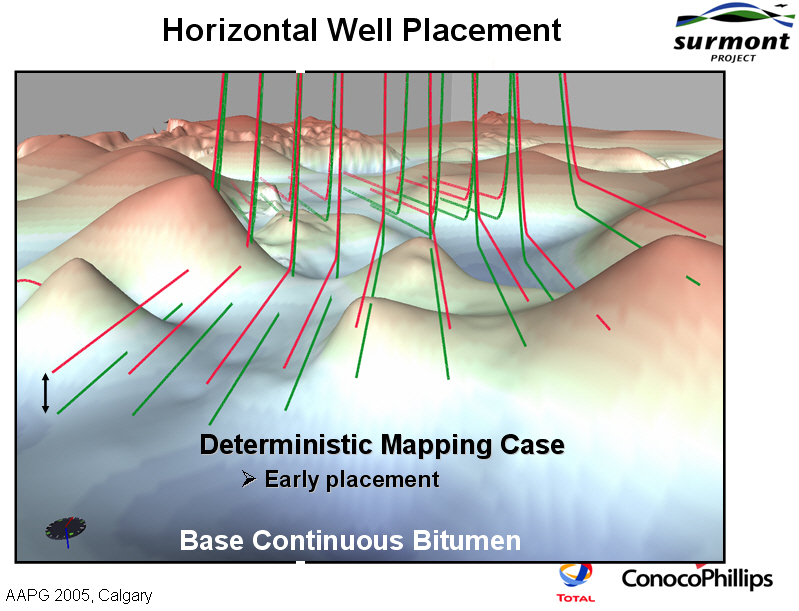
Horizontal well placement

Summary
-
Innovative approaches were used to quantify risks and uncertainty, for consistency, and to make decisions from a complex set of criteria.
-
Our Team improved decision making by capturing many aspects of the Geological Model both Deterministically and Probabilistically.
-
The different Quantitative perspectives lead to optimized
well placement scenarios.
 -
We gained team effectiveness and partner alignment.