Click
to article in PDF format.
Click
to article in PDF format.
A Planetary View of Mesozoic Plate Tectonics in the  Gulf
Gulf of
Mexico*
of
Mexico*
By
Richard H. Fillon1
Search and Discovery Article #30032 (2005)
Posted April 24, 2005
*Adapted from extended abstract prepared for
presentation at AAPG International Conference & Exhibition, Cancun, Mexico,
October 24-27, 2004.
1Earth
Studies Group, New Orleans, LA 70131 ([email protected])
In many respects the geology of the Gulf of Mexico is better understood than
other comparable marginal seas due primarily to its long history of drilling and
reflection seismic acquisition by the petroleum industry. However, the petroleum
accumulations and thick Tertiary section that attract industry also restrict
scientific ocean drilling. To date only the carbonate margin of the southern
Gulf and Quaternary fans in the deep eastern basin have been targeted.
Discovering new details of the nature and timing of the opening of the Gulf
basin, therefore, presents a considerable challenge. The goal of this ongoing
study is to determine whether the opening of the Gulf of Mexico is a predictable
manifestation of the planetary-scale superswell-related mantle stresses that
drive the movements of major plates and to evaluate implications for Gulf of
Mexico petroleum systems.
Predicting
microplate kinematics within the poorly defined boundary zone that separates
North Atlantic and South Atlantic spreading is pivotal in this analysis. It is
postulated that the movements of continental microplates in the Gulf of Mexico
are driven by mantle stresses that moved first North America and then South
America away from Africa.
|
uIntroduction
uFigure
captions
uPlate
tectonics
uReconstructions
uIntroduction
uFigure
captions
uPlate
tectonics
uReconstructions
uIntroduction
uFigure
captions
uPlate
tectonics
uReconstructions
uIntroduction
uFigure
captions
uPlate
tectonics
uReconstructions
|
Figure and Table Captions
Return to top.
Mesozoic Plate
Tectonics
While there is a considerable volume of published seismic and
biostratigraphic data that provides credible evidence of Triassic -
Jurassic rifting around virtually the entire Gulf margin, compelling
evidence of significant pre-Berriasian (Jurassic) plate movements
related to seafloor spreading and ocean crust formation is lacking.
Although several seismic stratigraphic studies that transect the
northeastern and western margins of the deep Gulf Basin suggest a
Jurassic age for the oldest basin-filling sediments, interpreting
Callovian (late Middle Jurassic) Louann Salt as autochthonous. It is
equally plausible that the salt is allochthonous, having been included
in the base of large superficial detachments containing post-synrift -
pre-drift strata of Late Jurassic and earliest Cretaceous age deposited
originally on attenuated continental crust of Gulf Rim. The Sea of
Cortez (Gulf of California) provides a well documented analog for this
type of margin failure during early opening. Observations of Jurassic
strata overlying undated oceanic crust therefore do not directly imply a
Jurassic crustal age.
Outcropping and drilled Mesozoic strata of the Gulf rim, the presence of
buried plume-related alkalic basaltic volcanoes of middle and Late
Cretaceous age, and the geometric requirement that the Yucatan Platform
be rotated into a position along the Texas - Louisiana margin to allow
the reassembly of Pangea are the principal constraints on the origin of
the Gulf of Mexico. There is general agreement among researchers that
the opening of the western basin of the Gulf of Mexico reflects the
counterclockwise rotation of a Yucatan microplate. Following recently
published paleomagnetic evidence the Chiapas portion of the Maya Block
is treated as a separate microplate in this study. It is recognized that
the rotation of a Yucatan microplate about the relatively well-known
Euler rotation poles that opened the North Atlantic Ocean cannot account
for the most probable trajectory of Yucatan. Published opening solutions
designed to provide an ideal Yucatan trajectory are purely kinematic,
not addressing the implications of a unique Gulf of Mexico stress field
on planetary-scale mantle processes that drive plate motions. Departing
from a purely kinematic solution for Yucatan microplate motion, this
study focuses on a rotation geometry linked to the stresses that moved
the major North and South American plates. Details of the predicted
timing and direction of Yucatan microplate rotation thus depend on the
changing relative positions of the well known North Atlantic and South
Atlantic Euler (rotation) poles. Comparison of North and South Atlantic
rotation poles and the history of Berriasian to Barremian (Neocomian)
rifting between South America and Africa, which heralded development of
a South Atlantic stress field, directly imply a post-late Berriasian
(Cretaceous) opening of the western Gulf of Mexico. Application of the
South Atlantic opening pole positions and angular velocities to the
opening of the western Gulf of Mexico further predicts that Yucatan
microplate rotation was mostly completed by early Aptian time (~109 Ma
BP).
The new Gulf of Mexico microplate kinematics proposed here predicts that
most Gulf of Mexico seafloor (~60 %) was created during the Early
Cretaceous period of stable geomagnetic polarity (120.4 - 83.5 Ma BP).
The absence of obvious magnetic lineations in the deep western basin is
therefore a predictable element of Gulf evolution. A further consequence
of post-Berriasian opening of the western Gulf of Mexico is that the
thick succession of Norphlet to Cotton Valley sediments that built-up on
thick Louann Salt (Callovian) in Oxfordian to early Berriasian time were
likely to have destabilized as Yucatan moved away from the
Texas-Louisiana margin. The movement of large superficial detachments
into the nascent Gulf Basin would have covered virtually all of the
oldest (Berriasian to earliest Aptian) oceanic crust located nearest the
basin margin. Magnetic spreading anomalies M10N to M0 would thus have
been strongly diminished or completely destroyed. In applying a Gulf of
California model, the superficial detachment phase in the western Gulf
of Mexico Basin began with the first plate movements initiated by mantle
stresses and therefore very likely coincided with the development of the
deeper crustal detachments that are characteristic of the early stages
of asymmetric continental fragmentation.
Analysis of dated oceanic plateau basalt accumulations and the inferred
tracks of related mantle plumes indicate that two hotspots transited the
central Gulf of Mexico basin during the Late Mesozoic. By holding mantle
plumes fixed relative to Africa, a procedure considered valid for
Atlantic hotspots, tracks are predicted that pass through the Gulf of
Mexico at critical times in its evolution. One hotspot, recorded in
conjugate oceanic plateau basalts of the Ceara and Sierra Leone Rises in
the Central Atlantic, is traced to a Triassic position within the
Central Atlantic Magmatic Province underlying the Bahamas and central
Cuban microplates. The Ceara-Sierra Leone Rise hotspot exited the Gulf
through South Florida in the Jurassic as North America began moving away
from Africa. The second important Gulf of Mexico hotspot is recorded in
accumulations of oceanic plateau basalts that comprise the Beata and
Aves Ridges in the Eastern Caribbean. The Beata-Aves Ridge hotspot
entered the Gulf region through West Texas, passing beneath the Rio
Grande Rift in the Barremian. It was centered in the western Gulf basin
in the middle Cenomanian and exited the basin beneath Yucatan in the
early Campanian. The Bermuda hotspot is also important for explaining
regional geology. It transited north of the Gulf basin proper, passing
beneath the Mississippi Embayment in Turonian through Campanian time.
Alkalic basalts of the northern Gulf Rim, which date between 110 and 60
Ma BP, probably record the combined effects of the Beata-Aves Ridge and
Bermuda hotspots. The northern end of the modern Caribbean Arc may be
pinned at the present location of the Beata-Aves Ridge hotspot.
Examples of Gulf Basin evolution constrained by this new planetary view
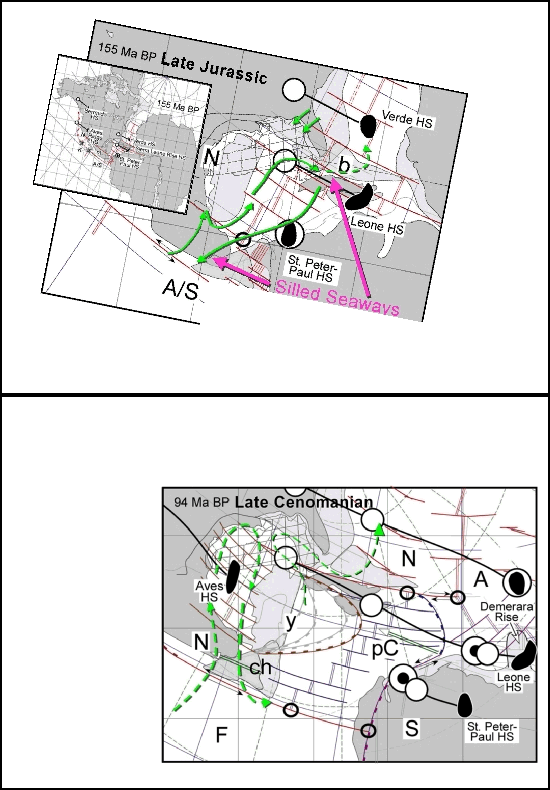
of microplate motion are provided in a series of plate reconstructions
that begin with the development of a rift valley system that breaks the
Yucatan Platform off the North American Plate (Figure
1) and ends with a fully opened Gulf of Mexico Basin (Figure
2). Implications for the petroleum systems of the Gulf Basin are
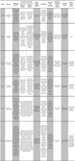
outlined in Table 1. Basin are
outlined in Table 1.
Return to top.
|

 Print this page