|
Figure Captions
Return to top.
The stratigraphic record of any sedimentary
basin is controlled by three variables: eustasy, subsidence, and
sediment supply. In foreland basins, high rates of subsidence
characterize the main thrust depocenter, formed by downwarping of the
foreland plate. Peripheral upwarping forms a “forebulge” as an elastic
response to thrust loading. Sediment supply feeds the foreland basin
from either the flexed foreland plate or the overriding thrust belt.
Eustasy and sediment supply control the short-term stratigraphic
framework, superimposed over lower frequency tectonosequences that are
controlled by the asymmetric slope of the basin and the position of the
forebulge. The basal unconformity of the foreland tectonosequence is
formed by erosion of the progressively migrating forebulge; its upper
unconformity is controlled by tectonic rebound.
The Eocene sedimentary record of the Maracaibo
basin was formed in a foreland basin setting during an oblique
collisional event between the Caribbean and South American plates. As a
result of this collisional event, a major depocenter developed in the
northwestern area of the basin. The source of shallow-water Eocene
clastic sediments was from the south during the early-middle Eocene and
from the south and east-northeast during the middle-late Eocene.
Depositional environments in the Eocene are highly variable and include
fluvial, deltaic, and marginal marine settings with strong tidal
influence.
The main objective of this study is to use a
dense well database (330 wells) combined with 2-D (500 km) and  3-D 3-D seismic (2000 km²) data of a representative area of the Maracaibo basin
shown in Figure 1 to:
seismic (2000 km²) data of a representative area of the Maracaibo basin
shown in Figure 1 to:
-
Illustrate the
overall structure of the Burro Negro zone lateral ramp fault and the
two different areas of Eocene sedimentation that the fault
separates.
-
Analyze intraplate
deformation and pull-apart basin formation in the Eocene Maracaibo
shelf and its effect on sedimentation.
-
Generate a high
resolution sequence stratigraphic framework in order to enhance
vertical and lateral correlations in a three-dimensional view.
-
Understand the
interplay between subsidence, eustasy, and sediment supply in a
sequence stratigraphic framework.
-
Generate maps and
evolutionary models for the Eocene clastic section in the central
Maracaibo basin.
-
Show the distribution
and setting of the most productive Eocene reservoirs in central Lake
Maracaibo area.
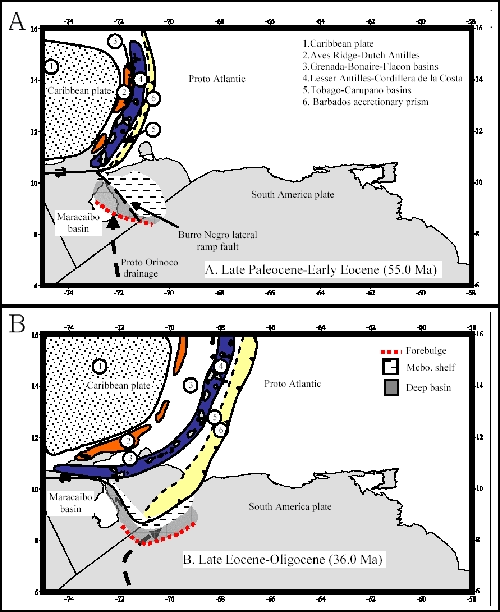
Late Paleocene-Early Eocene
The Maracaibo basin began to downwarp in
response to tectonic loading on its north and northeastern margins as
the Caribbean plate started to collide with northern South America
during late Paleocene time (Figure 2A).
Eocene clastic input from the south and southwest infill the basin and
onlap the Paleocene platform as tectonic loading continued. A flexural
bulge formed in the central part of the basin and migrated southward in
response of to west-to-east thrusting. Lower Eocene rocks onlap the
forebulge. NNE-striking faults (e.g., Icotea fault and Pueblo Viejo)
were reactivated as left-lateral strike-slip faults developing
pull-apart basins along their traces. The platform margin was located
along the Burro Negro fault zone.
Middle Eocene-Oligocene (Figure
2B)
Tectonic loading ended in central and south
Maracaibo basin, producing the regional “Eocene unconformity” by
tectonic rebound. Collision of the Caribbean plate moved SE-to-E and
induced right-lateral strike-slip motion on the Burro Negro lateral ramp
fault zone.
The lower Eocene clastic wedge of the
Maracaibo basin pinches out in the central part of the present-day Lake
Maracaibo and thickens to more than 4 km at the NE margin of the basin (Figure
3). To the south, the Eocene wedge onlaps against a folded Paleocene
high (forebulge). Back-stepping onlap of Eocene sequences toward the
south suggest subaerial exposure of upper Paleocene rocks. The clastic
wedge is divided into two main sections by the Burro Negro fault:
-
To the SW, fluvio-deltaic
sedimentation took place in a shelf setting with NW-striking normal
faults and formation of pull-apart basins.
-
To the NE,
deep-marine, Eocene-Miocene sediments were highly deformed by
folding and thrusting; Oligocene and Miocene syntectonic sub-basins
are bounded by structural highs characterized by chaotic reflections
(Figure 3).
The Eocene tectonosequence is confined between
two major unconformities:
The Eocene succession in central Lake
Maracaibo is characterized by an aggradational succession of sandstone
above the Paleocene unconformity overlain by a major retrogradational
succession of shale and sandstone with few progradational units and an
aggradational succession of sandstone near the top of the
tectonosequence. Using high-resolution well correlations, five genetic
sequences, one depositional sequence and seventeen parasequence sets
were interpreted. Assuming linear interpolation between the few age
controls from core data, the duration of parasequence sets is on the
order of 300 to 900 ky.
Evolution of the Eocene Maracaibo basin platform:
The stratigraphic
evolution of the Maracaibo basin during the Eocene is controlled by the
oblique collision between the Caribbean plate and passive margin of
South America in western Venezuela (Figure 2),
and to a much lesser degree by sediment supply and eustasy. Small
changes in the oxygen isotope record and the lack of major continental
ice caps during the early-middle Eocene greenhouse period suggest that
eustasy played a minor role in high frequency cycles observed in the
Maracaibo basin. The lateral and vertical continuity of facies
associations indicates that the Eocene shelf was never subaerially
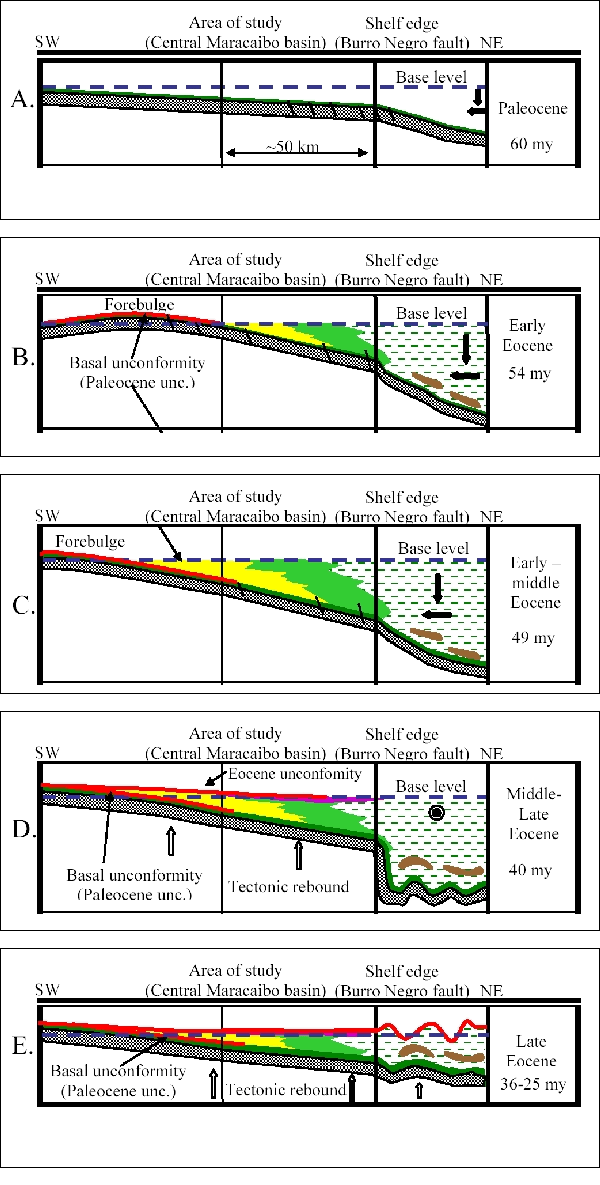
exposed. The evolution the Eocene Maracaibo shelf can be summarized as
follows (Figure 4):
1. Late Paleocene ~ 60 Ma (Figure
4A): The Maracaibo basin was a passive, mixed carbonate-clastic
margin that underwent tectonic loading from the NNW as the Caribbean
plate and arc system approached western Venezuela (Figure
2A). The shelf edge was located along the Burro Negro fault, and
subsidence rates increased rapidly across this fault.
2. Early Eocene ~54 Ma (Figure
4B): Tectonic loading from the north induced higher subsidence rates
on most of the shelf. Flexural loading created a forebulge to the south,
exposing the Paleocene platform and forming the Paleocene unconformity.
Clastic input began to infill the basin. Turbidites were deposited in
the deeper water Maracaibo basin, northeast of the Burro Negro fault.
3. Early-middle Eocene ~49 Ma (Figure
4C): Tectonic loading reached its maximum with high subsidence rates
(150 m/my) across the entire basin. The forebulge migrated progressively
southward and clastic sediments onlapped the Paleocene unconformity,
inducing retrogradation of the Eocene tectonosequence. Forebulge uplift
is estimated in 10 m/my.
4. Middle-late Eocene ~40 Ma (Figure
4D): Tectonic loading moved eastward. The lithosphere responded by
tectonic rebound characterized by uplift rates of 60 m/my. Rebound
affected the entire Eocene Maracaibo shelf, forming the Eocene
unconformity.
5. Late Eocene-Oligocene ~35-25 Ma (Figure
4E): The entire basin was subaerially exposed, and intra-basinal
erosion cannibalized a large amount of clastic sediments.
Distribution of hydrocarbons reservoirs in the
Maracaibo basin are mostly concentrated between the Icotea and Pueblo
Viejo faults SW of the Burro Negro fault zone.
Figure 5 is a transverse, E-W interpreted seismic line in the
central Maracaibo basin showing the main features of the basin’s
petroleum system from Cretaceous source rock to Eocene and Miocene
reservoirs.
Hydrocarbon source rocks in the Maracaibo
basin are Cretaceous carbonates of the La Luna Formation (Albian-Coniacian)
and to a lesser degree, Eocene and Miocene shales. Hydrocarbon
generation most likely occurred during the Paleogene, when Cretaceous
rocks were deeply buried in a foreland setting and reached thermal
maturation. Miocene inversion of the Maracaibo basin deeply buried
Eocene and Miocene rocks in the southern part of the basin (Maracaibo
syncline) and led to thermal maturation of Eocene-Miocene shale source
rocks.
Hydrocarbon migration and trapping occur in
two main phases:
During Paleogene oblique collision, a wedge of
fluvial-deltaic Eocene rocks was deposited in a foreland basin (Figure
4). Pull-apart basins controlled by reactivated Jurassic
N-S-trending faults within the Maracaibo basin formed. These faults
served as vertical pathways for hydrocarbon migration from the
Cretaceous source rocks to Eocene reservoirs (Figure
5). Vertical displacements along major faults allowed lateral
contact between Cretaceous source rocks and Eocene reservoir rocks and
contributed to increased upward hydrocarbon migration (Figure
5). Hydrocarbon traps are associated with anticlines formed during
creation of the pull-apart basins structures and are compartmentalized
by NW-striking faults (Figure 5). Regional
NNE dip of the basin also contributes to updip oil migration into Eocene
reservoir facies and trapping beneath the Eocene unconformity in the
central Maracaibo basin.
Post-Eocene inversion was characterized by
uplift of the Sierra de Perijá and the Mérida Andes, formation of the
N-S Maracaibo syncline, and inversion of Eocene structures in the
central basin. Hydrocarbon migration occurred along fault zones at the
Eocene unconformity and in places where post-Eocene reservoir rocks are
in contact with Eocene reservoirs. The Miocene depocenter was located in
the southern Maracaibo basin. Miocene continental facies pinch out to
the NE, forming a major stratigraphic trap for hydrocarbons that have
migrated upward (Figure 5).
Hydrocarbons in Eocene reservoirs of central Lake Maracaibo have API
gravity between 20 and 30 and are classified as medium oil. The
reservoirs are located on structural highs and in parasequence sets with
high sandstone content (Figure 5). The
structural highs were formed by strike-slip and inversion of
N-NE-striking normal faults. NNW normal faults separate the main
anticlines into discrete blocks. Structural lows to the east and west
tend to be wet reservoirs outside the main anticline areas. Most oil
production is located in the central and southern areas. To the north
these areas are less productive due to increase in shale content related
to an increase of tidal influence. Oil is most likely to be concentrated
in the main continuous distributary channel facies and sand bars. The
southern and central areas have been intensely drilled over the main
anticline structure. The northern area and flanks of the main anticline
are poorly drilled and open the opportunity for exploration of untested
stratigraphic traps in the central-west part of the study area. of untested
stratigraphic traps in the central-west part of the study area.
Return to top.
|

 Print this page
 Click
to article in PDF format.
Click
to article in PDF format.