|
uAbstract
uFigure
captions
uRegional
geology
uBasin
 tectonics tectonics
uSalt
domains
uHalokinetic
history
uReferences
uAbstract
uFigure
captions
uRegional
geology
uBasin
tectonics
uSalt
domains
uHalokinetic
history
uReferences
uAbstract
uFigure
captions
uRegional
geology
uBasin
tectonics
uSalt
domains
uHalokinetic
history
uReferences
uAbstract
uFigure
captions
uRegional
geology
uBasin
tectonics
uSalt
domains
uHalokinetic
history
uReferences
uAbstract
uFigure
captions
uRegional
geology
uBasin
tectonics
uSalt
domains
uHalokinetic
history
uReferences
uAbstract
uFigure
captions
uRegional
geology
uBasin
tectonics
uSalt
domains
uHalokinetic
history
uReferences |
Figure Captions
Return to top.
The geological evolution of Yemen was driven by the plate motions that
broke Pangea apart in the Mesozoic and formed the Gulf of Aden, Red Sea,
and the Arabian Peninsula in the Cenozoic. The stratigraphy and regional
geology of Yemen was established by detailed work of Beydoun (1964),
Powers et al. (1966), Beydoun and Greenwood (1968), Hughes and Clarke
(1988), Beydoun (1989), Haitham and Nani (1990), Paul (1990), Hughes and
Beydoun (1992), Bott et al. (1992), Schlumberger (1992), and Beydoun et
al. (1993). Hydrocarbon exploration activity became extensive after 1990
and provided considerable amount of subsurface data, which allowed
revised synthesis of basin evolution in Yemen, such as the work of
Redfern and Jones (1995), Ellis et al. (1996) and Beydoun et al. (1996).
The petroleum geology was summarized in Csato et al. (2001).
Two major tectonic periods occurred that formed the tectonic evolution
of Yemen. The first events took place in the Late Jurassic – Early
Cretaceous, when three rift basins developed within Gondwana land: the
Marib-Shabwa, the Sir-Sayun, and the Jeza-Qamar basin (Figure
1). The second major tectonic activity in the Cenozoic was related
to the opening of the Gulf of Aden and the Red Sea and the collision of
the Arabian Peninsula with Eurasia, respectively. The Mesozoic rifting
and sedimentary basin evolution is well constrained (e.g., Redfern and
Jones, 1995; Beydoun et al., 1996), while the complex, polyphase
tectonics in the Tertiary (Ellis et al., 1996) is much less understood.
At the end of the syn-rift phase, the Marib-Shabwa basin became isolated
from the sea maintaining a periodically opened marine passage, which
supplied saline water into the basin. The geographic separation and the
warm climate gave rise to massive evaporation. The deposited salt (Sabatayn
Formation) produced various halokinetic features during the Cretaceous
and Cenozoic that has been the subject of this study.
The study area is a sub-basin of the Marib-Shabwa rift in Yemen (Figure
1). The basin can be divided into two main segments: a southward
sloping Half-Graben and a north-south-oriented Full-Graben
segment (Figure 2). The full-graben is
composed of smaller scale features: half-grabens 1, -2, and –3; tectonic
accommodation zones between them; and a full-graben along the southern
border fault.
The Paleogene brought about a major tectonic reactivation in association
with the opening of the Gulf of Aden. Former Jurassic faults
wererejuvenated, and eventually new tectonic elements formed. The
extensional field slightly rotated anti-clockwise according to our
observations, which is in correspondence with the orientation of half-grabens
observed by Fantozzi (1996). Following the Paleogene events, intense
volcanism occurred in the Miocene associated with renewed extensions of
changing orientation in a clockwise direction (Huchon et al., 1991;
Davison et al., 1994; Thouché et al., 1997). Later the entire area
underwent a regional emergence with considerable erosion during the
Neogene (Davison et al., 1994).
The Marib Basin was isolated from the sea in Tithonian time, and the
continental rift became an evaporating environment. The salt
precipitation occurred at the beginning of post-rift phase following
Jurassic rifting. Differential loading of the overburden and some fault
activity initiated salt mobilization and formation of initial pillows in
the Early Cretaceous. Diapiric growth was maintained by passive
downbuilding through the Cretaceous. Intense Paleogene faulting
induced reactive diapirism that in places evolved into active
growth (using the terminology of Vendeville and Jackson, 1992;
Jackson and Vendeville, 1994 and Rowan, 1995).
Using subsurface data interpretations, this study has revealed a strong
relationship between basin tectonics and salt dynamics. Special salt
features are connected to tectonic positions in the Half-Graben and in
the Full-Graben, respectively.
Spatial zonation of salt structure domains is largely determined by
basin tectonics. Mostly Tertiary tectonics induced salt diapirism;
consequently, salt structures primarily evolved along Tertiary faults.
Since the Paleogene tectonics developed by reactivation of Jurassic
faults, the salt domains show close relationship with Jurassic basin
structures as well.
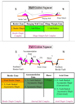
The Half-Graben segment is divided into two main salt domains: the Hinge
Margin Salt Complex and the Border Diapir Complex (Figures
2 and 3). The
former domain covers the hinge margin and the hanging wall of the Half-Graben,
while the Border Complex refers to connections with the southern border
fault. Salt Rollers Zone associated with young growth faults and
elongated Salt Pillow Zone on the hanging wall are distinguished;
Border Diapir Zone tilted by footwall uplift and a Normal
Fault-Controlled Diapir Zone surround the southern border fault.
The Border Diapir Complex is extended into the Full-Graben segment
along a border-parallel, internal full-graben. The deepest portion of
the main Full-Graben is occupied by an elongated diapir (Axial Diapir
Complex), which shows varying structural characters along strike. In the
middle, it is Reverse-Fault-Bounded in response to local
contractional effects in the overburden. Southwestward and
northeastward, the diapir becomes Normal-Fault-Flanked,
indicating local extensional stresses. Similar change in diapir
character was observed in the Border Complex. Tilted border diapirs
transform into normal- fault-bounded diapirs along Tertiary border-subparallel
faults. Accommodation or transfer zones among small-scale half-grabens
are marked by normal or strike-slip faults and are associated with
normal faulted Asymmetric, or non-faulted Symmetric
diapirs. Internal horsts are covered by flat salt features: Horst
Pillows (Figures 2 and
3).
The halokinetic history can be divided into two main stages:
Cretaceous passive growth and Paleogene reactive to active diapirism.
Seismic data provide evidence for early mobilization of salt after its
deposition in the Early Cretaceous. Salt pillows formed first under the
effect of differential loading and partly of local fault slip motion.
During the rest of the Cretaceous, the pillows slowly grew in a passive
way.
Diapiric growth was accelerated by the Paleogene tectonic activity.
Faults weakened and broke the overburden, producing pathways for the
moving salt. Additionally, fault tilting enhanced the differential
loading. Once the overburden thinned by erosion due to diapiric arching,
the salt broke its cover. Paleogene tectonics brought about
characteristically reactive diapiric processes with subsequent active
growth.
Beydoun, Z.R., 1964, The stratigraphy and structure of
the eastern Aden Protectorate. Overseas Geology and Mineral Resources
Supp. Ser., Bull. Supp. v. 5. HMSO, London
Beydoun, Z.R. and Greenwood, J.E.G.W., 1968, Aden
Protectoate and Dhufar, in Lexique Stratigraphique International,
Vol. III., Asie (L. Dubertret, ed.), CNRS, Paris, Fasc. 1062 p.
Beydoun, Z.R., Bamahmoud, M.O., and Nani, A.S.O., 1993,
The Qishn Formation, Yemen: lithofacies and hydrocarbon habitat: Marine
and Petroleum Geology, v. 10, p. 364-372.
Beydoun Z.R., As-Saruri, M., and Baraba, R.S., 1996,
Sedimentary basins of the Republic of Yemen: their structural evolution
and geological characteristics: Revue Institut Francais Petrole, v. 51,
p. 763-775.
Bott, W.F., Smith, B.A., Oakes, G., Sikander, A.H., and
Ibraham, A.I., 1992, The tectonic framework and regional hydrocarbon
prospectivity of the Gulf of Aden: Journal of Petroleum Geology, v. 15,
p. 211-243.
Csato, I., Habib, A., Kiss, K., Koncz, I., Kovács, Z., L•rincz.
K., and Milota, K., 2001, Play concepts of oil exploration in Yemen. Oil
and Gas Journal, v. 99.23, p. 68-74.
Davison, I., Al-Kadasi, M., Al-Khirbash, S., Al-Subbary,
A.K., Baker, J., Blakey, S., Bosence, D., Dart, C., Heaton, R., McClay,
K., Menzies, M., Nichols, G., Owen, G., and Yelland, A., 1994,
Geological evolution of the southeastern Red Sea rift margin, Republic
of Yemen: Geological Society of America Bulletin, v. 106, p. 1474-1493.
Ellis, A.C., Kerr, H.M., Cornwell, C.P., and Williams,
D.O., 1996, A tectonostratigraphic framework for Yemen and its
implications for hydrocarbon potential: Petroleum Geoscience, v. 2, p.
29-42.
Fantozzi, P.L., 1996, Transition from continental to
oceanic rifting in the Gulf of Aden: structural evidence from field
mapping in Somalia and Yemen: Tectonophysics, v. 259, p. 285-311.
Haitham, F.M.S., and Nani, A.S.O., 1990, The Gulf of Aden
Rift: hydrocarbon potential of the Arabian sector: Journal of Petroleum
Geology, v. 13, p. 211-220.
Huchon, P., Jestin, F., Cantagrel, J.M., Gaulier, J.M.,
Al Khirbash, S., and Gafaneh, A., 1991, Extensional deformations in
Yemen since Oligocene and the Africa-Arabia- Somalia triple junction:
Annales Tectonicae, v. 5, p. 141-163.
Hughes, G.W., and Clarke, M.W., 1988, Stratigraphy and
rock unit nomenclature in the oil-producing area of interior Oman:
Journal of Petroleum Geology, v. 11, p. 5-60.
Hughes, G.W., and Beydoun, Z.R., 1992, The Red Sea-Gulf
of Aden: biostratigraphy, lithostratigraphy and paleoenvironments:
Journal of Petroleum Geology, v. 15, p. 135-156.
Jackson, M.P.A., and Vendeville, B.C., 1994, Regional
extension as a geological trigger for diapirism: Geological Society of
America Bulletin, v. 106, p. 57-73.
Paul, S.K., 1990, People's Democratic Republic of Yemen:
a future oil province, in Brooks, J., ed., Classic Petroleum
Provinces. London, Special Publications of the Geological Society, v.
50, p. 329-339.
Powers, R.W., Ramirez, L.F., Redmond, C.D., and Elberg,
E.L., 1966, Sedimentary Geology of Saudy Arabia, in Geology of
the Arabian Peninsula: United States Geological Survey Professional
Paper 560-D.
Rowan, M.G., 1995, Structural styles and evolution of
allochthonous salt, central Louisiana outer shelf and upper slope, in
M.P.A. Jackson, D.G. Roberts, and S. Snelson, eds., Salt tectonics:
A global perspective: AAPG Memoir 65, p. 199-228.
Redfern, P., and Jones, J.A., 1995, The interior rifts of
the Yemen - analysis of basin structure and stratigraphy in a regional
plate tectonic context: Basin Research, v. 7, p. 337-356. tectonic context: Basin Research, v. 7, p. 337-356.
Schlumberger, 1992, Looking for Yemen's hidden treasure:
Schlumberger Technical Services Dubai, Middle East Well Eval. Rev., v.
12, p. 12-29.
Touché, F., Vidal, G., and Gratier, J.P., 1997, Finite
deformation and displacement fields on the southern Yemen margin using
satellite images, topographic data and a restoration method:
Tectonophysics, v. 281, p. 173-193.
Vendeville, B.C., and Jackson, M.P.A., 1992, The rise of
diapirs during thin-skinned extension: Marine and Petroleum Geology, v.
9, p. 331-353.
Return to top.
|

 Print this page
 Click
to article in PDF format.
Click
to article in PDF format.