
 Print this page
 Click to view posters in PDF format.
Recent Significant Gas Discoveries in China: Influence on National Energy Structure and Future Gas Exploration*
By
Chenxia Xie1
Search and Discovery Article #10067 (2004)
*Adapted from poster presentation at AAPG Annual Convention, Dallas, Texas, April 18-21, 2004.
1IHS Energy, Houston, Texas ([email protected])
Significant gas fields were discovered in China in
recent years, such as the Kela 2 gas field in the Tarim  Basin
Basin , Sulige gas field
in the Ordos Basin, Luojiazhai gas field in the Sichuan Basin, etc. These new
discoveries strengthen the gas supply to “West-Gas-To-East” gas trunkline.
Energy growth in China is expected to increase rapidly. As a clean-burning fuel,
natural gas is more welcome in energy-hungry China. The new gas discoveries plus
already existing important gas fields and the construction of gas pipeline
networks throughout the country, support the target of increasing gas percentage
from the current less than 3% to 5-8% in primary energy usage in the next ten
years.
, Sulige gas field
in the Ordos Basin, Luojiazhai gas field in the Sichuan Basin, etc. These new
discoveries strengthen the gas supply to “West-Gas-To-East” gas trunkline.
Energy growth in China is expected to increase rapidly. As a clean-burning fuel,
natural gas is more welcome in energy-hungry China. The new gas discoveries plus
already existing important gas fields and the construction of gas pipeline
networks throughout the country, support the target of increasing gas percentage
from the current less than 3% to 5-8% in primary energy usage in the next ten
years.
Most new gas fields have been discovered in the three
major gas-bearing basins: Tarim, Ordos, and Sichuan. New gas fields in each
basin have their own features. In the Sichuan Basin, new gas discoveries are
mainly made in the newly found Triassic oolitic limestone play in the
northeastern part of the basin; in the Ordos Basin, the distribution of the
Upper Paleozoic deltaic sandbodies controls the accumulation in the large Upper
Paleozoic gas field; while in the Tarim Basin, new gas discoveries are
concentrated in structure-dominated plays in the Kuche Depression. Since huge
resource potential exists in the surrounding areas of these new gas discoveries,
it is anticipated that more gas fields will be discovered in the areas with
similar tectonic features and sedimentary history.
|
|
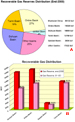
IntroductionFigures 1-2China has been growing more and more energy hungry. In 2003, China imported a record high 91 MMt crude oil, superseding Japan as the second oil importer after the United States. Energy growth in China is expected to increase rapidly. Currently coal continues its dominant role in primary energy usage in China, accounting for over 70%, oil being second, while natural gas accounts for only 2.5%, much lower than the world average level of 23%. In the most recent decade, numerous significant gas discoveries were found, and much effort has been made to build up the pipeline networks throughout the country. Gas supply districts are forming with dependence on gas-bearing basins, including Ordos, Tarim, Sichuan, and Qaidam onshore, and Yinggehai, Qiongdongnan, and East China Sea offshore. Gas reserves of the four onshore basins/districts (Figure 1) account for over 70% of China’s total (not including Taiwan) (Zhao et al, 2002) (Figure 2), and they are the subjects of discussion here. The most
recent decade is the most important stage for gas reserve growth in
China. The gas reserves discovered since 1990 occupy at least 55% of the
total in the four major onshore gas-producing basins, up to 93.5% in the
Tarim Figures 3-7
Large gas
fields are distributed in the Eastern Slope in the Ordos
Sichuan
Tarim
|



|
|
Figure 13. Structural contour map of Kela 2
gas field, Tarim |
|
|
Figure 14. Cross section of Kela 2 gas field, an anticline with reverse faults. |


Tarim Basin
is the largest continental basin in China, with an area of 560,000 km2.
Exploration has been quite active since middle 1980’s. Over 20 gas
discoveries have been made, especially the discovery of the Kela 2 gas
field (Figures 13 and
14), being the largest gas field of the
country at the time of its discovery and forming the foundation for the
construction of the trunk gas pipeline “West-Gas-To-East”. The gas
fields are mainly distributed in the Kuqa Depression and Tabei Uplift in
the northern part of the basin. Multiple source rocks and reservoirs
exist. Primary reservoirs exist in the Cretaceous-Paleogene sandstone
plays. By end-2000, the recoverable gas reserves of the Tarim Basin
reached 12,769 bcf, becoming the third largest gas-supply basin in China
after Ordos and Sichuan (Zhao et al., 2002, Xu and Shen, 1996; Qiu and
Gong, 1999; Jia, 2000.
Figures 15 and 16
|
|
Figure 15.
Structural contour map of Sebei gas fields, forming an anticlinal
trend, Qaidam |
|
|
Figure 16. Cross section along trend of Sebei gas fields, showing distribution of gas reservoirs. |


Qaidam is
the largest biogenic gas accumulation area of China, represented by
Sebei 1 and Sebei 2 fields (Figures 15 and
16). By end-2000, the recoverable gas
reserves of the basin were 2826 bcf. The biogenic gas fields are mainly
situated in the Sanhu Depression, accounting for 91.2% of the gas
reserves of the basin. The biogenic gas reservoirs are composed of the
Quaternary shaly sandstones deposited in shallow lacustrine environment.
Favorable traps are syndepositional anticlines. Main source rocks are
Upper Pliocene-Quaternary (Pleistocene) lacustrine dark mudstones and
carbonaceous mudstones. The Qaidam Basin supplies gas for Xining and
Lanzhou cities via the gas pipeline “Se (Sebei)-Ning (Xining)-Lan (Lanzhou)
(Zhao et al. 2002; Xu and Shen, 1996; Qui and Gong, 1999; Shurr and
Ridgley, 2002).
Before the
1990’s, natural gas was mainly used as fuel in the nearby areas around
gas fields. The discovery of the Jingbian gas field in the Ordos Basin
resulted in the construction of the gas trunkline “Shaan (Shaanxi)-Jing
(Beijing)”. As more and more gas fields were discovered, gas pipeline
networks were built. In the most recent decade, over 10,000 km of gas
pipelines have been constructed, including the eastern section of the
famous gas trunk “West-Gas-To-East.” Currently there are 3420 km of gas
pipelines under construction, including the western section of
“West-Gas-To-East.” Plans are to construct over 4,000 km of gas
pipelines to form a network in eastern China.
Is a natural gas era coming to China? The answer is “Yes.” Why?
1. China faces a larger and larger gap in the production and consumption of energy.
2. Rapidly growing gas reserves form the foundation for increasing gas usage.
3. Gas pipeline networks have been constructed to make it possible for increasing gas usage.
4. Increasing gas usage is favorable for environment protection.
It is believed that the above factors will spur the country’s gas exploration and production and vice versa.
The author is grateful to Keith Ina, Rick Luangkhot, and Tianguang Xu for their great help for illustration preparation, and to Richard Kyle for the text review. Partial data presented here are from IHS Energy’s field database. The author thanks IHS Energy for giving permission to publish it.
References
Jia, Chengzao, 2000, Recent Gas Exploration Progress in
Tarim Basin, China: AAPG Bulletin, v. 84, p. 1395-1518.
Kang, Zhulin, Chengde Fu, Shufen Cui, and Xianyi Yang, 2000, Introduction to Middle to Large Gas Fields in China: Petroleum Industry Press.
Liu, Qingsheng, Lungsang Chan, Qingsong Liu, et al.,
2004, Relationship between magnetic anomalies and hydrocarbon
microseepage above the Jingbian gas field, Ordos basin, China: AAPG
Bulletin, v. 88, p. 241-251.
Qi, Min, Hua Yang, and Jinhua Fu, 2001, Deep Basin Gas in
Ordos, in Deep Basin Gas Accumulation in Eerduosi Basin: Petroleum
Industry Press.
Qiu, Zhongjian, and Zaisheng Gong, 1999, Petroleum Exploration in China: Petroleum Industry Press.
Shurr, George W., and Jennie L. Ridgley, 2002, Unconventional Shallow Biogenic Gas Systems: AAPG Bulletin, v. 86, no. 11, p. 1929-1969.
Xu, Yongchang, and Ping Shen, 1996, A Study of Gas Origins in China: AAPG Bulletin, v. 80, no. 10, p. 1604-1614.
Zhao, Xianzheng, Jingming Li, Dongxu Li, Shuopeng Ma, et al., 2002, Rapidly Developing Ten Years of China Natural Gas Exploration: Petroleum Industry Press.
Zhou, Joe G., 1996, Evaluation of Sichuan Basin in China:
AAPG Bulletin, v. 80, p. 985-985
in China:
AAPG Bulletin, v. 80, p. 985-985