|
uAbstract
uIntroduction
uFigures
1.1-1.4
uPurpose
of presentation
uGlobal
considerations
uSummary
of two basins
uGeneral
Levalle  Basin Basin
uTakutu
Basin
uGeneral
Levalle Basin
uFigures
2.1-2.12
uGeneral
setting
uPaleogeography
& climate
uGeochemistry
uTakutu
Basin
uFigures
3.1-3.13
uGeneral
setting
uPaleogeography
& climate
uGeochemistry
uConclusions
uReferences
uAbstract
uIntroduction
uFigures
1.1-1.4
uPurpose
of presentation
uGlobal
considerations
uSummary
of two basins
uGeneral
Levalle Basin
uTakutu
Basin
uGeneral
Levalle Basin
uFigures
2.1-2.12
uGeneral
setting
uPaleogeography
& climate
uGeochemistry
uTakutu
Basin
uFigures
3.1-3.13
uGeneral
setting
uPaleogeography
& climate
uGeochemistry
uConclusions
uReferences
uAbstract
uIntroduction
uFigures
1.1-1.4
uPurpose
of presentation
uGlobal
considerations
uSummary
of two basins
uGeneral
Levalle Basin
uTakutu
Basin
uGeneral
Levalle Basin
uFigures
2.1-2.12
uGeneral
setting
uPaleogeography
& climate
uGeochemistry
uTakutu
Basin
uFigures
3.1-3.13
uGeneral
setting
uPaleogeography
& climate
uGeochemistry
uConclusions
uReferences
uAbstract
uIntroduction
uFigures
1.1-1.4
uPurpose
of presentation
uGlobal
considerations
uSummary
of two basins
uGeneral
Levalle Basin
uTakutu
Basin
uGeneral
Levalle Basin
uFigures
2.1-2.12
uGeneral
setting
uPaleogeography
& climate
uGeochemistry
uTakutu
Basin
uFigures
3.1-3.13
uGeneral
setting
uPaleogeography
& climate
uGeochemistry
uConclusions
uReferences
uAbstract
uIntroduction
uFigures
1.1-1.4
uPurpose
of presentation
uGlobal
considerations
uSummary
of two basins
uGeneral
Levalle Basin
uTakutu
Basin
uGeneral
Levalle Basin
uFigures
2.1-2.12
uGeneral
setting
uPaleogeography
& climate
uGeochemistry
uTakutu
Basin
uFigures
3.1-3.13
uGeneral
setting
uPaleogeography
& climate
uGeochemistry
uConclusions
uReferences
uAbstract
uIntroduction
uFigures
1.1-1.4
uPurpose
of presentation
uGlobal
considerations
uSummary
of two basins
uGeneral
Levalle Basin
uTakutu
Basin
uGeneral
Levalle Basin
uFigures
2.1-2.12
uGeneral
setting
uPaleogeography
& climate
uGeochemistry
uTakutu
Basin
uFigures
3.1-3.13
uGeneral
setting
uPaleogeography
& climate
uGeochemistry
uConclusions
uReferences
uAbstract
uIntroduction
uFigures
1.1-1.4
uPurpose
of presentation
uGlobal
considerations
uSummary
of two basins
uGeneral
Levalle Basin
uTakutu
Basin
uGeneral
Levalle Basin
uFigures
2.1-2.12
uGeneral
setting
uPaleogeography
& climate
uGeochemistry
uTakutu
Basin
uFigures
3.1-3.13
uGeneral
setting
uPaleogeography
& climate
uGeochemistry
uConclusions
uReferences
uAbstract
uIntroduction
uFigures
1.1-1.4
uPurpose
of presentation
uGlobal
considerations
uSummary
of two basins
uGeneral
Levalle Basin
uTakutu
Basin
uGeneral
Levalle Basin
uFigures
2.1-2.12
uGeneral
setting
uPaleogeography
& climate
uGeochemistry
uTakutu
Basin
uFigures
3.1-3.13
uGeneral
setting
uPaleogeography
& climate
uGeochemistry
uConclusions
uReferences
|
Figure Captions (1.1-1.4)
Return to top.
-
Review depositional
environments and source rock characteristics of two
geologically-similar South American Mesozoic rift basins that formed
at differentpaleolatitudes under different climates.
-
Compare tropical vs
temperate settings.
-
Goal: Increase awareness of
source risk associated with exploration for lacustrine-sourced basins.
-
Most South American and
African Atlantic margin petroleum plays are sourced by Lower
Cretaceous lacustrine source rock.
-
Most organic-rich
lacustrine source rocks were deposited in tropical to sub-tropical
settings.
-
Annual lake turnover
associated with the freeze/thaw cycle tends to limit preservation of
organic material in lake bottom sediment.
The depositional
model for a restricted lacustrine basin is shown in
Figure 1.1. This
representation is for the General Levalle basin of Argentina.
The locations of
the General Levalle Basin in Argentina and the Takutu Basin in
Guyana/Brazil are given in Figure 1.2. Major features of each are
summarized below.
-
Type- Intracratonic rift
basin
-
Age- Early Cretaceous
-
Paleolatitude- 45°South
-
Size- 150 km long, 5-50 km
wide, and over 6.5 km deep
-
Area- >5000 sq.km.
-
Sedimentary Fill- Early
coarse siliciclastic fill fines upward to an evaporite phase, then
coarsens upward again into siltstones and sandstone, capped by basalt
flows.
-
Structural reactivation-
none.
-
Type- Intracratonic rift
basin
-
Age- Early Jurassic to
Early Cretaceous
-
Paleolatitude- 2°North
-
Size- 280 km long, 40 km
wide, and over 7 km deep
-
Area- >11,200 sq. km.
-
Sedimentary Fill- Early
basaltic phase followed by lacustrine and basin margin clastics, an
evaporite phase, and final siliciclastic fill.
-
Structural reactivation:
Miocene.
Figure Captions (2.1-2.12)
|
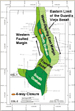 |
Figure 2.1. Basin outline map, General
Levalle Basin, with major structural elements on seismic base map. |
|
 |
Figure 2.2. Stratigraphic section, Hunt
Cd. GL x-1, General Levalle Basin, Argentina. Note poor relationship
of reservoir to seal and source. |
|
 |
Figure 2.3.
East-West seismic line 91-08 and cross-section, showing local
structure as well as general configuration of the basin.
|
|
 |
Figure 2.4.
Time structure map of prospect, on orange reflector (lower
gypsiferous siltstone, General Levalle Formation). |
|
 |
Figure 2.5.
Seismic line ARH-91-32 across General Levalle structure. |
|
 |
Figure 2.6.
Late Cretaceous paleogeography (94 Ma). (Image
from Christopher Scotese, The Paleomap Project,
http://www.scotese.com/cretaceo.htm,
and presented here with the
kind permission of Dr. Scotese.) |
|
 |
Figure 2.7. Early Cretaceous
paleogeography--125-115 Ma (above) and 130 Ma (below). (Image
from Ron Blakey, Northern Arizona University,
http://jan.ucc.nau.edu/~rcb7/Cret.jpg,
and presented here with
the kind permission of Dr. Blakey.) |
|
 |
Figure 2.8. Global reconstruction to show
Berriasian (Early Cretaceous [140 Ma]) paleogeography, showing General Levalle Basin at 45o
latitude. (Image from Robertson
Research, Phanerozoic Paleogeographic Reconstructions and Major
Source Rocks of the World, and presented here with the kind
permission of Robertson Research.) |
|
 |
Figure 2.9.
Early Cretaceous climate, with temperature indicators presented on a
global paleogeographic map, along with plot of temperature through
geologic time (Images from
Christopher Scotese, The Paleomap Project,
http://www.scotese.com/ecretcli.htm,
and presented with kind
permission of Dr. Scotese.) |
|
 |
Figure 2.10. Source and maturity data from
Hunt Cd. GL x-1 well. |
|
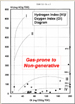 |
Figure 2.11. Van Krevelen diagram, showing
kerogen to be Type III/IV in Hunt Cd. GL x-1 well. |
|
 |
Figure 2.12. Cross-section along seismic line 91-8, showing location
of Hunt Cd. GL x-1 and the stratigraphic section it penetrated (part
of Figure 2.3).
|
Geologic Setting (Figures 2.1-2.5)
The
General Levalle Basin forms a long, narrow, and deep Lower Cretaceous
intracratonic rift in southern Cordoba province, Argentina. As a buried
Lower Cretaceous rift, it trends approximately north-south for over 150
km, ranges from 5 to 50 km in width, and is over 6500 m deep (Figure
2.1). Below a prominent mid-Cretaceous unconformity, steeply dipping
normal faults bound tilted graben and half-graben fault blocks (Figure
2.3).
The lower rift-fill section, the General
Levalle Formation (Figure 2.2), is a Valanginian-Hauterivian-aged
clastic-evaporite package, over 3200 m thick. It was deposited in an
arid, restricted, rift basin that included a hydrologically-closed
saline lake. Nine lithology-based members represent one
continuous cycle of deposition, with a lower coarse clastic sequence
gradually fining upward into an evaporite member and then coarsening
upward again into an upper sandstone. The uppermost rift fill sequence,
the Guardia Vieja Formation, is a series of Aptian basalt flows and
sills over 800 m thick with some clastic interbeds. Unstructured
Pleistocene to Upper Cretaceous strata overlie the buried rift basin.
In 1995-96, the first exploratory well in the
basin (Figures 2.4 and
2.5) tested a deep-seated anticline to 5179 m but
encountered just one minor show. Reservoir-quality sandstone occurs only
in the upper rift sandstone member, but this lacked adequate seals.
Basin-center dark shale below the evaporite member was thin,
surprisingly low in TOC, and overmature. Given the narrow, deep
depocenter, unfavorable reservoir-seal relationships, and the lack of
source facies, an effective petroleum system remains unproven in the
basin.
Paleogeography and Climate: Different Perspectives
Late Cretaceous paleogeography, portrayed by Christopher Scotese (Figure
2.6) shows the extent of the Tethys Ocean and the expanding Atlantic
Ocean. Interpretations of Early Cretaceous paleogeography are shown in
Figure 2.7, from Ron Blakey, and in
Figure 2.8, from Robertson Research. They
both show General Levalle Basin to be intracontinental.
Mild “ice
house” conditions existed in southern Gondwana in the Early Cretaceous,
probably with snow and ice during the winter season, as shown in
Figure
2.9, from Christopher Scotese.
Analysis of data and tests from Hunt Cd. GL x-1 well indicate that the
petroleum system in General Levalle Basin is poor. A summary of the
results is given in Figures 2.10 and
2.11, and the drilling results are
illustrated in Figure 2.12. The drilling
results of Hunt Cd. GL x-1 are listed below:
·
Lower Cretacous (Neocomian) rift fill.
·
Poor source rock found: Lean Type III/IV.
·
Lower rift shales overmature for oil.
·
Only 1 minor oil show.
·
Good evaporite seal in middle rift section.
·
Reservoirs below seal tightly cemented.
Takutu Basin, Guyana and
Brazil
Figure Captions (3.1-3.13)
|
 |
Figure 3.1 Major basin elements and leads, Takutu Basin, Guyana. |
|
 |
Figure 3.2 Stratigraphic column of Takutu Basin, graphically showing
reservoir, source, and seal potentials of the various units. |
|
 |
Figure 3.3. Structural cross-section, Takutu Basin, along with
elements of the petroleum system (from Crawford et al., 1985).
Reservoirs: fractured basalt and alluvial sands(?); seals: Pirara
salt and mudstone; source: Manari and Pirara formations. |
|
 |
Figure 3.4. Time structure map, on Apoteri Basalt, Takutu Basin. |
|
 |
Figure 3.5. Seismic line 79-7, along
Savannah Arch, showing two prospects. |
|
 |
Figure 3.6. Early Jurassic paleogeography
(195 Ma), showing location of Takutu Basin within the continent and
paleolatitude of 2oN. (Image
from Christopher Scotese, The Paleomap Project,
http://www.scotese.com/jurassic.htm,
and presented here with the
kind permission of Dr. Scotese.) |
|
 |
Figure 3.7.
Early Jurassic paleogeography, with
location of Takutu Basin, 205-195 Ma (above) and 200 Ma (below). (Images
from Ron Blakey, Northern Arizona University,
http://jan.ucc.nau.edu/~rcb7/Jur.jpg,
and presented here with
kind permission of Dr. Blakey.) |
|
 |
Figure 3.8. Early Jurassic (Toarcian—109
Ma) paleogeography, showing location of Takutu Basin. (Image from
Robertson Research, Phanerozoic
Paleogeographic Reconstructions and Major
Source Rocks of the World, and presented with kind permission of
Robertson Research.) |
|
 |
Figure 3.9. Early Jurassic climate,
with temperature indicators
presented on a global paleogeographic map, along with plot of
temperature through geologic time. (Images
from Christopher Scotese, The Paleomap Project,
http://www.scotese.com/ejurclim.htm,
and presented here with
kind permission of Dr. Scotese. |
|
 |
Figure 3.10. Plot of TOC (%) vs. depth of data from 4 wells in
Takutu Basin. |
|
 |
Figure 3.11. Van Krevelen diagram for
data from 4 wells in Takutu Basin. |
|
 |
Figure 3.12. Maturation profiles (vitrinite
reflectance vs. depth) for 4 wells in Takutu Basin. There are two
apparent trends in Turantsink 1. |
|
 |
Figure 3.13. Seismic line 91-20, showing
position of Turantsink 1, with post-drill interpretation. |
The Takutu basin is an ENE-trending
Jurassic-Early Cretaceous continental (lacustrine) rift basin, about 40
km wide and 280 km long, that cuts the Guyana shield in southwest Guyana
and northern Brazil (Figure 3.1). Prior exploration documented a stratigraphic section dominated by mudstone but including Jurassic
lacustrine source shale, siltstone, evaporites, and basalt (Figure 3.2).
Numerous anticlinal and tilted fault block structures, including a
noncommercial oil discovery (Figure 3.3), suggested an attractive
exploration play existed.
In late 1988
Hunt Oil Co. began operations in the basin. A three-year exploration
program included field geology, photogeologic mapping, several methods
of surface geochemical prospecting, reprocessing, and acquisition of SAR,
aeromagnetics, and 1331 km of new seismic. Exploration efforts
ultimately focused on the large basin-center Savannah Arch(Figures 3.3,
3.4, and 3.5). An anticline near the south end, where the exploration
well, Turantsink 1 (Figure 3.5), was drilled, was interpreted as a drape
feature above a thick lacustrine-fan-delta complex. However, the deep
structure proved rooted in a thickened salt section near the Jurassic
basin paleocenter.
Minor oil shows
were observed at several horizons, but the predicted sandstone
reservoirs are not present. This part of the basin had been affected by
a Tertiary hydrothermal event that drove the thick source shales into
overmaturity and destroyed porosity in all potential reservoir units.
This event plus unfortunate timing of Late Tertiary (Miocene) structural
reactivation severely downgrade the petroleum potential of the basin.
Early Jurassic
paleogeography, portrayed by Christopher Scotese (Figure 3.6), shows the
location of Takutu Basin. Interpretations of Early Jurassic
paleogeography are shown in Figure 3.7, from Ron Blakey, and in
Figure
3.8, from Robertson Research. These maps all show Takutu Basin to be
intracontinental. The climate in the interior of Pangea, including the
Takutu Basin area, was very hot and arid during source-rock deposition
in Early to Mid Jurassic time (Figure 3.9).
Source-Bed Geochemistry
Reduced TOC
levels in two Takutu Basin wells (Turantsink 1 and Lethem 1) are due, at
least in part, to over-maturation (gas window) of lacustrine shale
source rocks of the Pirara and Manari formations (Figure 3.10). Type
I/II kerogen is evident in early mature to mature Karanambo and Lethem
samples (Figure 3.11). Low HI numbers inTurantsink 1 are due to
overmaturity of the source interval. Overmaturity (Figure 3.12) and
degradation of rich oil-prone lacustrine shale was caused by intense
Miocene hydrothermal activity along south graben boundary faults.
The post-drill
interpretation, based on the Turantsink 1 (Figure 3.13), is that the
petroleum system was destroyed; this is based on the following:
-
Porosity destroyed by
cementation/mineralization.
-
Intense hydrothermal
activity along south fault.
-
Source very overmature.
-
No live oil or gas shows,
trace residual oil.
-
Takutu basin formed in the
Jurassic, related to opening of the southern North Atlantic Ocean.
-
General Levalle basin formed later, in the Early Cretaceous, related to opening of the
southern South Atlantic Ocean.
formed later, in the Early Cretaceous, related to opening of the
southern South Atlantic Ocean.
-
Both basins were
continental-interior rifts, cut-off from the sea, but with long-lived
hypersaline lakes and similar sedimentary fill.
-
Takutu sedimentation took
place in a tropical paleolatitude at a time of global “hothouse”
conditions.
-
Stable tropical climate
minimized lake turnover and promoted anoxic lake bottom conditions.
Oil-prone source rock, containing algal/ amorphous kerogen, was
deposited and preserved.
-
General Levalle
sedimentation took place at a temperate paleolatitude during mild
global “icehouse” conditions.
-
Seasonal lake turnover
apparently prevented accumulation and preservation of rich source rock
facies.
-
Only lean Type III/IV
kerogen was deposited and preserved, with little petroleum potential.
Blakey, Ron, 2004, Paleogeography
through Geologic Time (http://jan.ucc.nau.edu/~rcb7/global_history.html):
Northern Arizona University.
Crawford, F.D., C.E. Szelewski,
and G.D. Alvey, 1985, Geology and exploration in the Takutu graben of
Guyana and Brazil: Journal Petroleum Geology, v. 8, p. 5-36.
Robertson Research, Phanerozoic Paleogeographic Reconstructions and
Major Source Rocks of the World.
Scotese,
Christopher, 2004, The Paleomap Project (http://www.scotese.com).
Return to top.
|

 Print this page
 Click
to view poster presentation in PDF format.
Click
to view poster presentation in PDF format.


