Print this page
 Click to view article in PDF format.
Upper Ordovician Montoya Sequence Stratigraphy and Chert Porosity in Southeastern Delaware Basin*
By
David M. Thomas, III1 And Huaibo Liu1
Search and Discovery Article #30023 (2004)
*Adapted from “extended abstract” for presentation at the AAPG Annual Meeting, Salt Lake City, Utah, May 11-14, 2003.
1Tom Brown, Inc., Midland, TX ([email protected])
Stratigraphic Framework
The Upper
Ordovician (Cincinnatian) Montoya Group, of the southeastern Delaware Basin, was
deposited approximately 450 Ma on a carbonate ramp in a shallow marine
environment as a 2nd-order sequence. It is bounded by the unconformable Lower
Silurian Fusselman Formation above and Middle Ordovician Simpson Group below.
There are four formations; ( Cable
Cable Canyon, Upham, Aleman, and Cutter) described
in outcrop and correlated to the subsurface in the Delaware Basin. These
formations consist of four unconformity-bounded 3rd-order sequences in the study
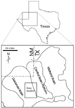
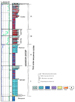
area (Figures 1 and 2). Sequence I, which include both the Cable Canyon and Upham Formations, is composed of lowstand systems tract (LST) siliciclastics and
carbonates, transgressive systems tract (TST) limestone/chert and a highstand
systems tract (HST) limestone. Sequence II contains the Lower Aleman Formation,
which is a TST limestone/chert and HST limestone. Sequence III is the Upper
Aleman Formation and includes a TST limestone/chert and HST limestone. Sequence
IV is the Cutter TST limestone/chert and HST carbonate (Figure 2). The LST and
the HST are essentially chert-free and might have trace amounts (less than 1
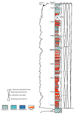
percent) of silicified skeletons. The chert-bearing facies occurs in the TSTs
and contains 20 to 60 percent chert by the rock volume (Figures 2 and
3).
Canyon, Upham, Aleman, and Cutter) described
in outcrop and correlated to the subsurface in the Delaware Basin. These
formations consist of four unconformity-bounded 3rd-order sequences in the study
area (Figures 1 and 2). Sequence I, which include both the Cable Canyon and Upham Formations, is composed of lowstand systems tract (LST) siliciclastics and
carbonates, transgressive systems tract (TST) limestone/chert and a highstand
systems tract (HST) limestone. Sequence II contains the Lower Aleman Formation,
which is a TST limestone/chert and HST limestone. Sequence III is the Upper
Aleman Formation and includes a TST limestone/chert and HST limestone. Sequence
IV is the Cutter TST limestone/chert and HST carbonate (Figure 2). The LST and
the HST are essentially chert-free and might have trace amounts (less than 1
percent) of silicified skeletons. The chert-bearing facies occurs in the TSTs
and contains 20 to 60 percent chert by the rock volume (Figures 2 and
3).
|
|
FaciesChert-Free FaciesThe chert-free
facies includes three main lithologies: 1) sandstone and sandy skeletal
packstone, 2) fine-to very coarse-grained skeletal packstone, and 3)
fine- to very coarse-grained skeletal grainstone. The sandstone and
sandy packstone of the
Chert-Bearing FaciesThe chert-bearing facies consist of host limestone and chert nodules, bands, and layers. The three primary lithologies are: 1) fine-grained skeletal grainstone (Figure 5 B), 2) fine-grained echinoderm packstone (Figure 5 C) and 3) lime wacke/mudstone; all are significant TST components. The wacke/mudstone found in the TSTs of the Upham, Lower Aleman, and Lower Cutter are dark in color and contain very fine spicules and spiculitic chert, representing deeper water, lower energy (deep-ramp) deposition with maximum water depth during the 3rd-order sequence sea-level rise (Figures 2 and 3). The fine-grained skeletal grainstones and packstones deposited in the upper Aleman are characterized by an even lighter color and well-sorted skeletons (dominantly echinoderms and ostracods). This is interpreted to be a medium-energy bank deposit capping a TST high-frequency sequence (Figure 6). The remnant structures in the chert coincide with that of the surrounding host rock. The Upper Aleman’s lithological vertical assemblage and lateral distribution is interpreted as a shallow-marine skeletal bank deposited on a gentle ramp developed toward the south. The HST coarser grained skeletal grainstone capping each cycle could have been partially exposed to the northeast (Figure 4).
Gas ReservoirsThree gas-reservoir intervals, Cutter, Aleman and Upham, have been drilled and reportedly developed. The reservoir porosity in the Cutter Formation in the northern portion of the study area occurs primarily in the dolomite that developed within the HST skeletal grainstone with some minor contribution from porous and fractured chert. The Upham reservoir tested in the southern part of the study area included porosity at the top of the HST grainstone and fractures in the transgressive chert. The upper Aleman is the primary Montoya pay and contains a number of high-frequency sequences and high-frequency sequence sets of TST chert-bearing and HST chert-free limestones (Figures 2 and 6). The reservoir porosity is predominantly from the chert. Reduced interparticle (Figure 5 D), moldic (Figure 5 E), small pore and micro (Figure 5 F) porosities in the chert with some minor porosity developed in the dolostone and limestone provide the primary gas reservoir.
Sedimentary History and Porosity DevelopmentDuring
deposition of the Montoya, a vast deep siliceous ocean covered the area
to the south. The movement of the silica-bearing upwelling water from
south to north along the sea floor resulted in early silicification that
was influenced by the environments of deposition, relative sea level,
and sedimentary facies. The development of the chert and chert porosity
was a direct result of the reaction rates and products of interstitial
water and sediments. The LST sandstone and packstone of the Three stages of silica diagenesis controlled the porosity evolution. The first stage was dissolution of metastable matrix and skeletal fragments as the siliceous, low-pH, upwelling water began to replace the primary interstitial water. The dissolution of this stage enlarged interparticle pore spaces and created moldic porosity. The second stage is silica precipitation on the pore walls to form a silica rim that partially replaced the metastable grains, such as echinoderms, ostracods, brachiopods, and bryozoans resulting in the main porous reservoir chert in the Aleman. The third stage was continuous silica precipitation and replacement that completely filled the porosity and replaced the calcite, forming a non-porous chert. The subsequent HST limestone deposition restricted further silicification and protected the porosity from further chert precipitation. In some areas the silicification was physically restricted in the second stage, resulting in reduced interparticle porosity. Elsewhere the chertification was almost completely prevented between stage 2 and stage 3, forming a small pore system. |