Print this page
 Click to view article as PDF
GCWhat Is Deconvolution?*
By
Robert E. Sheriff1
Search and Discovery Article #40132 (2004)
*Adapted from the Geophysical Corner column in AAPG Explorer, April, 2004, entitled “A Demystifying of Deconvolution” and prepared by the author. Appreciation is expressed to the author, to Alistar R. Brown, editor of Geophysical Corner, and to Larry Nation, AAPG Communications Director, for their support of this online version.
1Professor, University of Houston ([email protected])
General Statement
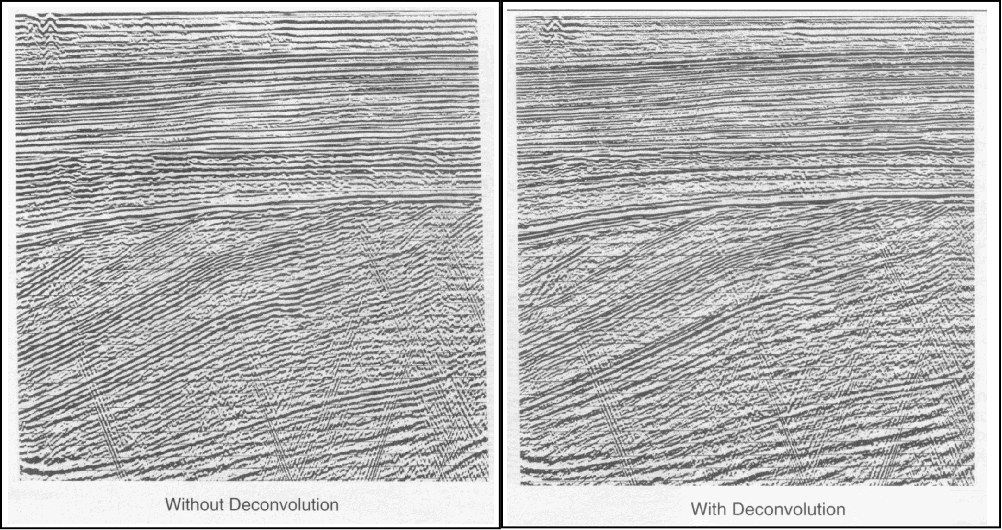
Deconvolution is a process universally applied to seismic data, but is one that is mysterious to many geoscientists. Deconvolution compresses the basic wavelet in the recorded seismogram and attenuates reverberations and short-period multiples. Hence, it increases resolution and yields a more interpretable seismic section.
Note the
differences in the Figure 1. The quality of modern seismic data owes a great
deal to the success of deconvolution. Seismic processing often involves several
stages of deconvolution, each of a  different
 type and with a different
objective.
type and with a different
objective.
Deconvolution usually involves convolution with an inverse filter. The idea is that this will undo the effects of a previous filter, such as the earth or the recording system. The difficulty in designing an inverse filter is that we hardly ever know the properties of the filter whose effects we are trying to remove.
|
uGeneral statementuFigure caption
u
|
Deterministic deconvolution
can be used to remove the effects of the recording system, if the system
In the case of the earth, the previous filtering that was applied is not known, and thus the deconvolution takes on a statistical nature. In this situation the needed information comes from an autocorrelation of the seismic trace. Because the embedded wavelet from the source is repeated at each reflecting interface, this repetition is captured by the autocorrelation and used to design the inverse filter.
The
embedded wavelet ordinarily dominates the early part of an
autocorrelation, whereas multiples dominate the later part. Hence
Autocorrelations may be calculated over several time windows in an attempt to allow for changes in the shape of the embedded wavelet as it travels through the earth. This is called adaptive deconvolution.
Spiking
deconvolution
shortens the embedded wavelet and attempts to make it as close as
possible to a spike. The frequency bandwidth of the data limits the
extent to which this is possible. This is also called whitening
deconvolution, because it attempts to achieve a flat, or white,
spectrum. This kind of deconvolution may result in increased
Predictive
deconvolution
uses the
later portions of the autocorrelation to remove the effects of some
multiples. Predictability means that the arrival of an event can be
predicted from knowledge of earlier Sparse-spike deconvolution attempts to minimize the number of reflections, thus emphasizing large amplitudes. |