|
u Setting Setting
uFigure
captions
uPaleocene
& Eocene deposits
uAndrew-Forties
deposits
uCromarty
sandstones
uConclusion
uSetting
uFigure
captions
uPaleocene
& Eocene deposits
uAndrew-Forties
deposits
uCromarty
sandstones
uConclusion
uSetting
uFigure
captions
uPaleocene
& Eocene deposits
uAndrew-Forties
deposits
uCromarty
sandstones
uConclusion
uSetting
uFigure
captions
uPaleocene
& Eocene deposits
uAndrew-Forties
deposits
uCromarty
sandstones
uConclusion
uSetting
uFigure
captions
uPaleocene
& Eocene deposits
uAndrew-Forties
deposits
uCromarty
sandstones
uConclusion
|
Figure Captions
|
 |
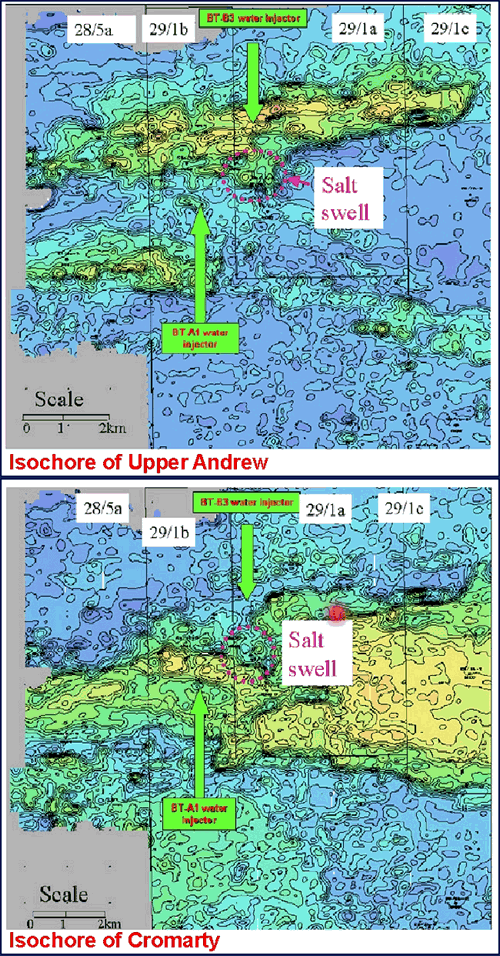
Figure 1. Isochores of the seismic lobes,
Bittern Field area.
|
|
 |
Figure 2. Line 648 south-to-north-to-west of
Bittern Field, showing two Andrew-Forties channel complexes and the
topographically infilling Cromarty sands between (yellow outline).
|
|
 |
Figure 3. Base Cromarty sand to top Mid-Andrew
isochore. Halokinesis immediately east of current Bittern
Field caused bifurcation of easterly flowing Andrew deposition
system. By Late Paleocene time, two distinct Forties-Andrew channel
complexes were active across Blocks 28/5 and 29/1.
|
|
 |
Figure 4. Top Cromarty to base Cromarty sand
isochore. Cromarty isochore suggests a funnel-shaped
channel system. However, the underlying topographic highs to the
north and south were really the controlling factors, confining most
of Cromarty deposition in a channel-form outline.
Click to view sequence of isochore of upper
Andrew (Figure 3) and of Cromarty (Figure 4).
|
|
 |
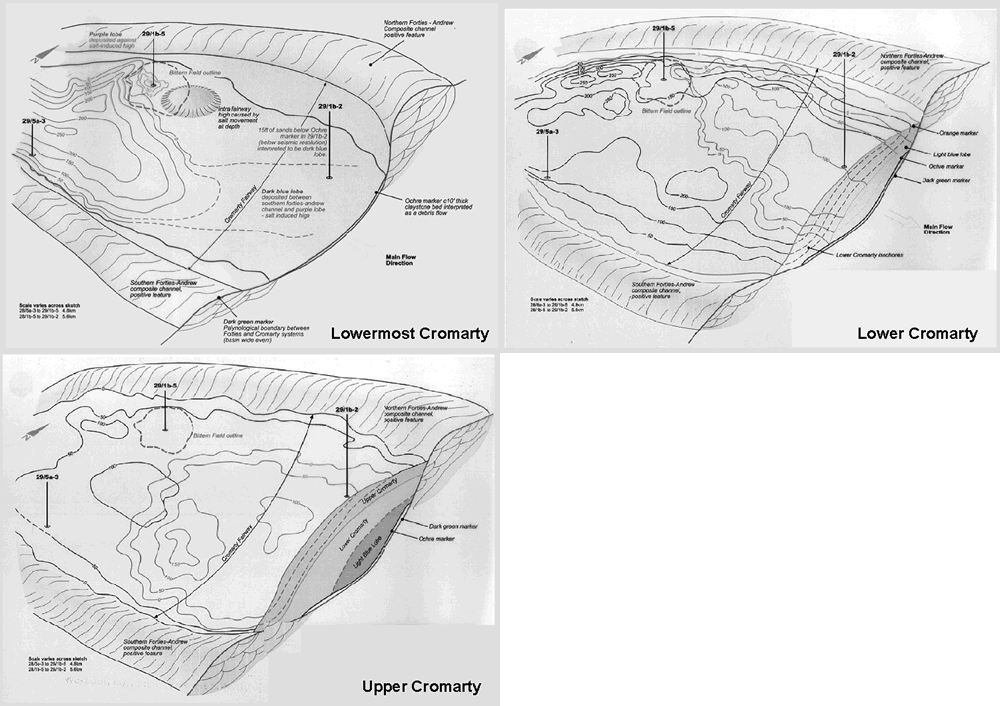
Figure 5. Sketch of Lowermost Cromarty
depositional model. Lowermost Cromarty deposition ends with blanket
of Ochre Marker debris flow. Isochore in 50-foot contours.
|
|
 |
Figure 6. Sketch of Lower Cromarty depositional
model. Light Blue: Lobe deposited to east of Bittern Field,
laterally offset from Purple and Dark Blue lobes.
There was less
influence of a salt high than during deposition of Lowermost
Cromarty. Following deposition of Light Blue Lobe, remaining part of
Lower Cromarty was deposited between Andrew-Forties features.
|
|
 |
Figure 7. Sketch of Upper Cromarty depositional
model. Upper Cromarty deposition is interpreted to have been
sheet-like, c 80 feet thick within Bittern Field area.
Red Lobe was
deposited to the southeast of Bittern, having by-passed the field
area. Majority of Upper Cromarty in 29/1b-2 is younger than that
seen at Bittern. Isochore in 50-foot contours.
Click to view sequence of Cromarty depositional
models (Figures 5, 6, and 7).
|
Return to top.
Paleocene and Eocene
Deposits
The story of the Tertiary deposition in the Bittern Field area has been
constructed by integrating 3D seismic, wireline log (conventional log
correlations and formation image data), core, cuttings, and
biostratigraphic information. The subdivision of the Cromarty sandstones
is based on detailed biostratigraphic (mostly palynology)
investigations. A major constraint on the Bittern geological
interpretation is the presence of a gas chimney between 3000 and
5500feet TVSS in the claystones overlying the reservoir. The gas chimney
extends over most of the Bittern field area, but a geological model has
been constructed based on seismically defined lobes (Figure1).
Halokinesis beneath the Chalk Group near the center of block 29/1 during
Paleocene times is interpreted to have divided an easterly flowing
Forties-Andrew system into two; a northern and a southern branch.
Andrew-Forties Deposits
The Andrew sandstones have acted initially as erosive events,
downcutting as deep as the top of the Chalk Group (Figure 2). There was
subsequently a more extensive Middle Andrew sand depositional event.
This now provides an excellent seismic reflector, as it reworked chalk
material that has been diagenetically altered such that the ‘‘Middle
Andrew’’ sandstones are pervasively cemented and have little in the way
of reservoir character. During later Paleocene, the main Forties
deposition was farther northeast in the Central North Sea, but
subsidiary Forties systems continued to use the older Andrew channels
and, by end Paleocene, had mostly back-filled these earlier channel
systems. Forties deposition within the Bittern Field area is interpreted
as mostly overbank and crevasse-splay type deposits. The Forties-Andrew
channel systems were positive topographic features at end Paleocene time
and acted as constraining features into which the earliest Eocene
Cromarty deposits were deposited. The end Paleocene event was marked
biostratigraphically by a major floral change, and this is a regional
event in the Central North Sea, here annotated as the Dark Green
Marker.
The Andrew-Forties isochore map (Figure 3) shows the positions of the
two channel complexes, and the Cromarty isochore (Figure 4) shows the
‘‘infill’’ between these two positive features.
Cromarty Sandstones
The Cromarty sandstones are subdivided based on thin,
biostratigraphically constrained, correlatable claystone beds that are
interpreted as debris flows. The three main sands are referred to as
Lowermost (Figure 5), Lower (Figure 6) and Upper Cromarty (Figure 7),
and the intra-Cromarty claystones are the Ochre Marker (between
Lowermost and Lower) and the Orange Marker (between the Lower and the
Upper Cromarty). These two claystones are correlatable field-wide events
and the Ochre can be correlated to wells 5km southwest and east of the
field. The sandstones are fine-grained, subarkosic quartz arenites; they
show a high net:gross ratio, average being some 90%. The Upper and
Lowermost sands have average porosities of about 34%; the Lower Cromarty
sands have average porosities of 32% in the discovery well, there being
a slight increase in siderite cement in the Lower compared to the other
two sands.
The earliest Cromarty sand deposits were within the field area, and they
constitute a relatively restricted lobate deposit, referred informally
as the Purple Lobe of the Lowermost Cromarty. This event was most likely
deposited as a splay from the northern channel complex; it appears to
have been limited to the east by a salt-induced high. A second, slightly
younger event, the Dark Blue Lobe, was deposited to the south and south
east of Bittern Field, having been mostly constrained by the southern
Forties-Andrew complex. Both of these events, which constitute the
Lowermost Cromarty, are capped by the Ochre Marker, which has been
identified in the Bittern Field and also the outfield 29/1b-2 and
28/5a-3 wells. The Ochre Marker appears in core to be a slumped and
contorted mix of dark gray, silty claystones interbedded with well
cemented very fine sandstones.
The Lower Cromarty began with the deposition of the Light Blue Lobe,
which by-passed the Bittern Field, except for the extreme northeastern
part, and was deposited to the east. This was then overlain by the rest
of the Lower Cromarty sands, which were deposited as more extensive
deposits, filling in more of the ‘‘channel-form’’ fairway between the
northern and southern Forties-Andrew channels. These sands were then
capped by a second field-wide debris flow, the Orange Marker. The
effects of any salt movement during deposition of the Lower Cromarty
appears to be considerably less than that during deposition of Lowermost
Cromarty, as the Lower Cromarty sands isochore is more uniform, thinning
onto the northern margin.
The Upper Cromarty sands were deposited as more sheet-like events, for
there is even less evidence in the cores for cross-bedding and/or graded
bedding. The isochore of the Upper Cromarty in the Bittern field is
uniform, approximately 85feet TV. The final deposit of Cromarty sands
was the Red lobe. This event was deposited to the southeast of the field
and is constrained by the 29/1b-2 well. From here, an ‘‘uplapping’’
event on the seismic pinches out before the Bittern field is reached.
The whole area was then blanketed in Sele claystones, before the
regional Balder volcanic event occurred. is reached.
The whole area was then blanketed in Sele claystones, before the
regional Balder volcanic event occurred.
Conclusion
Upon a
quick inspection of the Cromarty sand isochore map in Block 29/1, it may
be concluded that these sands were channelized. However, the interplay
between salt movement at depth and the topographically positive
Andrew-Forties channel complexes resulted in an east-west trending
channel-form topographic low which acted as a receptacle for these Early
Eocene deposits.
Return to top.
|

 Print this page
 Click to view article in PDF format.