|
uGeneral
statement
uFigure
captions
u Paleogeography Paleogeography
uTriassic-Jurassic
uEarly
Cretaceous
uMiddle
Eocene
uOligocene-Recent
uConclusion
uGeneral
statement
uFigure
captions
uPaleogeography
uTriassic-Jurassic
uEarly
Cretaceous
uMiddle
Eocene
uOligocene-Recent
uConclusion
uGeneral
statement
uFigure
captions
uPaleogeography
uTriassic-Jurassic
uEarly
Cretaceous
uMiddle
Eocene
uOligocene-Recent
uConclusion
uGeneral
statement
uFigure
captions
uPaleogeography
uTriassic-Jurassic
uEarly
Cretaceous
uMiddle
Eocene
uOligocene-Recent
uConclusion
|
Figure Captions
|
 |
Figure
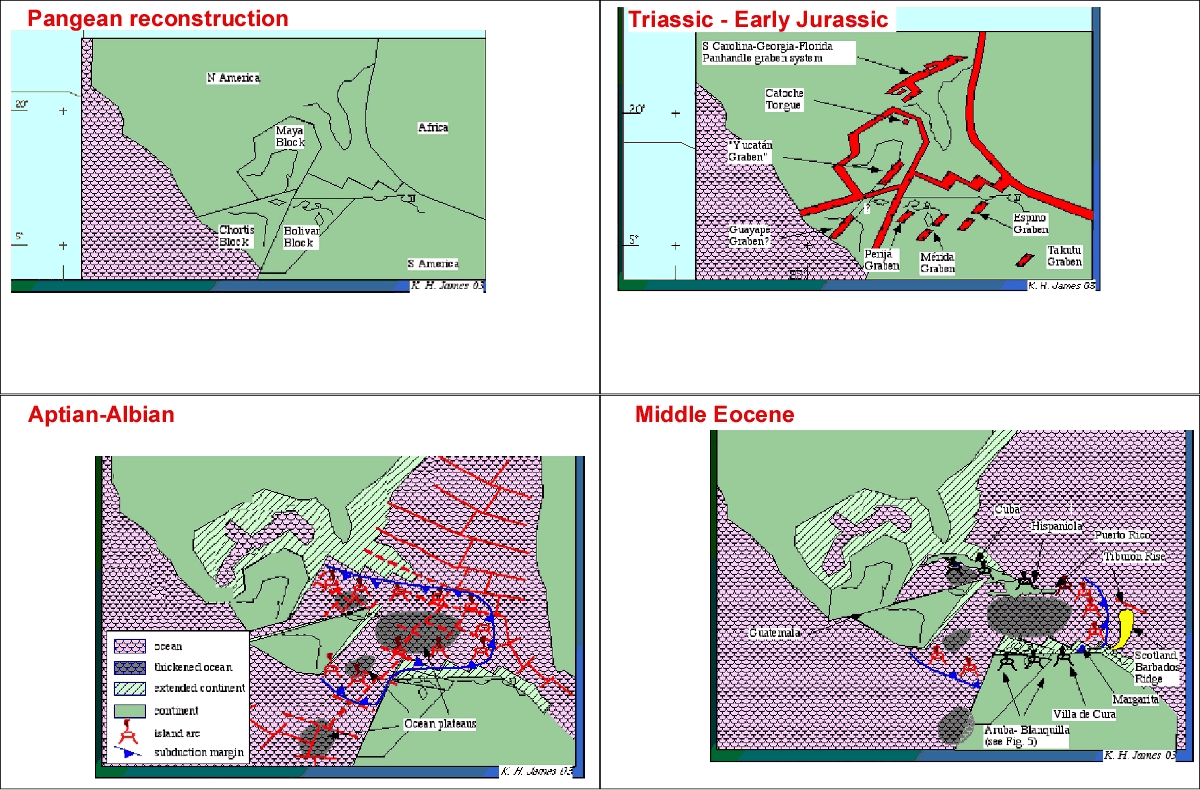
1. Pangean reconstruction, “Middle America.” Oceanic, island arc,
and continental extension removed; NW offset of North America
removed; Maya and Chortis E-W offset removed: eastern margins and
Jurassic rifts aligned (Figure 2); Bolivar Block restored to SW
along Bocono Fault (Figures 4 and
5). |
|
 |
Figure
2. Triassic – Early Jurassic paleogeography. Rifting heralded
extension of continental margins, drift, and ocean spreading and
established regional NE structural trends. Rifts on Yucatan and Chortis suggest former continuity. |
|
 |
Figure
3. Aptian-Albian paleogeography. Jurassic oceanic crust was in the
Gulf of Mexico, Yucatan Basin, Cayman Trough, and Caribbean. Ocean
plateau thickening occurred above triple junctions; spreading linked
Central and Equatorial Atlantic; subduction occurred between
converging plates; island arcs formed; Caribbean Plate became
isolated/defined. |
|
 |
Figure
4. Middle Eocene paleogeography. Regional flysch/wildflysch
deposition (at named locations). Arc activity dead except in Lesser
Antilles and Central America.
Click
to view sequence showing Pangean reconstruction and Triassic –
Middle Eocene paleogeography (Figures 1-4). |
|
 |
Figure
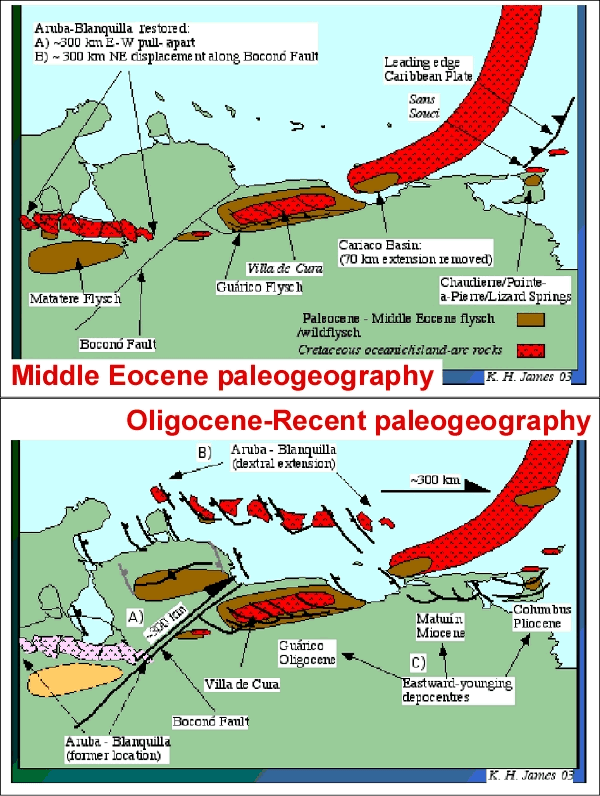
5. Middle Eocene paleogeography, Venezuela. |
|
 |
Figure
6. Oligocene-Recent paleogeography, Venezuela. A. NE displacement of
NW South America (Bolivar Block) along Bocono Fault. B. E-W
pull-apart of Aruba-Blanquilla. C. Eastward-younging depocenters.
Click
to view Venezuelan Middle Eocene – Recent paleogeography (Figures 5
and 6). |
Return to top.
Paleogeography
Triassic – Early
Jurassic (Figure 2)
?Triassic-Jurassic migration of North America to the west (ca. 1000 km)
and north (ca. 850 km), relative to Pangea, was accompanied by
intracontinental rifting (Figure 2), extension of marginal continental
crust, sinistral offset of remnant continental blocks (Maya and Chortis),
and development of oceanic crust (Gulf of Mexico, Yucatan Basin, Cayman
Trough, and Caribbean).
Early Cretaceous (Figure
3)
In Early
Cretaceous parts of the Yucatan, Venezuelan, and Colombian basins
thickened into ocean plateaus, probably because of decompression melting
associated with extension over triple junctions (Figure
3). Spreading
between South America and Africa resulted in connection of the Central
and South Atlantic by the beginning of the Albian. Convergence between
Pacific and Atlantic spreading areas and the Caribbean resulted in a
newly isolated plate, bounded by subduction island-arcs (Figure
3).
Throughout
the Cretaceous the Mid-Atlantic Ridge lengthened, N-S, by some 650 km
and stepped westward in the latitudes of 7-15 degrees N. Associated
NW-SE sinistral shear in the Caribbean to the west caused NE-SW-oriented
intraplate extension and plate thickening (further decompression
melting) in the western Venezuelan Basin/Beata Ridge/Haitian Basin area.
The Aves Ridge may have formed similarly at the same time.
Middle Eocene (Figures
4 and 5)
By Middle
Eocene, island-arc activity ceased along the northern and southern
Caribbean Plate boundaries. Increased clastic input reflected
ocean-continent interaction, possibly triggered by the K/T impact.
Violent Middle Eocene culmination of this episode, recorded by regional
wildflysch deposits containing multi-kilometer olistoliths, may
represent a further impact (Figure 4). Deposits include the Villa de Cura ophiolite of Venezuela and its original western extension, the
Aruba-Blanquilla complex (Figure 5). A regional Middle Eocene
unconformity and overlying, widespread, shallow-marine Middle Eocene
carbonates record regional uplift to the photic zone, erosion, and
carbonate deposition.
Oligocene – Recent
(Figure 6)
Since the
Oligocene, the Caribbean plate has moved eastward relative to South
America. Northwestern South America (Bolivar Block,
Figure 2) moved
northward at the same time, driven by sea-floor spreading in the
Pacific. Its northernmost part transgressed the Caribbean-South America
dextral plate boundary, suffering major internal pull-apart strain
(Figure 6). Eastward-migrating pull-apart basins, thrust fronts, and molasse basins developed in a dextral regime along northern
Venezuela/Trinidad and in a mirror-image, sinistral regime in the
Greater Antilles. Extension of the Aruba-Blanquilla island chain (Figure
6, formerly obducted island-arc, Figure 5) indicates up to 300 km of
eastward movement of the Caribbean relative to South and North America.
Important
features of this model are:
-
Its simplicity contrasts
sharply with the unlikely complexity and geometric improbability of
models that derive the Caribbean Plate from a Pacific location.
-
No major block rotations
were involved.
-
No major plate migration
occurred.
-
Oceanic crust in the Gulf
of Mexico, Yucatan Basin, much of the Cayman Trough and the Caribbean,
including the Grenada Basin) formed in the Jurassic. Only the central
Cayman Trough, Miocene-Recent, is young oceanic crust.
-
Cretaceous, Caribbean ocean
plateau thickening resulted from decompression melting. No mantle
plume/hotspot was involved.
-
Sinistral (Cayman) offset
between North America and the Caribbean Plate occurred along the
northern boundary of the Caribbean Plate and offset the continental
fragments of Maya and Chortis; it did not relate to the southern
Caribbean boundary.
-
Eastward
relative strike-slip between the Caribbean and North and South America
amounts to no more than 300 km and occurred in the Oligocene-Recent.
Return to top.
|

 Print this page
 Click to view article in PDF format.