|
Figure Captions
Return to top.
Geologic  Setting Setting of
the Cuu Long Basin of
the Cuu Long Basin
The Cuu
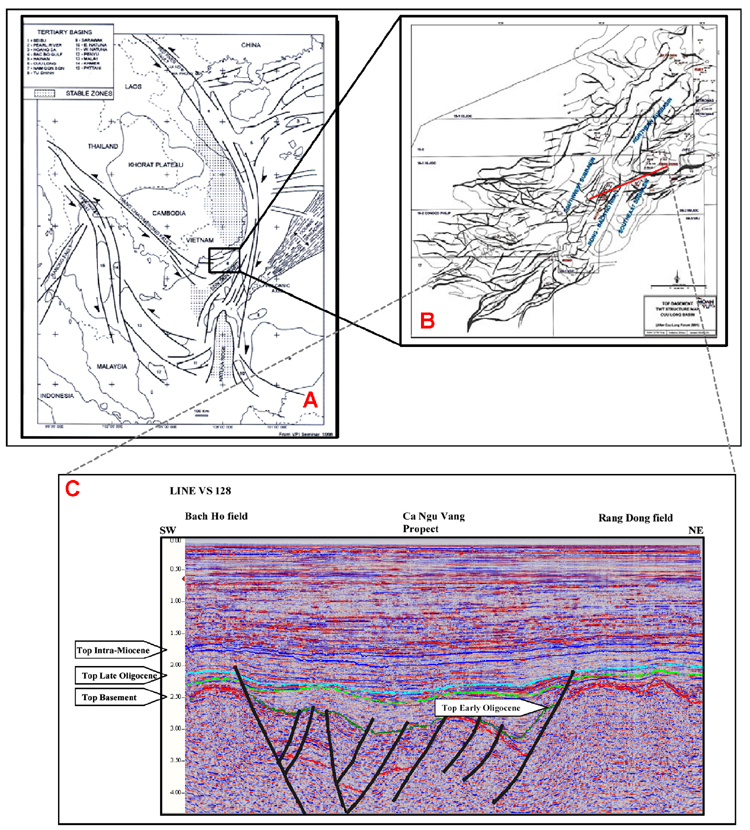
Long basin (Figure 1B) consists of four
major structures:
1) The
Southwest subbasin basin
2) The
Southeast subbasin
3) The
Central horst
4) The
Northern subbasin.
The
Southwest subbasin, located west of the Central horst, has E-W trending
structure, deepening to the east. The Southeast subbasin, located east
of the Central horst, is dominated by NE-SW-, ENE-WSW-, and
E-W-trending structures. The Central horst, which separates these two
subbasins, contains E-W- and N-S-trending faults (at Rong structure) and
NE-SW and E-W trending fields (at Bach Ho structure). The Northern
subbasin contains dominant NE-SW-trending faults and very minor E-W
fault system. The thickness of sediments may be up to 8000m. The current
oil fields are aligned along the NE-SW Central horst.
The
tectonic evolution history of the Cuu Long basin can be summarized as
follows:
a.
Pre-Tertiary plutonism: Plutonism was widespread during the Mesozoic
as a result of the northwestward-directed subduction of the
Proto-Pacific plate under the East Asian continent to form Jurassic-Late
Cretaceous magmatic bodies of granite-granodiorite. The sub-latitude and
sub-longitude oriented fracture systems are thought to have formed in
the plutons during that time.
b.
Rifting phase - The initiation of the Cuu Long basin: The Cuu Long
basin is a pull-apart basin that formed as a result of the extrusion and
subsequent clockwise rotation of the Indochina block during the
convergence between the India and Eurasia plates since Eocene. The basin
has NE-SW orientation. The successive of lateral extrusion and rotation
during Oliogcene developed secondary E-W-trending normal faults.
c. The
Post-rift period: Inversion occurred locally in Cuu Long basin
during Late Oligocene to Early Miocene. The stress field polarity is
reversed from the NW-SE extension to NW-SE compression. It is this stage
that creates the excellent fractured basement reservoir. Since Middle
Miocene, the basin has undergone passive subsidence without any tectonic
disturbance, except for the volcanic activities that occurred at some
places in the Cuu Long basin. The present-day maximum NNW-SSE in-situ
stress recorded by many wells in the basin indicates that the
compression continues to date.
The
development of the fracture system is summarized, as shown in
Figure 2.
The
stratigraphy of the Cuu Long basin is summarized in
Figure 3.
Play concept
The play
concept for the Cuu Long basin is illustrated by
Figure 4.
Source Rocks
The
effective source rocks are the Upper Oligocene shale that is present
throughout the basin and the Lower Oligocene interbedded shale. They
contain mostly kerogen type I/II generated from lacustrine sediments.
The average TOC is from more than 1% up to nearly 10%; the hydrogen
index ranges from 300 to more than 600 mg/gTOC (Figure
5).
Fractured Basement
Reservoir
Fractured
basement reservoirs are the unique characteristics of the Cuu Long
basin, although there are other oil discoveries in clastics and
volcanics plays. The first oil discovery in basement was made by
Vietsopetro in the Bach Ho field in 1988. Oil was stored in
macro-fractures, micro-fractures, and vuggy pores. The matrix porosity
of the magmatic body is negligible. Fractures inside the basement may
originate from one or a combination of the following factors:
1) The
cooling of the magmatic body
2) Tectonic
activity
3)
Hydrothermal processes
4)
Weathering and exfoliation.
However,
the tectonic activity and the hydrothermal processes are practically the
main factors that control the porosity of the fracture systems. Recent
studies (Cuong, T. X. 2001; Schmidt, J. et al., 2003) proved that the
compression event that occurred during Late Oligocene reactivated the
pre-existing faults/fractures and created effective porosity inside the
granite basement. The compression probably resulted from the restraining
band of a strike-slip motion along the E-W trending lineaments.
Most
fractures inside the basement are of high dip angles (40-75o).
Their strike directions vary from one field to another, or even within a
field. The permeability of these reservoirs is normally very good to
excellent (tens to thousands mD). Wells in fractured basement usually
flow at very good rates (up to 14,000 bopd). The depth of the top of the
basement reservoir is another issue. The basement tops of current oil
fields are about 2500 - 3000 mss. Their oil columns range from 1000-1500
m.
Hoan Vu JOC
has recently found oil at 4430 mss in the granite basement at 3700 mss
at the Ca Ngu Vang prospect. It seems that the depth of top of basement
is not a critical factor for exploring the oil in the basement.
Bach Ho (White Tiger) Field
This is a
giant oil field with reserves up to 1.0-1.4 mmm bbls. Current production
of this oil field is 250,000 bopd; 90% of which from the basement
reservoir; the remainder is from Oligocene and Miocene clastics.
Rong (Dragon) Field
This field
is located at the southern end of the Bach Ho field. Oil produces
from both basement and volcanics sections. The estimated reserves are
about 40 mmbbl.
The Ruby
field is located at the northeast part of the basin. Oil is produced
dominantly from Miocene sandstones and Oligocene volcanics. Current
production is about 20,000 bopd.
Rang Dong Fields
Oil is
produced mainly from fractured basement. A minor amount is from Miocene
sandstones. Current production is about 60,000 bopd.
Su Tu Den Fields
Oil was
discovered in the Su Tu Den prospect in both basement and Oligocene and
Miocene clastics. From field planning, production was expected to have
begun by the end of 2003.
Ca Ngu Vang Prospect
This is
characterized by the deepest basement reservoir, with flow rate of 2600
bopd and 6.8 mmscfgd. The Hoan Vu JOC is now conducting the appraisal
of this prospect. The preliminary reserves of this prospect is 90 mmbbl.
The authors
would like to express a sincere thanks to PetroVietnam and Hoan Vu JOC
for generously allowing the use of available data. We also would like to
thank our colleagues who have offered many good ideas during the
preparation of this article. A special thanks is due the Exploration
Department of the Hoan Vu JOC for providing us with favorable conditions
to preparation of this article.
Chang S. J., and Long N. T., 2001, An observation on the
fracture systems of the Southern Vietnam, Technical Forum 2001.
Cuong, T. X., 2001, Reservoir characterisation of
naturally fractured and weathered basement in Bach Ho field, Technical
Forum 2001.
Dong, L. T. et al., 2001, Basement Fractured Reservoir of
Bach Ho Oil Field - A Case Study, Technical Forum 2001 - A Case Study, Technical Forum 2001
Schmidt J. et al. 2003, Tectonic development of the Cuu
Long basin, Vietnam.
Return to top.
|

 Print this page
 Click to view article in PDF format.