|
Figure and Table Captions
Return to top.
The giant-sized Heidrun Field, located offshore mid-Norway, is developed
with a tension leg platform (TLP) and 5 subsea templates and has
produced over 500 million barrels of oil and nearly 5 billion Sm3 of gas
since production start in 1995.
The field is generally structurally complex, but the South Flank of the
field, discussed in this paper, is dominated by North-South trending and
dip-parallel, faults (Figure 1).
The approximately 800 m reservoir section comprises a generally
transgressive  sequence sequence ranging from continental to open marine deposits.
The hitherto main production contributors, are the excellent Garn and
Ile reservoirs deposited in a shallow marine setting (Figure 2). ranging from continental to open marine deposits.
The hitherto main production contributors, are the excellent Garn and
Ile reservoirs deposited in a shallow marine setting (Figure 2).
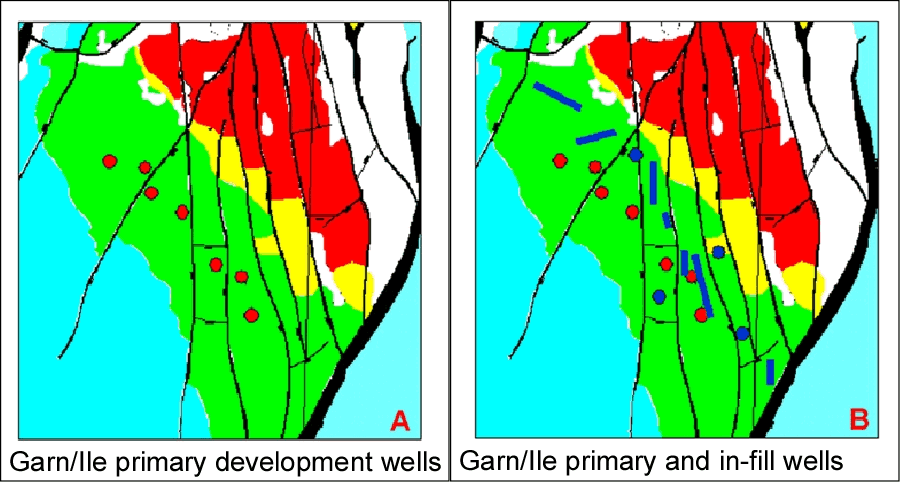
The drainage strategy is largely based on single Garn and Ile producers
in each segment for each of the two formations. Downflank water
injectors and one gas injector, together with gas cap expansion, provide
pressure support (Figure 3).
Before production start, this drainage strategy was assumed to recover
more than 60% of the oil in place in the two reservoirs (Dragsten,
1994). Updated understanding indicates that even these relatively
homogeneous reservoirs give challenges and that more extensive in-fill
drilling is required (Figure 4).
Primary development wells target pristine conditions and the economic
outcome ranges are generally all attractive. The late-life in-fill
wells, on the other hand, battle the additional uncertainty of fluid
movement and the economic outcome may be negative. In-fill well planning
has to address possibly conflicting data like observed well behaviour,
reservoir simulation results, and in this case, time-lapse seismic
interpretation.
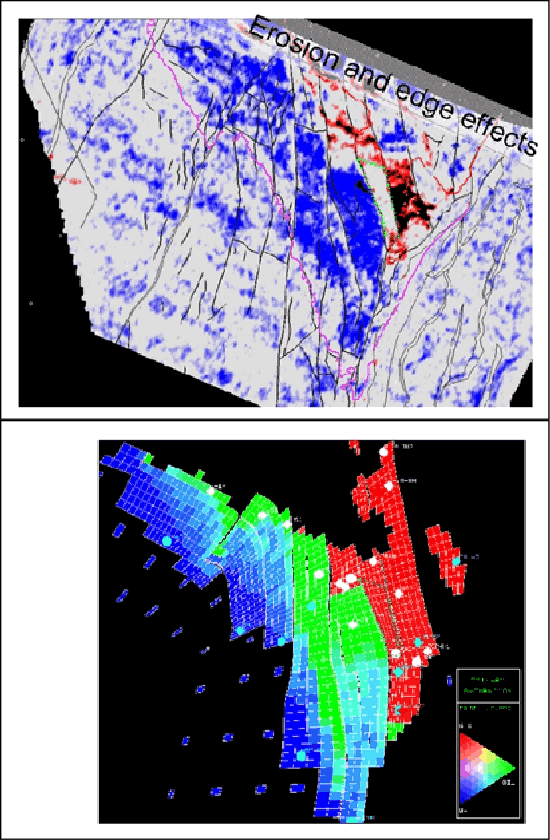
A seismic survey was acquired downflank of the TLP (Figure 5) in 2001
and parallel processed with the 1986 seismic data from before production
start. It was immediately recognised that the seismic data revealed
fluid movement information as the character of seismic attributes proved
consistent with the main faults and initial contacts (Figure 6). This is
further presented in Furre et al, 2003.
Well Planning and Results
Planning and Lessons Learned from the First Well (A-42A)
A handful of well targets had been identified based on the simulation
model. Acknowledging the complexity of these well targets, the Operator
invited the license partners to in-depth discussions. The well targets
were checked against seismic attribute and inversion data and it was
decided to pursue two targets. The targets were concluded to be viable,
though associated with high risk. True enough, the result from the first
well showed both a more complex geology and drainage pattern than
modelled, and the license partners further acknowledged the importance
of risk handling when planning the second well.
Second Well (A-30)
Careful interpretation of time-lapse seismic attribute data showed an
area where oil in the Garn Formation appeared to be undrained (Figure
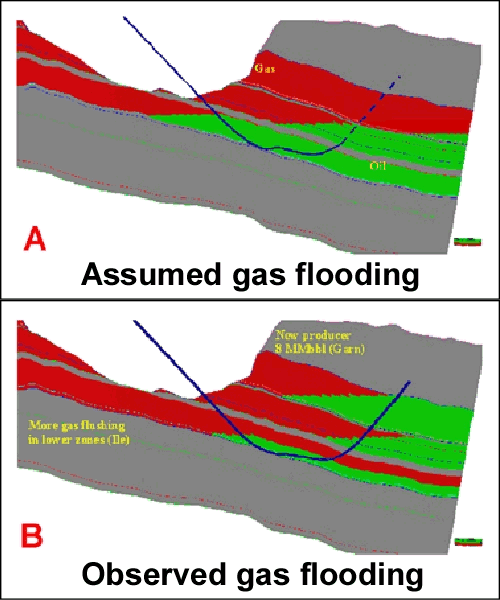
6). Reservoir simulations indicated that the area was gas flooded and
that to target the underlying Ile Formation was a better alternative
(Figure 7). The platform gas processing capacity currently constraints
the oil production, so it is important to minimise the risk of massive
gas production. This concern favoured to have the Ile Formation as the
primary target. Neither the simulator model nor the time-lapse seismic
had perfectly predicted the A-42A outcome, and based on the many
accurate predictions from the simulation models earlier in the field's
life, the simulation results were given priority over the seismic data.
On the other hand, a thick, homogeneous offshore oil reservoir like the
Garn Formation is the best possible candidate for seismically tracking
fluid movements (De Waal and Calvert, 2003). To handle a case of
conflicting data, we realised that we neither had any jointly agreed
procedures between staff from different disciplines nor between the
license partners. This meant that extensive, but constructive
discussions were required to reach a license decision. It was finally
agreed to extend the well from the primary Ile target with a pilot well
to a secondary Garn target to test the reliability of the time-lapse
seismic information.
Results from A-30 well were that this well proved to be gas-flooded in
the primary Ile target, but it was extended to discover a less flooded
secondary Garn target. The A-30A producer followed to target
approximately 8 MMbbl of oil reserves (Figure 8).
Unlike the primary development wells and previous in-fill wells, A-30
had proven to be a well target with no safe downside. There had been a
shift from the early-life phase of the field when revenue was
predominantly a return on the initial development investment, to a
late-life regime when revenue is largely a return on the knowledge
capital (Figure 9).
Uncertainty is traditionally regarded as undesired, and efforts are made
to limit the outcome range and improve the project. This approach will
work when one has a working Base Case model, but is inadequate when
dealing with alternative scenarios.
A real option is honouring the value of inherent flexibility in a
project, e.g. opportunities that can be pursued and actions that can be
taken (Table 1). The positive indication from the seismic was a source of
opportunity, a real option.
A successful well will get a lot of management attention when put on
production. The enthusiasm over a good result is rarely matched by
managerial requests to continually build a bank of available options.
One could be misled to think that the key decision was to drill the
A-30A producer after proving oil with the A-30 pilot. We argue that the
true value creation was during the earlier planning stages when the
license partners were battling the time-lapse seismic uncertainties,
optimising the timing of seismic acquisition and drilling schedule and
deciding on the pilot extension of A-30.
The A-30 well process comprises a case of real option identification,
protection and exercising. Unfortunately, conventional value-based
management metrics focus on annual measures like ROCE (Return on Capital
Employed) and EVA (Economic Value Added), complemented by production and
reserves reporting. Though important metrics, neither of these measures
will capture that the plan was to drill an Ile target and that
production eventually came from a
different formation (Figure 10). Unless well communicated from the
technical staff as well as requested by management, the story of the
strength of a flexible plan will not be told. The staff?management
"push-pull factor" is critical as also identified by De Waal and
Calvert, 2003. We believe that E&P companies that want to be competitive
in mature areas should at least qualitatively monitor the future
opportunities generated, i.e. their real options portfolio.
The authors thank the Heidrun license partners ConocoPhillips, Fortum,
Statoil and Petoro for fruitful co-operation during this project and for
allowing us to publish these data.
De Waal, H. and Calvert, R., 2003, Overview of global 4D
seismic implementation strategy: Petroleum Geoscience, February 2003.
Dragsten K. et al, 1994, Drainage strategy for the
Heidrun Field: SO-A-RE-003, June 1994.
Faiz, S., 1999, Real-option application: From successes
in asset valuation to challenges for an enterprise-wide approach: SPE
68243.
Furre, A.K.,
Munkvold, F. R., Nordby, L. H., 2003, Improving reservoir understanding
using time-lapse seismic at the Heidrun field: EAGE 2003.
Return to top.
|

 Print this page
 Click to view article in PDF format.