Print this page
 Click to view article in PDF format.
Rift Sequences of the Southern Margin of the Gulf of Corinth (Greece) as Exploration / Production Analogues*
By
Richard Collier1 and Greg Jones2
Search and Discovery Article #50007 (2004)
*Adapted from “extended abstract” for presentation at the AAPG International Conference, Barcelona, Spain, September 21-24, 2003.
1University of Leeds, Leeds, United Kingdom
2Rock Deformation Research (RDR), Leeds, United Kingdom
General Statement
The initiation and
development of continental rifts is the focus of much debate, nowhere more so
than in the Pliocene-Recent Gulf of Corinth Rift, Greece, where active rifting
has been widely studied and reported (Jackson et al., 1982; Armijo et al.,
1996). Along the southern margin of the Corinth Rift, the deeply dissected
mountains of northern Peloponnesos (Figure 1) spectacularly expose extensional
half-grabens bounded by approximately WNW/ESE-trending normal  fault
fault systems (Doutsos
and Poulimenos, 1992). The onshore area of the rift is up to approximately 40 km
in width and 120 km long and includes both seismically inactive and active fault
systems, and associated syn-rift sediment fill. As such, it provides a rare
opportunity to assess the structural and stratigraphic evolution of a rift and,
consequently, to gain an insight into basin-forming processes.
systems (Doutsos
and Poulimenos, 1992). The onshore area of the rift is up to approximately 40 km
in width and 120 km long and includes both seismically inactive and active fault
systems, and associated syn-rift sediment fill. As such, it provides a rare
opportunity to assess the structural and stratigraphic evolution of a rift and,
consequently, to gain an insight into basin-forming processes.
Doutsos and
Poulimenos (1992) described the structure of the rift in this area and proposed
that the surface normal faults were linked to a low-angle fault at deeper
crustal levels (>7 km depth). More recently, Sorel (2000) and Chery (2001) have
again suggested that the Corinth Rift is underlain by a major north-dipping
crustal detachment fault, the "Khelmos detachment" (>100 km long). Based on
field studies, Sorel (2000) concludes that this detachment fault is exposed at
the southern edge of the rift system, within the valley of the Krathis River
(Figure 1). Sorel (2000) also proposed that activity on both the extensional
faults and the underlying detachment has progressively migrated northwards
through time. Chery (2001), using a mechanical model, has further suggested that
the Corinth Rift may eventually evolve to become a metamorphic core complex
under continued extension, comparable to the Snake Range Fault System in Nevada,
USA. The interpretation of earthquake focal mechanisms (Rietbrock et al., 1996)
and inversion of GPS and SAR interferometry data following the 1995 Aigion
earthquake (Bernard et al., 1997) have also been used to support a model
invoking low-angle north-dipping faulting.
The objective of
the current study was twofold. Firstly, we set out to test the presence of a
regionally mappable detachment fault. Secondly, we aimed to test the northward
basin migration hypothesis of previous authors, based upon new field mapping and
observations of stratigraphic relationships in successive half-grabens.
|
|
Results of Geological MappingThe study area includes the deeply incised north-south river valleys that transect the southern margin of the rift around the town of Kalavrita (Figure 1). Exposures of the rift sequences have been mapped over some 500 km2 at 1:50,000 scale in an area of significant topographic relief. Exposure in this area is variable but numerous road cuts, deeply incised river valleys, and cliffs allow the characterisation of the main outcrop pattern. The geological map has been used to construct cross-sections to show the relationships identified (e.g., Figure 2).
Pre-Rift SequencesIn this area, complexly deformed Mesozoic carbonate-dominated units form the primary basement to the syn-rift fill sequences. These units were emplaced generally from east to west across Peloponnesos during mid-Tertiary continental collision and overthrusting (so the thrust sheets strike perpendicular to the younger rift faults). The internal structure of the Mesozoic units has not been mapped in this study, but it is recognised that pre-existing structure may have played a role in controlling, for example, the segmentation of the rift.
Syn-Rift SequencesThe
overlying ?Pliocene to Recent syn-rift fill sequences are dominantly
nonmarine, but they include the well known Gilbert-type fan delta
deposits in the northern part of the onshore rift (Ori, 1989; Dart et
al., 1994) and marine deposits of the present-day Gulf (Brooks and
Ferentinos, 1984; Stefatos et al., 2002). Many of the nonmarine
sequences are poorly dated; this means that only lithostratigraphic
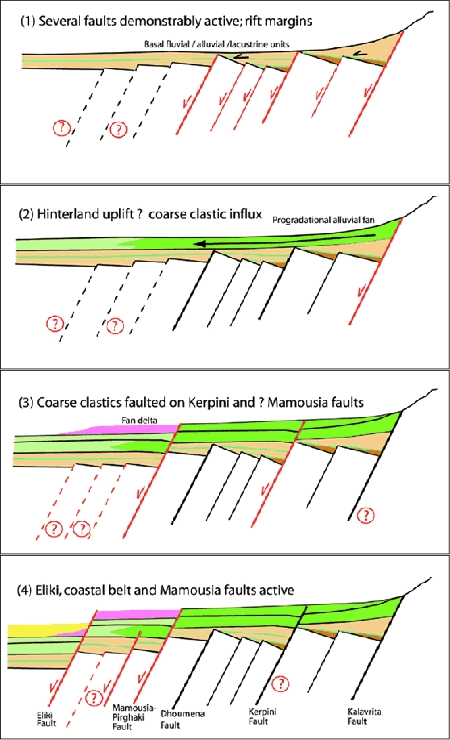
correlation of units between adjacent (1) Basal clastic fluvial/alluvial to lacustrine formation. This unit includes basal conglomerates with massive and trough cross-stratified pebble and cobble conglomerates which overlie the basement units. The formation is up to ca. 800 m thick (north of the Kerpini and Dhoumena faults). Numerous outcrops across the study area show that these sediments are both thickened and back-rotated into the main north-dipping faults. In addition, they strongly onlap the adjacent hangingwall slopes (Figure 2); all of these characteristics indicate their syn-tectonic nature. Clast compositions suggest that these early syn-rift sediments include materials derived from the adjacent footwall blocks, presumably during active footwall uplift and erosion. The
southernmost depocentre, controlled by the Kalavrita (2)
Progradational alluvial fan formation. A phase of significant
alluvial progradation subsequently transported large volumes of coarse
clastic sediment across the rift, from the south. A marked coarsening-up
facies boundary defines the base of this formation (north of the Kerpini
Large-Scale FaultingFive main
north-dipping South and
east of Kalavrita, exposures are often limited by surficial deposits but
topographic relief suggests a major W/E The next
significant The
Dhoumena To the
north, the Mamousia-Pirghaki The active
coastal
Meso-Scale FaultingDominantly
north-dipping planar and listric meso-scale faults are also seen in the
Vouraikos valley (throws of centimeters to ~100 m). A number of these
Tectono-Sedimentary EvolutionTwo issues
arise: (1) the presence or absence of a regional basal detachment Firstly,
the Khelmos detachment is not mapped as a 100-km long, continuous
detachment feature. For example, the Kerpini
Secondly,
the timing of faulting is more complex than previously recognised (Figure
3). A relative chronology of 1) Activity
was initially distributed over a relatively wide area with three major
faults (Kalavrita, Kerpini and Dhoumena Faults) and several subsidiary
or splay faults active. It is not known if the Mamousia-Pirghaki 2)
Subsidence on the Kalavrita 3)
Kilometre-scale faulting on the Kerpini 4)
Subsequently the Mamousia-Pirghaki 5) The
final stage of activity has seen the Mamoussia-Pirghaki
This
evolution indicates that the rift did not evolve through a simple south
to north progression of
ConclusionIn conclusion, the near continuous exposure of the early rift in numerous river valleys offers a unique opportunity for evaluating the spatial and temporal evolution of a rift and its associated sedimentary fill and for use as extensional basin analogues for the hydrocarbon industry.
ReferencesArmijo, R., Meyer, B. King, G.C.P., Rigo, A., and Papanastassiou, D., 1996, Quaternary evolution of the Corinth Rift and its implications for the Late Cenozoic evolution of the Aegean: Geophysical Journal International, v. 126 (1), p. 11-53. Bernard, P., and 27 co-authors, 1997, The Ms=6.2, June 15, 1995, Aigion earthquake (Greece): Evidence for low angle normal faulting in the Corinth rift: Journal of Seismology, v. 1, p.131-150. Brooks, M., and Ferentinos, G., 1984, Tectonics and sedimentation in the Gulf of Corinth and the Zakynthos and Kefallinia channels, western Greece: Tectonophysics, v. 101, p. 25-54. Dart, C.J., Collier, R., Gawthorpe, R., Keller, J., and Nichols, G. 1994, Sequence stratigraphy of (?)Pliocene-Quaternary syn-rift, Gilbert-type fan deltas, northern Peloponnesos, Greece: Marine and Petroleum Geology, v. 11, p. 545-560. Doutsos, T., and Poulimenos, G., 1992, Geometry and kinematics of active faults and their seismotectonic significance in the western Corinth - Patras rift (Greece): Journal. Structural Geology, v. 14, no. 6, p. 689-699. Jackson, J.A., Gagnepain, J., Houseman, G., King, G.C.P., Papadimitriou, P., Soufleris, C., and Virieux, J., 1982, Seismicity, normal faulting, and the geomorphological development of the Gulf of Corinth (Greece): The Corinth earthquake of February and March 1981: Earth and Planetary Science Letters v. 57, p. 377-397.
McGurk, A.C. 1999. The structure and growth of normal
McNeill, L.C., Collier, R., Pantosti, D., De Martini, P.,
and D'Addezio, G., in press. Observations on the recent history of the
Eastern Eliki Ori, G.G. 1989, Geologic history of the extensional basin of the Gulf of Corinth (?Miocene-Pliocene), central Greece.:Geology, v. 17, p. 918-921.
Rietbrock, A., Tiberi, C., Scherbaum,. F., and Lyon-Caen,
H. 1996. Seismic slip on a low angle normal
Roberts, G.P., 1996. Variation in
Sorel, D., 2000, A Pleistocene and still active
detachment Stefatos, A., Papatheodorou, G., Ferentinos, G., Leeder, M., and Collier, R. 2002, Seismic reflection imaging of active offshore faults in the Gulf of Corinth: their seismotectonic significance: Basin Research, v. 14, p. 487-502. |