Print this page
 Click to view article in PDF format.
GCAdvances
in Spectral Decomposition and  Reflectivity
 Modeling in the Frio Formation of the
Gulf Coast*
Modeling in the Frio Formation of the
Gulf Coast*
By
Michael D. Burnett1 and John P. Castagna2
Search and Discovery Article #40113 (2004)
*Adapted for online presentation from the Geophysical Corner column in AAPG Explorer, January, 2003, entitled “ISA Method Spotted Gas Anomalies” and prepared by the authors. Appreciation is expressed to the authors, to R. Randy Ray, Chairman of the AAPG Geophysical Integration Committee, and to Larry Nation, AAPG Communications Director, for their support of this online version.
1Fusion Geophysical, Dallas ([email protected])
2University of Oklahoma, Norman, Oklahoma ([email protected])
The seismic interpreter now has the use of a simple tool to aid in the search for hydrocarbons by allowing individual target reflection events to be spectrally analyzed and compared to gas response modeled from well logs with and without pay. The seismic reflection is then decomposed to spot a positive gas response.
Until now, spectral decomposition techniques have used windowing methods to decompose the seismic trace into its constituent frequencies -- but these methods:
-
Mix reflection events and introduce unwanted artifacts into the data.
-
Restrict the usefulness of spectral decomposition to the inspection of single-frequency maps to try to relate amplitude maxima to geologic events.
Recent advances in techniques have yielded a method that does not use windowing to decompose the trace: The Instantaneous Spectral Analysis (ISA) method uses a wavelet transform technique to produce single-frequency reflection events that are accurately localized in time. Each full-spectrum reflection can be visualized and analyzed at its uncontaminated single-frequency equivalents.
|
uGeneral statementuFigure captionsuFrio bright spotu3-D map displaysuWell log modelinguSpectral resultsuConclusion
uGeneral statementuFigure captionsuFrio bright spotu3-D map displaysuWell log modelinguSpectral resultsuConclusion
uGeneral statementuFigure captionsuFrio bright spotu3-D map displaysuWell log modelinguSpectral resultsuConclusion
uGeneral statementuFigure captionsuFrio bright spotu3-D map displaysuWell log modelinguSpectral resultsuConclusion
uGeneral statementuFigure captionsuFrio bright spotu3-D map displaysuWell log modelinguSpectral resultsuConclusion |
Frio Seismic Bright Spot
Figure 1
shows a high amplitude reflection characterizing a
Frio reservoir in which gas is trapped
stratigraphically due to a sand pinchout. The
Frio sand, which is about 68 feet thick, is shown in
Figure 2, with the well log synthetic
seismogram tie. Notice that the gas pay has a low velocity compared to
the brine-filled part of the sand at the base. This adds significant
strength to the
What cannot be seen is the behavior of
the individual seismic frequencies; i.e., what effect does the
hydrocarbon charge make on the amplitudes of each discrete frequency.
Because the ISA technique allows uncombined
This is very similar to the familiar
AVO gather -- except where adjacent traces represent the reflection's
response to changing offset in the AVO gather. Here each trace
represents the reflection's amplitude at a single frequency, or
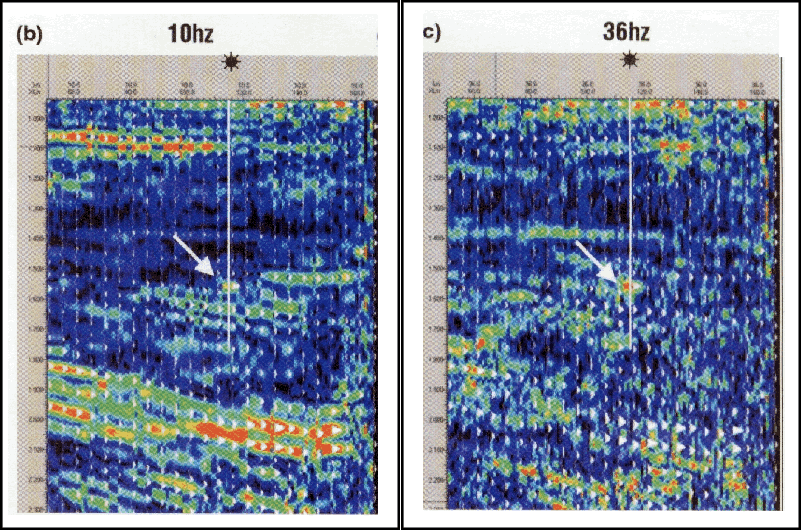
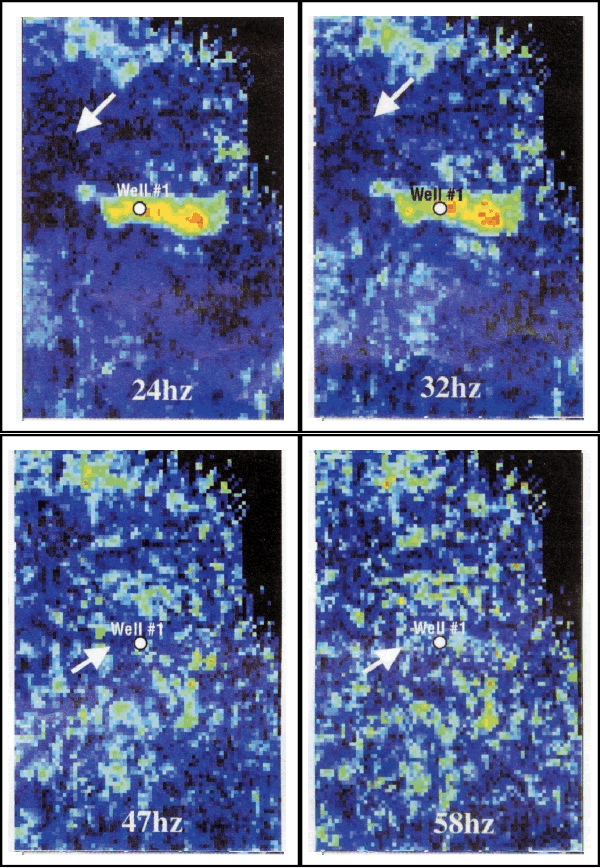
amplitude The anomalous response caused by the pay clearly can be seen as a very high amplitude with a peak frequency that is shifted toward the high end of the useable bandwidth. When the process is run on the entire seismic line, single-frequency panels are produced, as shown in Figure 3b and 3c. Note that at 10 Hz, the pay does not exhibit high amplitude, while at 36 Hz, it is one of the brightest events on the section. The Frio bright spot on the 36 Hz seismic line in Figure 3c agrees with the frequency gather shown in Figure 3a. The pay has relatively little energy at 10 Hz, but at 36 Hz, it is one of the few remaining events to have high reflection strength. This is in contrast to the strong events centered between 2.0 and 2.1 seconds at the wellbore. They have visually lower frequency and their strongest reflection amplitudes are closer to 10 Hz. When viewed as a frequency panel movie, the changing contrast becomes very striking. 3-Dimensional Map DisplaysWhen the ISA process is applied to cubes of seismic data, the results are a series of single-frequency cubes that are loaded onto the workstation and interpreted. Figure 4 shows four slices from the frequency cubes on the pay horizon:
As Figure 4
shows, the pay is acting completely different than the surrounding sand
when viewed at discrete frequencies. This is even more apparent when all
the frequency maps are viewed as a movie. The pay has a distinctly
different dynamic frequency response than the background because the
hydrocarbons have changed the
Well Log Modeling Confirms Frequency Response
To understand the seismic response, let
us examine the detailed
The local Similarly, the amplitude low at 24 Hz in the curve with no hydrocarbons can be seen in the maps in the area surrounding the reservoir. Spectral Results
The sand that produces in this
Frio field is present along strike, pinches out updip, and is not
present downdip. If the observed anomalous
There could be other geologic
conditions that would cause the
The technique illustrated here will work best in sands with high porosity and permeability, but it has been employed successfully in consolidated sands and carbonates in a variety of depositional environments and depths. Others uses include:
Because the input to this process is simply the migrated data, the better the data quality, the more accurate the results of this method. Conclusion
A new type of spectral decomposition
has been shown to be useful as a simple tool to isolate the
By viewing frequency maps as a movie,
subtle changes in frequency become dynamically visible. The observed
unique This method shows great promise to become another valuable seismic detection tool in the search for hydrocarbons. |