Print this page
 Click to view article as PDF
GCSeismic/Geology Links Critical*
By
Alistair R. Brown
Search and Discovery Article #40130 (2004)
*Adapted for online presentation from article of the same title by the same author in Geophysical Corner, AAPG Explorer, November, 1996. Appreciation is expressed to the author and to M. Ray Thomasson, former Chairman of the AAPG Geophysical Integration Committee, and Larry Nation, AAPG Communications Director, for their support of this online version.
1Consulting reservoir geophysicist, Dallas Texas ([email protected])
Seismic data today, particularly 3-D, contain a great amount of information and can yield maps of considerable accuracy. All seismic information, however, is relative, so to give it the greatest possible accuracy we must calibrate it to the local geology.
Since seismic data respond to the acoustic properties of rocks, the geology needs to be expressed in some comparable form. Thus sonic (acoustic) logs and density logs from wells have become the established form of subsurface information used for making seismic ties.
In this article, we shall review the traditional technique for tying well logs - and thus the rocks penetrated by the well - to seismic data.
|
uTying well logs to seismic data
uTying well logs to seismic data
uTying well logs to seismic data
uTying well logs to seismic data
|
Tying Well Logs to Seismic Data Assuming we have both a sonic log (A) and a density log (B), they are multiplied together point-by-point to give an acoustic impedance log (C, Figure 1). This is converted from depth to time using some velocity function. By subtracting one acoustic impedance value from another progressively down the log, now in time, we obtain acoustic impedance contrasts, which are a direct expression of seismic reflectivity (D). This is a series of spikes, which implies a very high frequency content; this is, of course, what we expect, because the information came directly from well logs measured down a borehole only centimeters from the rock under study. Seismic data have a lower frequency content because the energy has traveled from the surface and back again. Because of this lower frequency content, the seismic energy pulse is rather broad. Some estimate of the shape of this pulse, or wavelet, is then made, and each spike on the reflectivity log is given this broader shape (E).
The
superimposition of the resulting many wavelets provides the
Because of
velocity error, some relative sliding up and down may be necessary to
help the match. In this way we transfer some geological identity onto
the seismic section. Although this is a time-honored approach, the
similarity between the The tying of well and seismic data is overall an immensely complicated business - we have often over simplified it. The more detailed our seismic interpretations become (using 3-D and other modern technologies) and the more we seek stratigraphic and reservoir information, the greater is the need for an accurate link between seismic and geology.
1. The
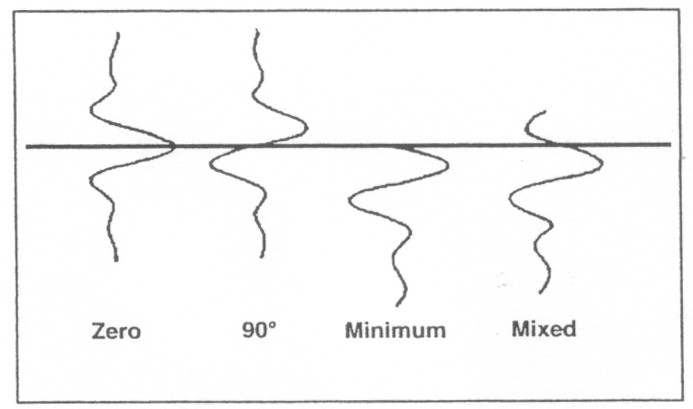
seismic wavelet used to construct the Polarity. Phase. Frequency content.
2. Well logging errors and variable borehole conditions (washouts, mud cake, etc.) may mean that the logs are not measuring the properties of the unaltered rock away from the borehole as intended. 3. Seismic data and well log data measure the properties of very different sized rock volumes because of their different resolution. A single well log value will be measuring the property of about 10 m3 of rock. A single seismic value will be measuring the property of about 100,000 m3 of rock. 4. There may be significant positioning errors of either the well or the seismic data. Surveying on land, navigation at sea, and well deviation are all subject to error. Many old wells have been found to be seriously mislocated. All this, of course, affects which seismic trace should be used for the well tying exercise. 5. Amplitude-Variation-with-Offset (AVO) effects in the data before stacking may mean that the stacked output trace which we are trying to tie has amplitudes that are fundamentally wrong.
1. In addition to questioning polarity and frequency content, we should think critically about data phase. We should not necessarily believe the data phase is what it is supposed to be, but rather we should analyze the phase to our own satisfaction. This can be done analytically or interpretively - and different people prefer different approaches.
Knowledge
of the data phase tells us the wavelet we should use in constructing the
2. We should try to use modern well logs recorded with long-spaced tools, and we should be cognizant of the borehole conditions. 3. The difference in resolution between seismic data and well data follows from the fundamental laws of physics and thus is not under our control. 4. We should question the location of each well with respect to the seismic grid. I know of mislocations by as much as 700m. Even for modern, accurate well and seismic data there is some positional uncertainty, and we should consider incorporating into our tying methodology uncertainties in the range of 30m to 100m.
5. AVO
effects cannot be comprehended for normal stacked data. In the future
more well tying will be conducted using unstacked traces of different
shot-to-receiver offsets and the |