Print this page
PSPermian-Jurassic
Tectonic and Depositional  Control
 on Oil Fields in the Central Moesian Platform,
Romania*
on Oil Fields in the Central Moesian Platform,
Romania*
By
Aurelia Liliana Stan1 and Adriana Raileanu2
Search and Discovery Article #10046 (2003)
*Adapted for online presentation from poster session presented at the AAPG Convention, Salt Lake City, Utah, May, 2003.
1Geophysicist, Romanian Oil Corporation Petrom-S.A.,Geological Exploration Research and Design Center, Bucharest, Romania ([email protected])
2Sedimentologist, Romanian Oil Corporation Petrom-S.A.,Geological Exploration Research and Design Center, Bucharest, Romania ([email protected])
Editorial Note: This article, which is highly graphic (or visual) in design, is presented as: (1) four posters, each represented by a PDF image, which contains the usual enlargement capabilities; and (2) searchable HTML text with figure captions linked to corresponding illustrations with descriptions.
Users without high-speed internet access to this article may experience significant delay in downloading some of the PDF files due to their sizes.
Click on individual poster below, to view it in PDF format..
 First Poster
 |
Third
Poster |
|
Second Poster |
Fourth Poster |
The study area is located in the Romanian part of the Central Moesian Platform.
The focus of this paper is the recognition of the main Permian-Jurassic fault
systems in order to define the major events: tectonics, eustacy, and
sedimentation.
The basement faults are responsible for igneous intrusions and extrusions. Permian-Triassic magmatism is associated with a W-E rift area, generating horst-graben structures. Three Jurassic intracratonic basins were recognized: a basin characterized by syndepositional faults and thermal subsidence; a strike-slip basin; and a fossil rift basin, with en echelon external faults.
In the first basin, deposition took place as a result of subsidence and eustacy
interaction. In the second basin, a strike-slip fault system developed, with two
main faults. The direction of sedimentary influx is identical to the direction
of the block movement. The source area for this basin is located on the uplifted
horst, which was cannibalized. In the fossil rift basin, the direction of the
Jurassic sediment influx is opposed to the block movement. Active bi-directional
erosion was generated externally along the normal fault escarpment of the fossil
rift shoulder. Internally, an active depocenter shifted to the source area.
Middle Jurassic offshore distal sandbars, littoral bars, and delta-front and fan
delta represent the prospects for hydrocarbon fields. The main Upper Jurassic
prospect is represented by carbonate shelf margin, with diagenetic control on
the pore system.
The hydrocarbon
fields are distributed asymmetrically, and they are mostly encountered in the
strike-slip basin.
|
uDepositional sequences & tectonics
uDepositional sequences & tectonics
uDepositional sequences & tectonics
uDepositional sequences & tectonics
uDepositional sequences & tectonics
uDepositional sequences & tectonics
uDepositional sequences & tectonics
|
Click to view sequence of uninterpreted and interpreted profiles (Figures 4, 5).
Click to view sequence of uninterpreted and interpreted profiles (Figures 6, 7).
Click to view sequence of uninterpreted and interpreted profiles (Figures 8, 9).
Click to view sequence of uninterpreted and interpreted profiles (Figures 10, 11).
Click to view sequence of maps of Central Moesian Platform (Figures 12, 14, 15).
Click to view sequence of Middle and Upper Jurassic depositional systems (Figures 20, 21).
The study area is located in the Central Moesian Platform between
Oltet-Teleorman rivers, the Danube River, and the Peri-Carpathian
The focus of this article is the recognition of the main
Permian-Jurassic
A few representative N-S and W-E trending seismic profiles were
selected
in order to recognize the main The Permian-Triassic basement faults present N-S and E-W trends. The latter faults are responsible for igneous intrusions and extrusions associated with pyroclastic rocks along Craiova-Optasi Uplift, due to Hercynian and Cimmerian Orogenesis.
In the north of the Moesian Platform, the Permian-Triassic magmatism is
associated with an extensional rift area, along W-E trending Three types of the Jurassic intracratonic basins were recognized (Figure 15). The first (1) is the southern-central basin characterized by normal syndepositional faults and thermal subsidence (Corabia, Studina, Plopii-Slavitesti, Diosti, Boianu, and Malu Mare structures). The second (2) basin is strike-slip type and is located between SS1 and SS2 strike-slip faults (Ciuresti, Priseaca, Oporelu, Strejesti, Fauresti, Mamu, and Draganu structures). The third (3) type is a fossil rift basin, with external en echelon, normal faults (Tatulesti, Braniste, and Tomsanca structures). 1. Jurassic deposition in the southern-central basin took place as a result of subsidence and eustacy interaction. The source areas were the former Triassic uplift (Leu, Corabia, and Harlesti structures), and the main transport trend was SE-NW, and locally NE-SW.
2. In the second basin, the strike-slip - Two main faults, a sinistral one (SS1) and a dextral one (SS2). - Normal splay faults (Fx1, Fx2, Fx3, Fy). - Antithetic and synthetic en echelon faults (Mamu, Fauresti, and Ciuresti areas)
- A
normal transfer
The direction of sedimentary influx was the same as the direction of the
uplifted block movement. The source area for this basin was located
laterally on Iancu Jianu, Fauresti and Mamu uplifted horst, the latter
one being cannibalized to the north (escarpment
3. In the third, fossil rift basin - Spineni, the direction of the
Jurassic sedimentary influx was opposed to the block movement,
externally generating active bi-directional erosion along the normal
Jurassic Depositional Sequences and Tectonics Neglecting Jurassic post-tectonic events, the restored geometry of depositional sequences and their definition on logs, in terms of facies models, allowed us to predict and correlate the main regional events in basin evolution (Figures 16, 17, 18, and 19). In Toarcian, III order composite sequences were induced by long-term uplift conditions, which also determined, in early Aalenian, the development of the HST succession, only. In Middle Bajocian, active subsidence led to the absence of the basal and middle parts of the III order depositional sequence (Figures 18 and 19). In Callovian, due to regional extensional conditions, the Moesian Platform tilted and rotated, and an important discontinuity occurred as a maximum flooding surface. This surface was used as a marker in restoring of the depositional profiles. Other III order composite sequences are of Oxfordian and Tithonian ages. These are composed by higher frequency IV and V order sequences, as minor transgressive-regressive cycles. The Tithonian sequences are defined as two autochthonous carbonate wedges in a LST regime. To the south, the Tithonian carbonate wedges have an aggradational geometry, strongly influenced by the constant subsidence rate superposed on a general tendency of rapid sea level lowering. To the north, the distal pelagic carbonate facies shows progradational geometry on the by-pass, faulted (in the strike - slip system) slope, with a low rate of sedimentation. Due to the strike-slip deformation in the NW, high subsidence prevailed. The uplift influenced the sedimentation in the NE and SE, where subaerial erosion resulted in intraformational hiatus or re-sedimentation (Figures 19, 20, and 21). In late Bajocian, late Callovian, and late Tithonian, the strike-slip system was more active, while the influence of the syndepositional normal faults decreased.
To illustrate the
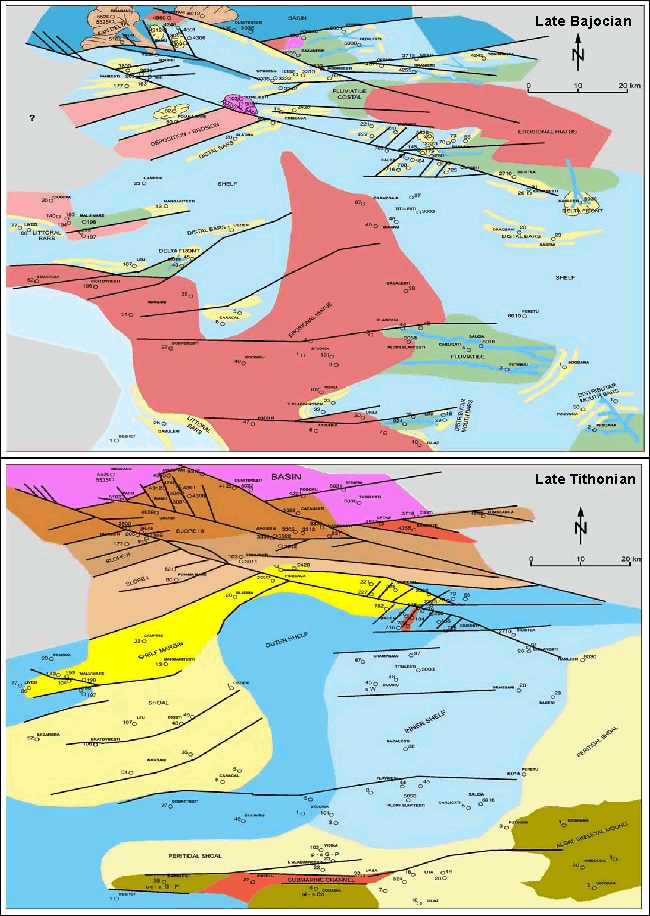
The Middle Jurassic depositional systems are represented by coastal
fluviatile domain, littoral and offshore bars, strand plain, delta
system, shelf, shelf margin, slope, fan delta and basin (Figure 20).
Offshore distal sandbars, littoral bars, and delta front and fan delta
represent the prospects for Iancu Jianu, Fauresti, Spineni, Oporelu,
Bacea, and Ciuresti
In Late Jurassic, the depositional systems consisted of carbonate
shoals, banks or reefs on the internal and external shelf, a marginal
shelf, faulted slopes, and basin (Figure 21). The main prospect is
represented by Tithonian carbonate shelf margin with diagenetic
The defining of the major events in the basin evolution of Central Moesian Platform (Figure 22) led to the following conclusions : - Based on older and new considerations, Permian-Jurassic successions may be interpreted in terms of intracratonic extensional basins followed by subaerial erosion and strike-slip deformation in the northern part of the study area; in the southern-central areas, conditions for thermal subsidence of the basin prevailed.
-
The
- It
is worth noting that most of the Jurassic commercial
Sandulescu, M. 1984, Geotectonics of Romania (in Romanian): Bucharest, Editura Technika Publishing House, 336 p. Tari, Gabor, Oprea Dicea, Joe Faulkerson, Georgi Georgiev, Svetlozar Popov, Mihai Stefanescu, and Gary Weir, 1997, Cimmerian and Alpine stratigraphy and structural evolution of the Moesian Platform (Romania, Bulgaria), in Regional and petroleum geology of the Black Sea and surrounding region: AAPG Memoir 68, p. 63-90. |
 Figure 1. Tectonic sketch map of the Moesian Platform (after Sandulescu,
1984; Tari et al., 1997).
Figure 1. Tectonic sketch map of the Moesian Platform (after Sandulescu,
1984; Tari et al., 1997). Figure 2. Jurassic chrono-litho-bio-stratigraphic diagram, Moesian
Platform.
Figure 2. Jurassic chrono-litho-bio-stratigraphic diagram, Moesian
Platform. Figure 3. Location of seismic and depositional profiles in study area.
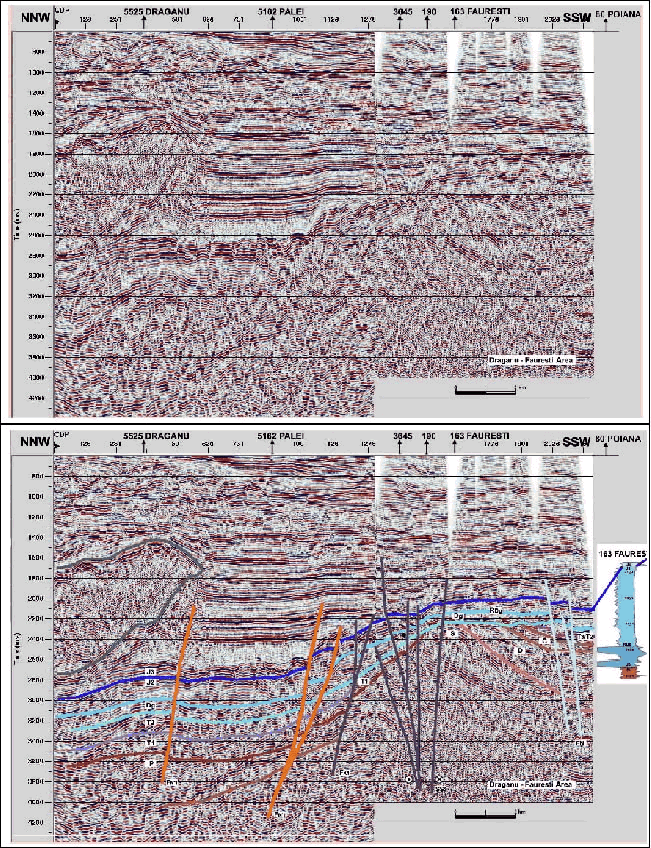
 Figure 4. Uninterpreted time migrated seismic profile across
Draganu-Fauresti area.
Figure 4. Uninterpreted time migrated seismic profile across
Draganu-Fauresti area. Figure 5. Interpreted seismic profile across Draganu-Fauresti area,
showing
Figure 5. Interpreted seismic profile across Draganu-Fauresti area,
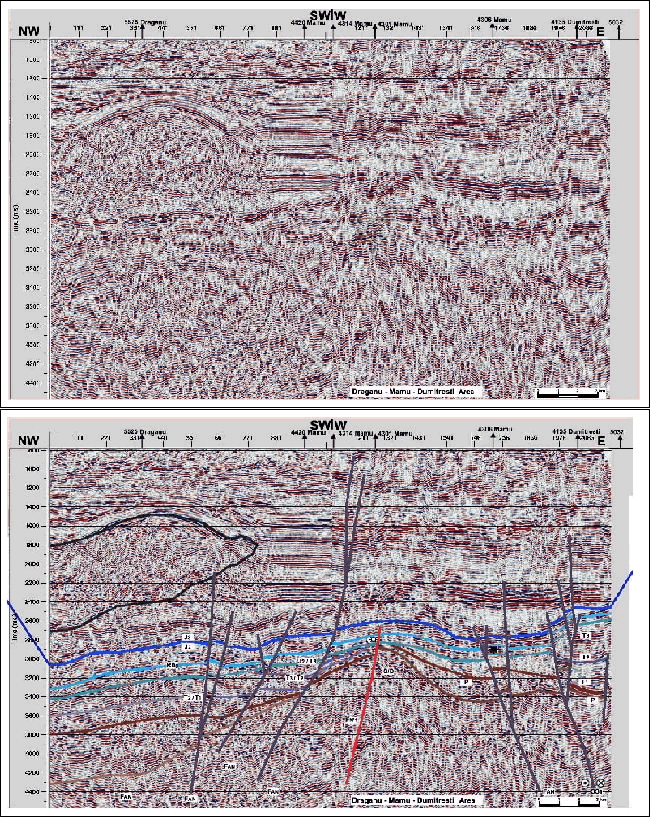
showing Figure 6. Uninterpreted time migrated seismic profile across
Draganu-Manu-Dumitresti area.
Figure 6. Uninterpreted time migrated seismic profile across
Draganu-Manu-Dumitresti area. Figure 7. Interpreted seismic profile across northern eroded faulted
horst (Mamu Field); different structural types are present: normal
Figure 7. Interpreted seismic profile across northern eroded faulted
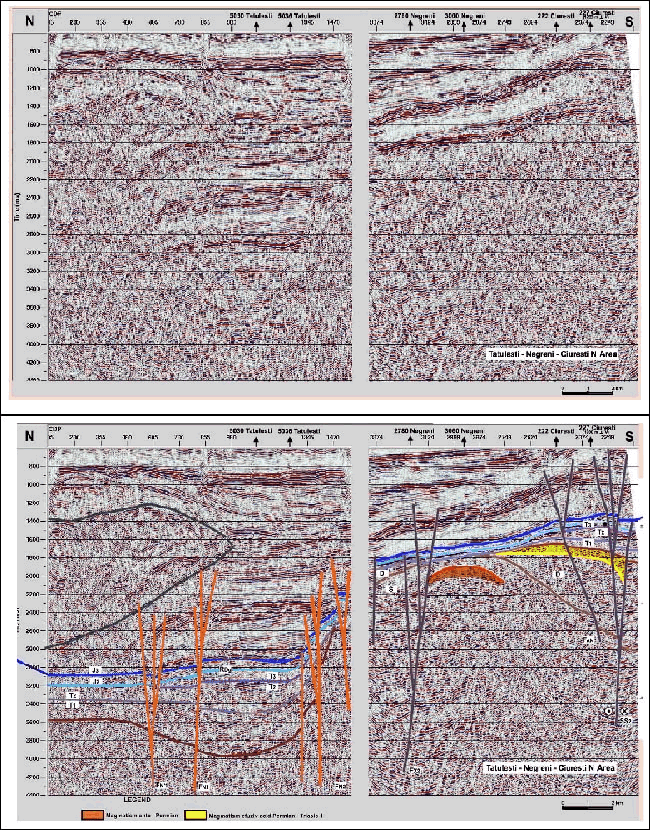
horst (Mamu Field); different structural types are present: normal  Figure 8. Uninterpreted time migrated seismic profile across
Tatulesti-Negreni-North Ciuresti area.
Figure 8. Uninterpreted time migrated seismic profile across
Tatulesti-Negreni-North Ciuresti area. Figure 9.
Interpreted seismic profile across the highest southern
Triassic
Figure 9.
Interpreted seismic profile across the highest southern
Triassic Figure 10. Uninterpreted time migrated seismic profile across
Oporeolu-Ciuresti-Crampoaia area.
Figure 10. Uninterpreted time migrated seismic profile across
Oporeolu-Ciuresti-Crampoaia area. Figure 11. Intrepeted seismic profile across Oporeolu-Ciuresti-Crampoaia
 Figure 12. Sketch map showing areal
  Figure 13. Tectonogram with Permian-Triassic rift configuration.
 Figure 14. Areal
  Figure 15. Sketch map of Jurassic elements, Central Moesian Platform.
 Figure 16. Depositional profile 3, with restored architecture of
Jurassic depositional sequences.
Figure 16. Depositional profile 3, with restored architecture of
Jurassic depositional sequences. Figure 17. Depositional profile 4. Restored
architecture of Jurassic
depositional sequences.
Figure 17. Depositional profile 4. Restored
architecture of Jurassic
depositional sequences.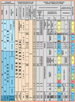 Figure 18. Chronostratigraphy and sequence stratigrpahy of Jurassic
successions on the Moesian Platform, correlated with global eustatic
cycles.
Figure 18. Chronostratigraphy and sequence stratigrpahy of Jurassic
successions on the Moesian Platform, correlated with global eustatic
cycles. 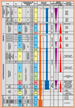 Figure 19. Jurassic tectonic and eustatic events on the Moesian
Platform.
Figure 19. Jurassic tectonic and eustatic events on the Moesian
Platform. Figure 20. Late Bajocian depositional systems—Falling Stage Systems
Tract.
Figure 20. Late Bajocian depositional systems—Falling Stage Systems
Tract. Figure 21. Late Tithonian depositional systems—Lowstand Systems Tract.
 Figure 22. Systems tracts related to the oil fields.