|
uIntroduction
uFigure
captions
uStructural
framework
tNormal-drag
folds
tReverse-drag
folds
tComposite
 fold fold structures structures
tPlastic
flow
uConclusions
uReferences
uAcknowledgments
uIntroduction
uFigure
captions
uStructural
framework
tNormal-drag
folds
tReverse-drag
folds
tComposite
fold structures
tPlastic
flow
uConclusions
uReferences
uAcknowledgments
uIntroduction
uFigure
captions
uStructural
framework
tNormal-drag
folds
tReverse-drag
folds
tComposite
fold structures
tPlastic
flow
uConclusions
uReferences
uAcknowledgments
uIntroduction
uFigure
captions
uStructural
framework
tNormal-drag
folds
tReverse-drag
folds
tComposite
fold structures
tPlastic
flow
uConclusions
uReferences
uAcknowledgments
uIntroduction
uFigure
captions
uStructural
framework
tNormal-drag
folds
tReverse-drag
folds
tComposite
fold structures
tPlastic
flow
uConclusions
uReferences
uAcknowledgments
|
Figure Captions
 Figure 1. Oritupano-Leona location map. The
study area is located on the southern flank of the Eastern Venezuela
Basin, in the foredeep platform zone. Figure 1. Oritupano-Leona location map. The
study area is located on the southern flank of the Eastern Venezuela
Basin, in the foredeep platform zone.
 Figure 2. Map showing normal-fault
trends and major oil fields in the Oritupano-Leona Block, along with a highly reduced log
of the Oficina Formation and overlying and underlying units. Figure 2. Map showing normal-fault
trends and major oil fields in the Oritupano-Leona Block, along with a highly reduced log
of the Oficina Formation and overlying and underlying units.
 Figure 3. Different features of folding in
Oritupano-Leona Block. a) Normal-drag folds. b) Reverse-drag folds. c)
and d) Composite fold structures. e) Folding by plastic flow. See inset
for location of sections. A: anticlinal structure, S: synclinal
structure, HW: hanging wall, FW: footwall. Figure 3. Different features of folding in
Oritupano-Leona Block. a) Normal-drag folds. b) Reverse-drag folds. c)
and d) Composite fold structures. e) Folding by plastic flow. See inset
for location of sections. A: anticlinal structure, S: synclinal
structure, HW: hanging wall, FW: footwall.
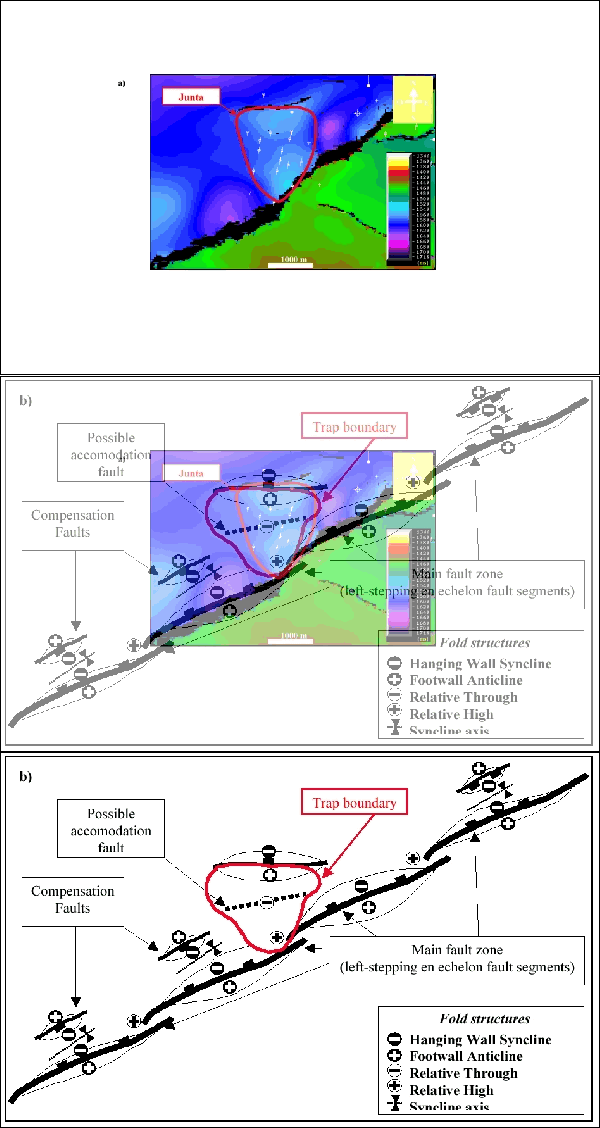
 Figure 4. Junta field structure. a) Time map
of Base Oficina. b) Line drawing with the interpretation of the
structural elements. Figure 4. Junta field structure. a) Time map
of Base Oficina. b) Line drawing with the interpretation of the
structural elements.
Click to view sequence of time map and line
drawing.
The southern flank of the Eastern Venezuelan Basin represents a relative
stable region characterized by extensional tectonics. The study area
shows a regional dip about 4° North. The fault planes display a general
planar geometry and dip around 45°. Two main fault systems are
identified; they follow a NE-SW and a W-E trend (Figure 2). Both main
fault systems control trapping.
The first fault system is parallel to the southern hinge of the basin.
The NE-SW fault system has synthetic dips, with dipping planes to NW.
The fault planes affect the whole section, including the basement. In
general, this system corresponds to regional lineaments and shows syn-sedimentary
characters. The Guara-Leona and Junta-Merey trends correspond to this
system (Figure 2). Fault throws can reach 1000 feet. Their origin is
associated to the flexural uplift which affected the basin during the
Oligocene-Miocene times (Elrich and Barrett, 1992).
The second fault system, trending W-E, display both antithetic and
synthetic dips. The fault traces show a dogleg pattern. It derives from
linkage of segmented fault planes (Laubscher, 1956, Cartwright et al.,
1995; Marchal et al., 1998). Longitudinal folds are mainly related to
this fault system and constitute the most important traps in the
Oritupano-Leona area; the production comes mainly from reservoirs
located in the upper and middle section of the Oficina Formation. This
fault system seems to be in relation with the extensional strain
resulting from dextral strike-slip movements along the boundary of
South-America and Caribbean plates (Elrich and Barrett, 1992).
Normal-drag folds are recognized in most of the fields of the Oritupano-Leona
Block (Figure 3a). They form anticlines in the footwall of main
antithetic faults and synclines in the hanging wall. The hinges of these
normal-drag folds are parallel to the fault strike. Even though the
largest reservoirs of the Oritupano-Leona Block are located in the
footwall (Figure 3a), significant hydrocarbon production has come from
traps located in the hanging wall (e.g., 41 MMBbls of oil in Oritupano B
and 400 MBbls of oil in Oritupano C). In the Leona Field these folds
reach their maximum expression.
Reverse-Drag Folds
Reverse-drag folds are well expressed in Leona Field (Figure 3b). They
form anticlines in the hanging wall of main faults. A narrow, 10-km long
discontinuous belt of fold is defined in the hanging wall of the main
Leona fault and shows a hinge parallel to the fault. Five major folds
are identified. They affect the middle section of Oficina formation in
areas where the fault planes change their dips. Several wells have
penetrated these folds, confirming their hydrocarbon potential. More
than 2.7 MMbbls of oil has been produced from this type of traps. Minor
reverse-drag folds have been also observed in Oritupano-Leona area but
they have not associated oil production.
In some fields of Oritupano-Leona area, normal-drag folds are associated
to reverse-drag structures in vertical section (e.g., Eastern Leona
field, Figure 3c). The superposition of these two kinds of fold is due
to local complexity of the fault-plane network. The coexistence of both
major types of fold associated with normal faulting may lead to the
juxtaposition of two traps formed by elongated anticlinal structure on
both sides of the fault (Figure 3c). In the Leona Field, more than 2.7 MMbbls of light-medium oil has come from the reverse-drag folds.
The Junta field is made of a composite system of folds (Figure 3d). The
secondary features of two interacting fault systems make the structural
closure of this field: the first is composed of a fault zone of
left-stepping en echelon fault segments striking NE-SW, and the second
is represented by a W-E-striking fault (Figure 4). Associated with the
main fault zone (NE-SW) dipping NW is a parallel set of compensation
fault segments dipping SE. The trap is divided in two parts: the first
part is composed of the footwall anticline associated with normal-drag
folding on a compensation fault segment; the second part is formed by a
residual high located in the hanging wall of the main fault zone.
Located at the relay zone formed by two overlapping normal fault
segments, this high consists in a residual topography between two
synclinal structures due to normal drag folding in the hanging wall of
each fault segment, which belongs to the NE-SW main fault zone (Figure
4). The Junta trap has been drilled by 55 wells and has produced more
than 14 MMbbls of oil.
Minor folding can be also due to ductile deformation in the ramp of a
relay zone formed by two overlapping faults. This kind of folding is
characterized by structural highs in the overlapped zone. Folds
associated with relay ramps, related to segmented en echelon faults, are
frequently seen in the Oritupano “A”, “B” and Leona fields.
In Adobe field, located in the central part of the area, W-E cross
sections have allowed us to identify particular small features,
wavy-shaped in the Oficina Formation (Figure 3e). This type of folding
could be related to plastic flow deformation, and slumping, as
determined by the competence of sediments. This type of structure is
rare in the area, and its economic potential has not yet been
established.
1. The use of 3D seismic allows the identification of favorable
structures, of various scales, for oil trapping. Normal- and
reverse-drag folds represent new exploration and re-development
opportunities for these mature oil fields. Reverse-drag folds have been
successfully drilled in Leona Field. Many gas and oil reservoirs have
been discovered in recent years.
2. These types of traps constitute an important economic up-side
potential for the Oritupano-Leona Block. Their identification can be
used as a critical element for searching for new reservoirs in developed
areas.
3. Further detailed studies of fault-related folding will lead to a
better understanding of the sealing capacity of faults, fluids
movements, and reservoir charge in order to improve oil recovery in
fields.
Azalgara, C., Salas, D., Ibáñez, G., and De Almeida, H.,
2000, Trampas de tipo pliegue de arrastre asociado a falla normal en la
Fm. Oficina, área Oritupano-Leona, Cuenca Oriental de Venezuela: X
Congreso Venezolano de Geofísica.
Cartwright, J.A., Trudgill, B.D., and Mansfield, C.S.,
1995, Fault growth by segment linkage: an explanation for scatter in
maximum displacement and trace length data from Canyonlands grabens of
SE Utah: Journal of Structural Geology, v. 17, p. 1319-1326.
Erlich, R.N., and Barrett, S.F., 1992, Petroleum geology
of the Eastern Venezuela Foreland Basin, in Macqueen, R.W., and
Leckie, D.A. (eds.), Foreland Basins and Fold Belts. AAPG Memoir 55, p.
341-362. Belts. AAPG Memoir 55, p.
341-362.
González de Juana, C., Iturralde de Arozena, J.M. y
Picard Cadillat, X., 1980, Geología de Venezuela y de sus cuencas
petrolíferas: Ediciones Foninves, v. 2, 1051 p.
Laubscher H.P., 1956, Structural and seismic deformations
along normal faults in the Eastern Venezuelan Basin: Geophysics, v. 21,
p. 368-387.
Marchal, D., Guiraud, M., Rives, T and Van Den Driessche,
J., 1998, Space and time propagation processes of normal faults, in
Jones, G, Fisher, Q.J., and Knipe, R.J. (eds.), Faulting, Fault Sealing
and Fluid Flow in Hydrocarbon Reservoirs: Geological Society, London,
Special Publication 147, p. 51-70.
Mencher, E., Fitcher, H.J., Renz, H.H., Wallis, W.E.,
Renz, H.H., Patterson, J.M., and Robie, R.H., 1953, Geology of Venezuela
and its oil fields: AAPG Bulletin, v.37, no. 4, p. 690-777.
Parnaud, F., Pascual, J.C., Truskowsky, I., Gallango,
O., Pasalacqua, H. and Roure, F., 1995, Petroleum geology of the central
part of the Eastern Venezuelan Basin, in Tankard, A.J.; Suárez
Soruco, R., and Welsink, H.J. (eds.), Petroleum Basins of South America:
AAPG Memoir 62, p. 741-756.
Porras, J., Selva, C., and Díaz, M., 2001, Reverse-drag
folds: New structural traps in a mature oil field: Leona Field case
study (abstract): AAPG Hedberg Conference.
We would like to thank Perez Companc for the permission to publicate
this article. We also thank the Oritupano-Leona teams for providing us
helpful information from the fields.
Return
to top.
|

 Print this page
 Click to view article in PDF format.