Print this page
 Click to view article in PDF format.
Extensional Folding in the Eastern Venezuela Basin: Examples from Fields of Oritupano-Leona Block*
By
Jesús S. Porras1, Eduardo L. Vallejo1, Denis Marchal1, and Carlos Selva1
Search and Discovery Article #50003 (2003)
*Adapted from “extended abstract” for presentation at the AAPG Annual Meeting, Houston, Texas, March 10-13, 2002.
1Pérez Companc, Caracas, Venezuela
Introduction
A large variety of folds have been identified in the Oritupano-Leona area. The Oritupano-Leona Block is located at the Greater Oficina Trend (Figure 1). More than 12 isolated oil fields constitute the block. Structurally, the fields are located in the southern flank of the Eastern Venezuela Basin (EVB), in the foredeep platform zone (Parnaud et al., 1995) (Figure 1). The field is affected by normal faulting mainly trending N60°E (Figure 2). Productive section is represented by the Oficina Formation (Early Miocene) (Figure 2), although uppermost reservoirs of the underlying Merecure Formation (Oligocene) have produced an acceptable volume of oil. Cumulative oil production of the block is over 340 MMbbls since its discovery in the1940’s. Reservoirs are composed of sandstones of estuarine to shallow-marine environments.
Detailed 3D
seismic interpretation distinguished various types of folds in the area:
normal- and reverse-drag fold, composite fold structure and folds related to
plastic flow. Longitudinal folds that include normal- and reverse-drag folds
are common features in several fields and reported by different workers (Mencher
et al., 1953; González de Juana et al., 1980; Azalgara et al., 2000; Porras et
al., 2001). These folds are responsible for major oil accumulations. Normal-drag
folds form the largest, with extended reservoirs in the footwall of master
normal faults (Azalgara et al., 2000), whereas reverse-drag folds provide the
structural closure for trapping in the hanging wall, especially in Leona Field (Porras
et al., 2001). Composite fold structures and folds related to plastic flow are
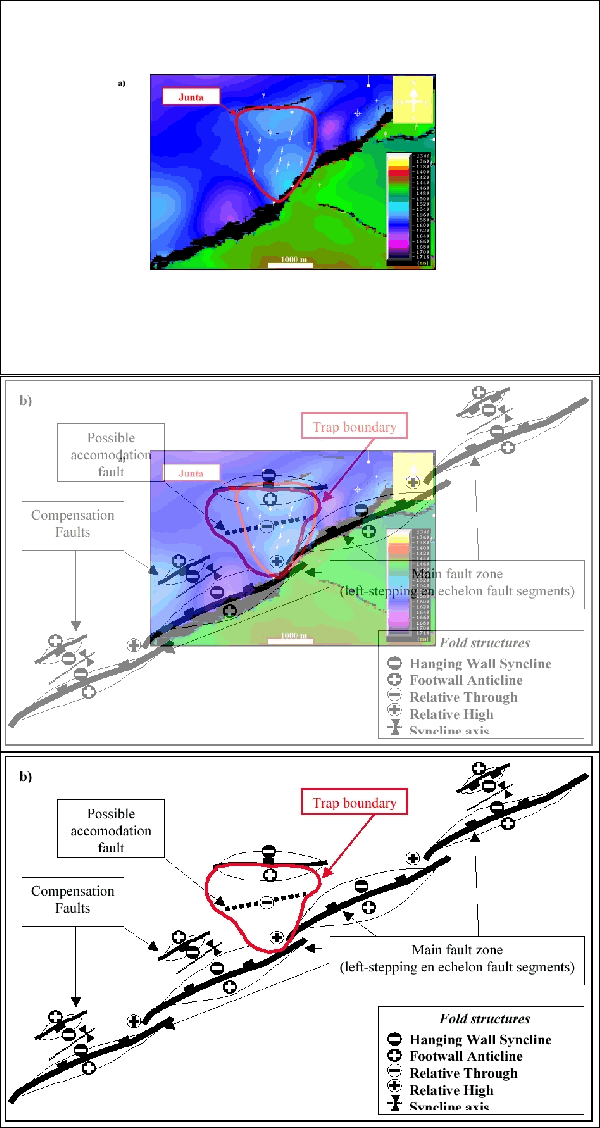
also described. The Junta field trap is a complex structure formed by a
combination of folds related to normal  fault
fault growth, linkage, and interaction.
|
|
Click to view sequence of time map and line drawing.
Structural Framework
The southern flank of the Eastern Venezuelan Basin represents a relative
stable region characterized by extensional tectonics. The study area
shows a regional dip about 4° North. The
The first
The second
Normal-Drag Folds
Normal-drag folds are recognized in most of the fields of the Oritupano-Leona
Block (Figure 3a). They form anticlines in the footwall of main
antithetic faults and synclines in the hanging wall. The hinges of these
normal-drag folds are parallel to the
Reverse-drag folds are well expressed in Leona Field (Figure 3b). They
form anticlines in the hanging wall of main faults. A narrow, 10-km long
discontinuous belt of fold is defined in the hanging wall of the main
Leona
Composite Fold Structures
In some fields of Oritupano-Leona area, normal-drag folds are associated
to reverse-drag structures in vertical section (e.g., Eastern Leona
field, Figure 3c). The superposition of these two kinds of fold is due
to local complexity of the
The Junta field is made of a composite system of folds (Figure 3d). The
secondary features of two interacting Minor folding can be also due to ductile deformation in the ramp of a relay zone formed by two overlapping faults. This kind of folding is characterized by structural highs in the overlapped zone. Folds associated with relay ramps, related to segmented en echelon faults, are frequently seen in the Oritupano “A”, “B” and Leona fields.
Plastic FlowIn Adobe field, located in the central part of the area, W-E cross sections have allowed us to identify particular small features, wavy-shaped in the Oficina Formation (Figure 3e). This type of folding could be related to plastic flow deformation, and slumping, as determined by the competence of sediments. This type of structure is rare in the area, and its economic potential has not yet been established.
Conclusions1. The use of 3D seismic allows the identification of favorable structures, of various scales, for oil trapping. Normal- and reverse-drag folds represent new exploration and re-development opportunities for these mature oil fields. Reverse-drag folds have been successfully drilled in Leona Field. Many gas and oil reservoirs have been discovered in recent years. 2. These types of traps constitute an important economic up-side potential for the Oritupano-Leona Block. Their identification can be used as a critical element for searching for new reservoirs in developed areas.
3. Further detailed studies of
ReferencesAzalgara, C., Salas, D., Ibáñez, G., and De Almeida, H., 2000, Trampas de tipo pliegue de arrastre asociado a falla normal en la Fm. Oficina, área Oritupano-Leona, Cuenca Oriental de Venezuela: X Congreso Venezolano de Geofísica.
Cartwright, J.A., Trudgill, B.D., and Mansfield, C.S.,
1995, Erlich, R.N., and Barrett, S.F., 1992, Petroleum geology of the Eastern Venezuela Foreland Basin, in Macqueen, R.W., and Leckie, D.A. (eds.), Foreland Basins and Fold Belts. AAPG Memoir 55, p. 341-362. González de Juana, C., Iturralde de Arozena, J.M. y Picard Cadillat, X., 1980, Geología de Venezuela y de sus cuencas petrolíferas: Ediciones Foninves, v. 2, 1051 p. Laubscher H.P., 1956, Structural and seismic deformations along normal faults in the Eastern Venezuelan Basin: Geophysics, v. 21, p. 368-387.
Marchal, D., Guiraud, M., Rives, T and Van Den Driessche,
J., 1998, Space and time propagation processes of normal faults, in
Jones, G, Fisher, Q.J., and Knipe, R.J. (eds.), Faulting, Mencher, E., Fitcher, H.J., Renz, H.H., Wallis, W.E., Renz, H.H., Patterson, J.M., and Robie, R.H., 1953, Geology of Venezuela and its oil fields: AAPG Bulletin, v.37, no. 4, p. 690-777. Parnaud, F., Pascual, J.C., Truskowsky, I., Gallango, O., Pasalacqua, H. and Roure, F., 1995, Petroleum geology of the central part of the Eastern Venezuelan Basin, in Tankard, A.J.; Suárez Soruco, R., and Welsink, H.J. (eds.), Petroleum Basins of South America: AAPG Memoir 62, p. 741-756. Porras, J., Selva, C., and Díaz, M., 2001, Reverse-drag folds: New structural traps in a mature oil field: Leona Field case study (abstract): AAPG Hedberg Conference.
AcknowledgmentsWe would like to thank Perez Companc for the permission to publicate this article. We also thank the Oritupano-Leona teams for providing us helpful information from the fields. |
 Figure 1. Oritupano-Leona location map. The
study area is located on the southern flank of the Eastern Venezuela
Basin, in the foredeep platform zone.
Figure 1. Oritupano-Leona location map. The
study area is located on the southern flank of the Eastern Venezuela
Basin, in the foredeep platform zone. Figure 2. Map showing normal-
 Figure 3. Different features of folding in
Oritupano-Leona Block. a) Normal-drag folds. b) Reverse-drag folds. c)
and d) Composite fold structures.
Figure 3. Different features of folding in
Oritupano-Leona Block. a) Normal-drag folds. b) Reverse-drag folds. c)
and d) Composite fold structures. Figure 4. Junta field structure. a) Time map
of Base Oficina. b) Line drawing with the interpretation of the
structural elements.
Figure 4. Junta field structure. a) Time map
of Base Oficina. b) Line drawing with the interpretation of the
structural elements.