Print this page
 Click to view article in PDF format.
The Stratigraphic Evolution of Monterey Fan Area and Growth Patterns of Related Channel Complexes*
By
Andrea Fildani1,2 and William R. Normark2
Search and Discovery Article #30017 (2003)
*Adapted from “extended abstract” for presentation at the AAPG Annual Meeting, Salt Lake City, Utah, May 11-14, 2003.
1Department of Geological and Environmental Sciences, Stanford University, Stanford, CA 94305 ([email protected]).
2U.S. Geological Survey, Menlo Park, CA 94025
General Statement
The modern Monterey submarine fan, which is one of the largest turbidite systems
off the western US, encompasses as much as 600 meters of deposition that
accumulated within less than a million years. The merging of all the
seismic- reflection
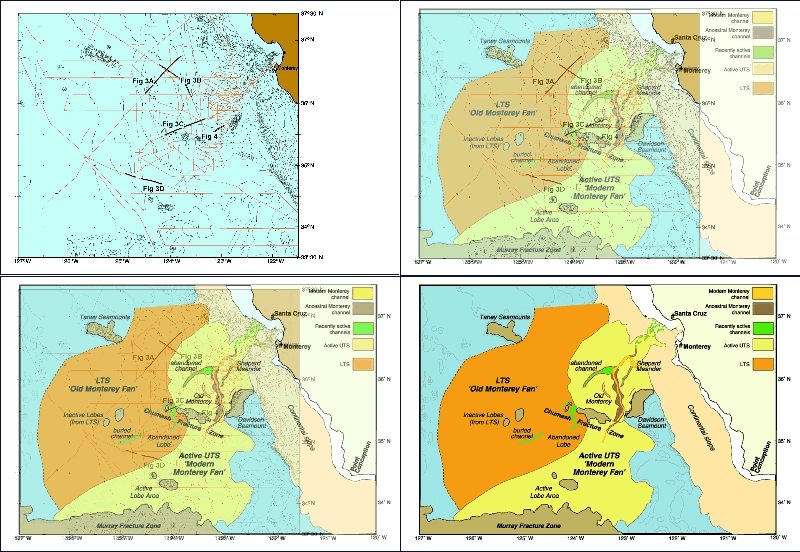
 data available from the area of the Monterey fan (Figure 1)
showed that the Monterey fan is, in fact, composed of two major turbiditic
systems with different sources and timing of deposition (Figure 2):
data available from the area of the Monterey fan (Figure 1)
showed that the Monterey fan is, in fact, composed of two major turbiditic
systems with different sources and timing of deposition (Figure 2):
-
Lower Turbidite System (LTS).
-
Modern Upper Turbidite System (UTS).
The UTS, which comprises much less than half of the total fan volume, includes
four channel-levee systems that show a complex history of channel switching
resulting from autocyclic and, possibly, tectonic influences. These
channel-levee complexes are located in the northeastern quadrant, the
best-documented area of the modern fan. The age of samples from the base of the
modern Monterey channel wall collected with the submersible ALVIN indicates that
the entire UTS is probably no older than 500 ka, and reflection profiles show
that it is nowhere thicker than 600 meters (Figure 3). This recent depositional
system, which is much less than half of the total fan volume, is present only in
the eastern part of the study area and it wedges out toward the west, northwest,
and southwest (Figure 3). The most recent deposits of the UTS are in the
southern distal area, with a succession of southward-propagating lobes fed by
rapidly shifting channels (Figure 2). The modern Monterey fan-valley is largely
a by-pass zone funneling sediment to the southern lobe area, with a retrofit
channel still evident in the transition from a leveed valley to the lobe
depositional area (Figure 4).
The UTS is underlain by the more extensive LTS (Figure 3), which comprises a series of lower-relief, less well-defined channel, overbank, and lower-fan/basin-plain elements. The age of the LTS is unknown but its basal deposits may be as old as the age of oceanic crust underneath (early Miocene). The channel and overbank elements of the LTS do not have the high relief and distinctive character of those in the UTS deposits and constitute loosely defined sediment pathways. No clear feeder system(s) on the California margin has(have) been identified for the LTS, but distribution of sediment pathways suggests that the source(s) for LTS lies(lie) north of the fan channels systems fed by the modern canyon systems. The inferred age of the LTS and the most recent plate boundary reconstruction suggest that its initial source was when the fan area was near the present Transverse Ranges.
 Figure 1:
Trackline map of the USGS and Scripps Institution of Oceanography cruises
over the Monterey fan area showing location of seismic-
Figure 1:
Trackline map of the USGS and Scripps Institution of Oceanography cruises
over the Monterey fan area showing location of seismic- Figure 2:
Schematic map of the area of deposition of the Monterey fan showing the
areal distribution of the Lower Turbidite System (LTS) and the
superimposed and most recently active Upper Turbidite System (UTS).
Figure 2:
Schematic map of the area of deposition of the Monterey fan showing the
areal distribution of the Lower Turbidite System (LTS) and the
superimposed and most recently active Upper Turbidite System (UTS). Figure 3:
Line drawings of selected seismic-
Figure 3:
Line drawings of selected seismic- Figure 4: 3.5
kHz seismic-
Figure 4: 3.5
kHz seismic-