Print this page
 Click
to view article in PDF format.
Click
to view article in PDF format.
Paleogene  Depocenter
 along the Northeast Margin of the Maracaibo
Basin: Structure along an Exhumed, Eocene Age Lateral Ramp Fault in the
Maracaibo Basin, Western Venezuela*
along the Northeast Margin of the Maracaibo
Basin: Structure along an Exhumed, Eocene Age Lateral Ramp Fault in the
Maracaibo Basin, Western Venezuela*
By
Alejandro Escalona1 and Paul Mann2
Search and Discovery Article #30018 (2003)
*Adapted from “extended abstract” for presentation at the AAPG Annual Meeting, Salt Lake City, Utah, May 11-14, 2003.
1Jackson School of Geosciences, Department of Geological Sciences, The University of Texas at Austin, Austin, Texas ([email protected]).
2Jackson School of Geosciences, Institute for Geophysics, The University of Texas at Austin, Texas
Abstract
Two different
tectonic models have been proposed for the thick Eocene depocenter located along
the northeastern margin of the Maracaibo basin, Venezuela. The first model
proposes that the depocenter is a foreland basin controlled by
southwestward-directed overthrusting during late Paleocene-middle Eocene
collision between the Caribbean and South American plates. The second model
proposes that the northeast sedimentary wedge was controlled by a large tear
fault, or lateral ramp, separating SE-directed, but independently moving, thrust
sheets. Regional seismic lines reveal the structure of the Paleogene depocenter
in the northeastern area of the Maracaibo basin. The Burro Negro fault forms a
line of separation between shallow to outer shelf, less deformed rocks to the SW
from deep marine highly deformed rocks to the NE. Configuration of the basin and
faults mapped on regional-scale 2D seismic lines tied to wells supports a tear,
or lateral-ramp fault origin, which allowed SE migration of the thrust front
east of the Maracaibo basin.
|
|
IntroductionIn Venezuela, a west-to-eastward younging pattern of thrusts and lateral ramp faults are developed along the Caribbean - South American boundary (Figure 1). In present-day Maracaibo basin, these lateral ramps and thrusts are largely inactive, but exposed by later inversion related to the North Andean orogeny. The main objectives are to illustrate the overall structure of the Burro Negro fault, an exhumed Eocene age lateral ramp fault exposed along the eastern edge of the Maracaibo basin, by using a compilation of outcrop and subsurface observations compiled from previous workers and regional 2D seismic data. These data show that the Burro Negro fault, is rigth-lateral strike-slip in character and separates an unthrusted, asymmetrical shallow to deep basin from a thrusted area of deepwater sedimentary rocks.
Regional SettingFigure 2 shows the present-day configuration of the Maracaibo basin, located in western Venezuela. The basin is a triangular depression bounded by two main mountain ranges trending NE and NNE. The Sierra de Perijá and Oca fault bound the basin to the west and north, respectively. The Mérida Andes bounds the basin to the SSE. The Boconó fault, a dextral strike-slip fault, follows the crest of the Mérida. To the east the depression is bounded by the Trujillo Mountains, trending NW-SE and ending near the Valera fault. East of the Trujillo Mountains are the Lara nappes folded into an anticlinorium trending NE-SW (Mathieu, 1989).
A regional time slice at 3400 ms, covering most of the Lake Maracaibo
area and part of the eastern alluvial plains, (Figure 2), intersects
Cretaceous to Miocene rocks. Prominent structural features within the
3400 ms time slice include NNE striking faults (e.g., Icotea and Pueblo
Viejo faults), formed during Jurassic rifting and reactivated as Eocene
strike-slip faults. Another family of east-west-striking faults is
observed, mainly in the central part of the basin. These faults were
previously interpreted as a flexural response to the subsidence of the
South American plate due to load of the Caribbean plate during the
Paleogene (Castillo, 2001). Two models for the structural evolution of
the Maracaibo basin and the development of the Eocene A) Foreland basin (Lugo, 1991; Audemard, 1991; Lugo and Mann, 1995): A NE-dipping thrust front, located in the northern part of the basin and Falcón area, controlled a parallel Eocene foredeep. The thrust front and foredeep migrated southeastward with the emplacement of the Lara nappes.
B) Tear fault or lateral ramp or transversal (Stephan, 1985; Mathieu,
1989): A
Database and MethodologyThis study uses 2000 km2 of 3D seismic data, located at the center of the Maracaibo basin, and approximately 500 km of 2D seismic lines. Regional time slices, produced by merging many of the 3D seismic surveys of the Lake Maracaibo area (Castillo, 2001), were also used. Five deep exploratory wells located in the central and eastern parts of the basin were tied to seismic data. A fence diagram shown in Figure 3 orients the various tectonic elements interpreted in the eastern map of the Maracaibo basin.
Tectonic ElementsLower Eocene Clastic Wedge: Foreland Basin, Forebulge, and Thrust FrontIn the Maracaibo basin, lower Eocene rocks onlap the Paleocene unconformity and back-step from north to south (Figure 3). Southward migration of younger, onlap deposits over the Paleocene unconformity indicates southward migration of the forebulge as subsidence increases. By middle Eocene most of the Maracaibo basin was subaerially exposed. Isostatic rebound and cessation of tectonic loading over the basin suggests a termination of the Maracaibo foreland basin.
Burro Negro Fault Zone, Platform Break and Lateral RampDeeper Eocene rocks are to the NE from a stable shallower platform to the SW. Gonzáles de Juana et al. (1980) defined a paleogeographic boundary between the shallow marine environments to the south (platform province) and basinal environments to the north, coinciding with the mapped surface trace of the Burro Negro fault zone. Orientation of Eocene convergence, west of the Burro Negro fault, indicates SW vergence (Mathieu, 1989). Main depocenters were located in front of the folded system during the end of the Eocene east of the Burro Negro fault (Mathieu, 1989), where Paleocene-Eocene flysch and slumps have been observed. Therefore, the Burro Negro fault area can be defined as the shelf edge between the deep basin located to the NNE and the platform to the SSW. The fault was reactivated by oblique collision of the Caribbean coming from the west using the Burro Negro fault as a continental bathymetric reentrant within the NE-trending South American plate boundary where the Caribbean plate could be translated towards the SE, acting as a lateral ramp between collided and uncollided parts of a diachronously forming fold-thrust belt.
Chaotic Zones: Fault Zone, Shale Diapirs?Structurally chaotic zones separate the Oligocene-Neogene sub-basins, north of the Burro Negro fault. These chaotic zones exhibit characteristics similar to those observed in highly fractured fault zones or shale diapirs, where basinal shale is overpressured by the Eocene-present compression.
Eocene Barinas Basin
The Eocene Barinas basin
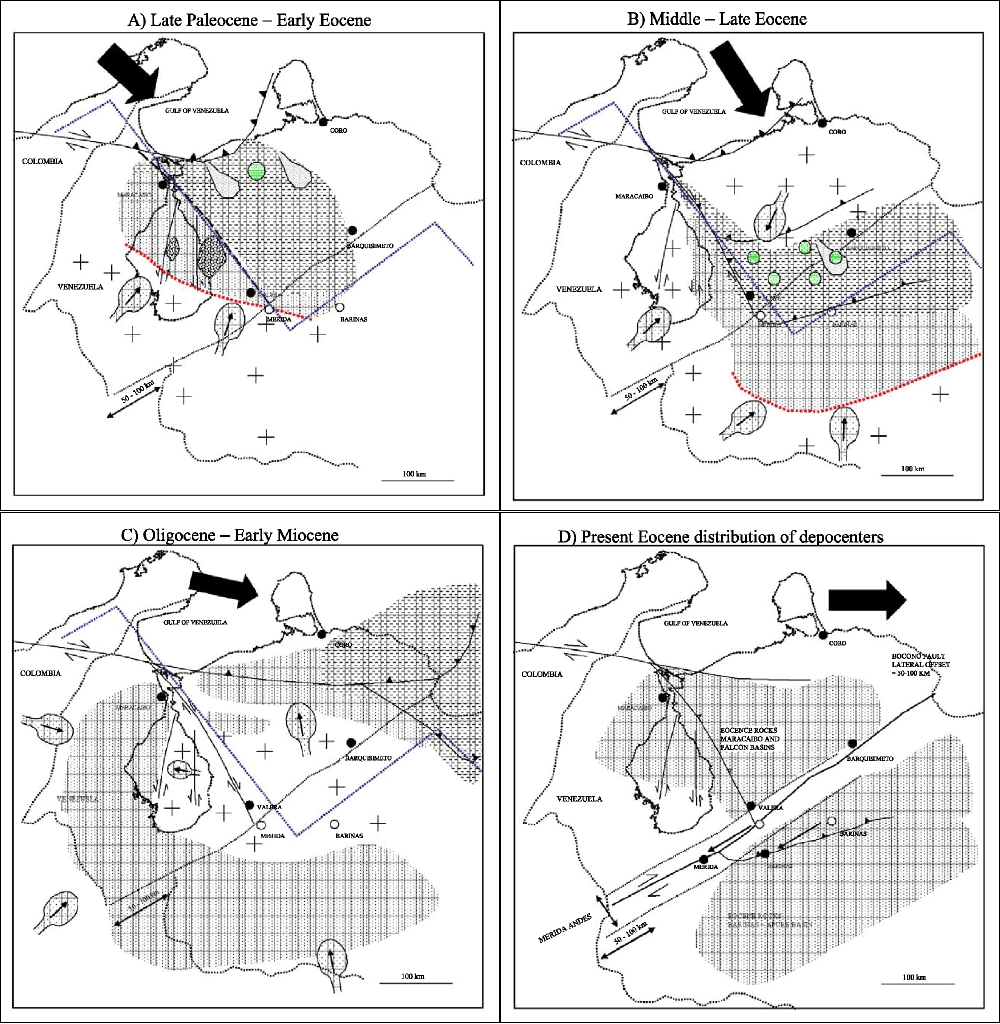
Paleogene Evolution Model for the Maracaibo BasinAn integrated reconstruction of the evolution of the Maracaibo basin during the Paleogene is summarized in Figure 4. Three main stages can be described as follows: a. Late Paleocene - early Eocene (Figure 4A): The Maracaibo basin begins to downwarp as a response of tectonic loading in the north and northeast as the Caribbean plate collides with northern South America. A flexural bulge that formed in the central part of the basin migrated southward in response to the thrust belt located in the north- northwest. b. Middle - late Eocene (Figure 4B): Tectonic loading ends in central and south Maracaibo basin, producing a regional unconformity by tectonic rebounding. The thrust front begins to move southeastward, bounded to the west by the Burro Negro fault in the northeastern part of the basin. c. Late Eocene - Oligocene (Figure 4C): The Caribbean plate moves ESE into the deepwater reentrant and induces strike-slip motion in the area; coeval folding continues east of the Burro Negro fault.
d. Late Tertiary (Boconó fault; Figure 4D): Uplift of the Mérida Andes
during the Late Tertiary separates the Maracaibo basin from the Barinas
basin. Later motion along the Boconó fault displaces the Maracaibo basin
northeastward towards the Barinas Eocene
ReferencesAudemard, Felipe, 1991, Tectonics of western Venezuela: Unpublished Ph.D. dissertation, Rice University, Houston, 245 p. Castillo, Maria Veronica, 2001, Structural analysis of Cenozoic fault systems using 3D seismic data in the southern Maracaibo Basin, Venezuela: Unpublished Ph.D. dissertation, The University of Texas at Austin, Austin, 189 p. González de Juana, C., Iturralde, J. M. and Picard, X. (eds.), 1980, Geología de Venezuela y de sus cuencas petrolíferas: Ediciones Funinves, Tomo 2, 616 p. Lugo, J., 1991, Cretaceous to Neogene tectonic control on sedimentation: Maracaibo Basin, Venezuela: Unpublished Ph.D. dissertation, The University of Texas at Austin, Austin, 219 p. Lugo, J., Mann, P., 1995, Jurassic-Eocene tectonic evolution of Maracaibo Basin, Venezuela, in A. Tankard, Suarez, S., Welsink, H. (eds.), Petroleum Basins of South America: AAPG Memoir 62, p. 699-725. Mathieu, X., 1989, La Serranía de Trujillo-Ziruma aux confins du bassin de Maracaibo, de la sierra du Falcón et de la Chaine Caraibe. Lithostratigraphie, tectonique (surface-subsurface) et evolution geodynamique: Dissertation, L’Universite de Bretagne Occidentale, Bretagne, 264 p. Stephan, J. F., 1985, Andes et Chaine Caraibe sur La Transversal de Barquisimeto (Venezuela), Evolution geodynamique: Geodynamique des Caraibes, Symposium, Paris, p. 505-529. |