Print this page
 Click
to view article in PDF format.
Click
to view article in PDF format.
Processes of Mud Volcanism in the Barbados-Trinidad Compressional System: New structural, Thermal and Geochemical Data*
By
Eric Deville1, Anne Battani1, Roger Griboulard2, Sophie Guerlais1, Siegfried Lallemant3, Alain Mascle1, Alain Prizhofer1, and Julien Schmitz1
Search and Discovery Article #30017 (2003)
*Adapted from “extended abstract” for presentation at the AAPG Annual Meeting, Salt Lake City, Utah, May 11-14, 2003.
1Institut Français du Pétrole, Rueil-Malmaison, France
2Université de Bordeaux I, Talence, France
3Université de Cergy-Pontoise, France
General Statement
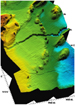
Subsurface sediment mobilization in SE Caribbean occurs in a context of plate boundary between the Caribbean plate and the South American plate, at the junction between the Barbados accretionary prism and the transform system of the northern Venezuela. Within this compressional and transpressional system, a several hundred kilometres-long active belt of mud volcanoes and shale diapirs develops from the Barbados tectonic wedge to the thrust belt of Northern Venezuela (Figure 1). In this system, the mud volcanoes of Trinidad and Venezuela are only the emerged part of a widely developed phenomenon in the offshore area of the Barbados prism (especially in its southern part). This has been notably spectacularly evidenced by the recent results of the CARAMBA survey of the O/V ATALANTE in 2002 (Figures 2 and 3).
|
|
Structural SettingMud domes and
volcanoes developed in different structural settings (Biju-Duval et al.,
1982; Valery et al., 1985; Brown and Westbrook, 1987; Brown, 1990;
Rutledge and Leonard 2001; Deville et al., 2003a, b [in press],
Figure 1). The front of the tectonic wedge
is characterized by an imbricated thrust system mostly devoid of active
mud volcanism activity. The main province of active shale diapirs and
mud volcanoes is found within the core of the tectonic prism along ramp
anticlines and on top of sigmoid rises of mud diapirs (Figure
2), or else along major transfer zones (especially at the eastern
extremity of the El Pilar fault in the Barbados prism; Valery et al.,
1985; Griboulard et al., 1991). In the slope between Trinidad and the
Barbados prism mud volcanoes have a rather random
Nature of the Mud and of the ClastsCombined X-ray diffraction and SEM studies (in the Trinidad and on cores collected from mud volcanoes of the Barbados prism) have shown that the solid particles within the mud are composed of clays (kaolinite, illite, smectite, vermiculite), chlorite, and muscovite, but also abundant grains of quartz, feldspar (albite, K-feldspar), carbonates (calcite, dolomite, siderite), titane oxides (rutile, anatase), apatite, barite, and pyrite. The grain size varies from less than 0.2 µm to more than 200 µm, and the grains are supported within a very thin matrix constituted by a mixing of various clays, micas sheets, and also small fragments (less than 5 µm) of quartz and albite with clearly angular shapes and internal microfractures, especially in quartz. The mechanical damage probably results from shearing during compaction or mud volcanism eruptive processes. Such quartz grains can make up more than 90% of the solid fraction within the mud. In the Trinidad mud volcanoes with a recent eruptive activity (Piparo, Devil’s Woodyard, Columbus group, Anglais Point, Moruga), exotic clasts are found (mainly centimetric to pluri-decimetric). The nature of the clasts is polygenic (carbonates, sandstones, shales, calcite, sulphur nodules, etc.). Some clasts are ancient pebbles initially interbedded within Tertiary formations and mobilized during eruptions, but most of the clasts show angular shapes resulting from intense fracturing. Fractures are filled with carbonate cements (Ca and Ca-Mg). Frequently, real breccias made up of angular and initially joined elements are included within calcite crystallizations. We interpret most of the angular clasts and the breccia as the result of hydraulic fracturing processes. Using nannofossils, it is possible to date precisely the clasts expelled by the mud volcanoes. According to the ages obtained, these elements belong to Tertiary formations, ranging from Paleocene to Miocene. Cretaceous clasts are expelled by the Piparo mud volcano in the Central Range, the older elements being of early Barremian age. But in this case, these clasts can come from the base of the Naparima thrust sheet and they do not necessarily have a deep origin. On the other hand, the mud shows systematically a mixing of species ranging from Cretaceous to Late Miocene. This suggests that the mud consists of a mixture of microscopic elements of various origins (from Tertiary formations, but also from Cretaceous levels). These data show that the zone of initiation of the mud volcanism is necessarily at least as deep as the Paleogene and probably the Cretaceous, because the mud intrusions do not crosscut thrust sheets involving Cretaceous-Paleogene formations, except for Piparo. In the offshore, the study of nannofossils in cores collected from the south of the Barbados prism suggests that the mobilized sediments in shale domes and mud volcanoes, are of Miocene-Pliocene age (zones NN15 to NN21) at the front of the mud volcanism zone. However, various horizons probably including the Eocene, and certainly including Oligocene (zones NP25 to NP21), Miocene, and Pliocene intervals have been mobilized in the inner part of the Barbados Ridge. Gas CompositionIn the onshore mud
volcanoes of Trinidad, the gas is mainly methane associated with
moderate concentrations of ethane, propane, and carbon dioxide. This dry
gas is characterized by a dC13
of methane which ranges between -52 and 33o/oo (Figure
4). Such d13C1
values associated with very dry gases are generally interpreted as
intermediate values between a purely bacterial gas and a purely
thermogenic gas. Nevertheless methane
d13C can be affected by post-genetic phenomena
(segregation during migration, chemical bacterial alteration) and it is
possible to use the d13C(C1)
vs C1/C2
diagram (Figure 4) to distinguish some of
these processes (Prinzhofer and Pernaton, 1997). This suggests that a
mixing hypothesis between bacterial and thermogenic gas must be rejected
because in these cases the bacterial end member would have methane
d13C between -52 and
-33 o/oo, which are too heavy values, incompatible with a bacterial
origin. Therefore, we consider that most of the analyzed gas samples
have a strictly thermogenic origin. The dryness of the gas would be due
to a segregation process, which probably occurred during its migration
from depth to the surface (adsorption on the solid grains of the mud,
and solubility processes). The concentration in C2+
is higher in the sites where eruptions occurred recently (Piparo and
Devil’s Woodyard, Columbus). We suppose that adsorption occurs mainly
during steady state phases and that C2+
is released only during and after catastrophic eruptions. Though the
maturity of the gas is difficult to define precisely because of the
segregation processes mentioned above, this thermogenic gas has probably
been generated in the oil window. In the case of very recent (Neogene)
gas generation, as observed in Trinidad, high flows of thermogenic gas
could have been generated at temperature around 150oC,
similar to the equilibrium temperature of the deep reservoir that has
fed the mud volcanoes (Dia et al., 1999). The chemical and isotopic
composition of the gas suggests a cogenetic origin with the
Thermal MeasurementsNew heat flow
measurements made during the CARAMBA survey, on some active mud
volcanoes in the southern area of the Barbados prism, show positive
anomalies (values higher than 100mW/m2, up to 230 mW/m2
at the vicinity of mud volcanoes in a heat flow background regime lower
than 40 mW/m2). Moreover, at the vicinity of some mud
volcanoes, BSRs are shallower compared to the areas around suggesting
that the stability field of gas-hydrates is here more restricted to
upper levels compared to the surrounding areas. We interpret those
anomalies as related to heat diffusion associated to the circulation of
hot fluids into the conduits of the mud volcanoes. We also studied the
temperature
DiscussionMud volcanoes
correspond to sedimentary eruption of liquefied material forming cones
or mud pies and associated superficial mud flows, whereas shale dome
correspond to piercing diapirs of mobilized plastic shales, which have
probably never been liquefied. Mud volcanism and shale dome processes
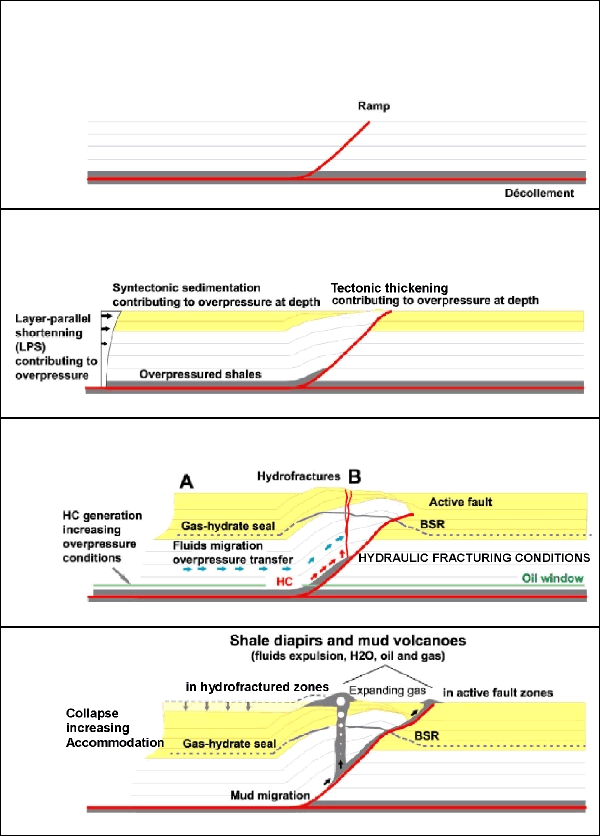
are both obviously related to the development of Hydraulic fracturing resulting from excess pore pressure tends to be sub-horizontal (Figure 5). Consequently, lateral hydraulic connectivity may be enhanced. High pore pressures in the center of piggyback basins, if approaching the lithostatic load, may be transmitted laterally towards the anticline crest where sedimentary thickness are smaller. Consequently, if pore pressure overcome the vertical load, upward mud extrusion can occur. Low pore fluid pressure near the surface will favor the lateral emplacement as sedimentary sills or chambers from the main vertical mud conduits toward the surrounding formations. This process is well imaged on some seismic sections (Biju-Duval et al. 1985), and has been proven by drilling in Trinidad (Higgins and Saunders, 1974). Mud volcanoes, can significantly modify the flow path of water and hydrocarbons migration within the basin. Both are efficient vertical conduits allowing direct escapes to the surface, as evidenced by methane-rich cold seeps associated to the development of numerous chemiosynthetic communities (Jollivet et al., 1990).
References
Battani, A., Prinzhofer, A., Ballentine, C.J., and
Deville, E. 2001. Identifying the relationship between mud volcanoes,
grounwater flow and Biju-Duval, B., Le Quellec, P., Mascle, A., Renard, V., and Valery, P., 1982, Multi-beam bathymetric survey and high resolution seismic investigations on the Barbados ridge complex (Eastern Caribbean). Tectonophysics, v. 80, p. 275-304. Brown, K.M., 1990, The nature and hydrologic signifiance of mud diapirs and diatremes for accretionary systems. Journal of Geophysical Research, v.95, no. B6, p. 8969-8982. Brown, K.M., and Westbrook, G.K., 1987, The tectonic fabric of the Barbados ridge accretionary complex. Marine and Petroleum Geology, v. 4, p. 71-81. Deville E., 2000, Evidence for extension tectonics in the crest of the Barbados accretionary prism. Special Publication of the Geological Society of Trinidad and Tobago and the Society of Petroleum Engineers, TC06. Deville, E., Battani, A., Griboulard, R., Guerlais, S., Herbin, J.P., Houzay, J.P., Muller, C., and Prinzhofer A., 2003a (in press), Mud volcanism origin and processes : New insights from Trinidad and the Barbados Prism. Special publication on Surface Sediment Mobilisation, The Geological Society (London).
Deville, E., Mascle, A., Guerlais, S.-H., Decalf, C., and
Colletta, B., 2003b (in press), Lateral changes of frontal accretion
and mud volcanism processes in the Barbados accretionary prism and some
implications. AAPG special publication on Mexico and the Caribbean
Region: Plate Tectonics, Basin Formation and Dia, A.N., Castrec-Rouelle, M., Boulegue, J., and Comeau, P., 1999, Trinidad mud volcanoes: where do the expelled fluids come from. Geochimica Cosmochimica Acta , v. 63, p. 1023-1038. Griboulard, R., Bobier, C., Faugeres, J.C., and Vernette, G., 1991, Clay diapiric structures within the strike-slip margin of the southern Barbados prism. Tectonophysics, v. 192, p. 383-400. Heppard, P.D., Cander, H.S., and Eggertson, E.B., 1998, Abnormal pressure and the occurrence of hydrocarbons in offshore eastern Trinidad, West Indies. American Association of Petroleum Geologists Memoir 70, 215-246. Higgins G.E., and Saunders J.B., 1974, Mud Volcanoes. Their nature and origin. Verhandlungen Naturforschenden Gesselschaft in Basel, v. 84, p. 101-152.
Jollivet, D., Faugéres, J.C., Griboulard, R., Desbruyéres,
D., and Blanc, G., 1990, Composition and spatial Prinzhofer, A., and Pernaton, E., 1997, Isotopically light methane in natural gas: bacterial imprint or diffusive fractionation ?, Chemical Geology, v. 142, p. 193-200. Rodriguez, K., 1988, Oil source bed recognition and crude oil correlation, Trinidad, West Indies. Organic Geochemistry v. 13, no. 1-3, p. 365-371. Rutledge, A.K., and Leonard, D.S., 2001, Role of multibeam sonar in oil and gas exploration and development. Offshore Technology Conference 12956, 12 p.
Speed, R.C., Barker, L.H., and Payne, P.L.B., 1991,
Geologic and Talukdar, S., Dow, W., Castano, J., and Persad, K.P., 1990, Geochemistry of oils provides optimism for deeper exploration in Atlantic off Trinidad. Oil & Gas Journal, v. 88, no. 46, p. 118-122. Valery, P., Nely, G., Mascle, A., Biju-Duval, B., Le Quellec, P., and Berthon J.L. 1985 Structure et croissance d’un prisme d’accrétion tectonique proche d’un continent: la ride de la Barbade au sud de l’arc antillais. In: Géodynamique des Caraïbes, A. Mascle ed., édition Technip, (Paris), 173-186. |