|
uIntroduction
uFigure
captions
uGeologic
framework
uSediment
distribution & gravity
u Interpretation Interpretation
uReferences
uIntroduction
uFigure
captions
uGeologic
framework
uSediment
distribution & gravity
uInterpretation
uReferences
uIntroduction
uFigure
captions
uGeologic
framework
uSediment
distribution & gravity
uInterpretation
uReferences
uIntroduction
uFigure
captions
uGeologic
framework
uSediment
distribution & gravity
uInterpretation
uReferences
uIntroduction
uFigure
captions
uGeologic
framework
uSediment
distribution & gravity
uInterpretation
uReferences
|
Figure Captions
 Figure 1.
Location map of the Pearl River Mouth Basin, South China Sea, showing
the various elements of the basins (after Moldovanyi et al., 1995). Figure 1.
Location map of the Pearl River Mouth Basin, South China Sea, showing
the various elements of the basins (after Moldovanyi et al., 1995).
 Figure 2.
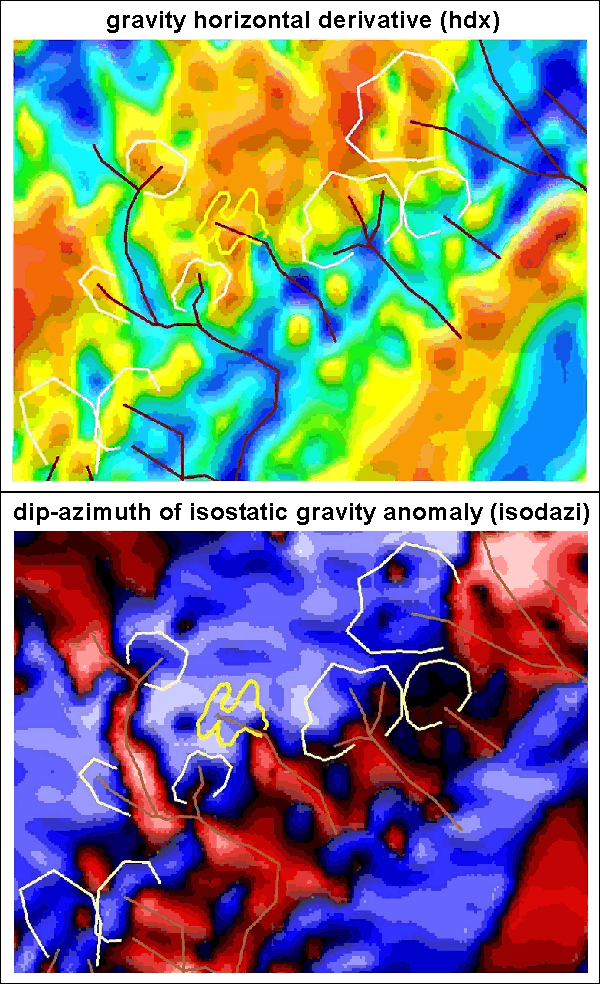
NW Borneo interpreted channel/canyon systems (CCS, in dark brown) with
Lingan Fan (yellow) and speculative fans (white) on background of
gravity horizontal derivative (hdx). Figure 2.
NW Borneo interpreted channel/canyon systems (CCS, in dark brown) with
Lingan Fan (yellow) and speculative fans (white) on background of
gravity horizontal derivative (hdx).
 Figure 3.
NW Borneo interpreted channel/canyon systems (CCS, in brown) with Lingan
Fan (yellow) and speculative fans (cream) on background of dip-azimuth
of isostatic gravity anomaly (isodazi). Figure 3.
NW Borneo interpreted channel/canyon systems (CCS, in brown) with Lingan
Fan (yellow) and speculative fans (cream) on background of dip-azimuth
of isostatic gravity anomaly (isodazi).
Click here
to view sequence of Figures 2 and 3 (hdx and isodazi, respectively).
 Figure 4.
Pearl River Mouth Basin (PRB) interpreted channel/canyon systems (CCS,
in brown) with interpreted fans (yellow) on background of dip-azimuth of
isostatic gravity anomaly (isodazi). Figure 4.
Pearl River Mouth Basin (PRB) interpreted channel/canyon systems (CCS,
in brown) with interpreted fans (yellow) on background of dip-azimuth of
isostatic gravity anomaly (isodazi).
Return
to top.
The Pearl
River Mouth Basin (PRB) is a passive margin rift system composed of
three subbasins (Figure 1). The southernmost of these, the Zhu II subbasin, is significantly extended in a new interpretation that
integrates potential fields data with geological literature in a
GIS-based visual database. The PRB formed over Mesozoic continental
crust and inherited the pre-existing tectonic zones of weakness of that
crust (Pigott and Ru, 1994). Paleogene extension that formed the
depocenters of the PRB occurred mainly from Late Eocene to Late
Oligocene and included a component of dextral shear (Edwards, 1992). The
shear may originate from reactivation of NW-SE-trending strike slip
faults (Xia and Zhou, 1993). These basement trends are well
suited to imaging with potential fields data. The strike-slip faults
appear to control some edges of subbasins and uplifts, including the
Shenhu Uplift boundary with the Zhu II Depression. The shear trend also
seems to influence the paleo-Pearl River drainage.
The
initiation of seafloor spreading is marked by the 30 Ma “breakup” or T7
unconformity, a key boundary separating the more isolated
depocenters containing lacustrine source-prone rift fill from the
succeeding and widespread paleo-Pearl River deltaics (Chen et al.,
1994). The deltaic reservoirs in the Zhu I and Zhu III subbasins have
been the target of most PRB exploration. Few wells have tested the edge
of the Zhu II subbasin, where a lack of reservoir quality sands has been
perceived (Letsch et al., 1994). Recent advances in understanding
deepwater depositional systems (i.e., Posamentier, 2000; Dickson and
Macurda, 2001) predict turbidite reservoirs well outboard of the deltaic
environments explored to date.
Recent work
on a non-exclusive study of the South Atlantic by one of the authors
(Dickson) introduced the possibility of defining controls on sediment
distribution systems from regional gravity data. Examples from both
Brazilian and West African basins suggested the relationship was not
restricted to a single basin.
Offshore
northwest Borneo, the authors identified feature patterns on gravity
attribute images that correlate with interpreted channel/canyon systems
(CCS). These CCS debouch into the known Tertiary Lingan Fan (Mohamad and
Lobao, 1997) and additional speculative fans (Figures 2 and
3); their
sources coincide with the locations of slump-scars and back-cutting
shelf edges. Similar distinct CCS patterns appear to correlate to the
Tertiary Pearl River fan system, initiating at the delta front (Chen et
al., 1994), extending across the slope and terminating at the southern
basin extension, raising the expectation for turbidite reservoirs.
Interpretation
This study
significantly extends the Zhu II subbasin beyond the Neogene thick
(Hirayama, 1991). A restricted Paleogene-aged basin is inferred, with
favorable implications for source-rock deposition and with thinner total
section, avoiding the overmaturity of the Baiyun depocenter.
Interpretation is of a channel/canyon system that provides the clastic
conduits for bringing sands into the far basin (Figure 4) to form turbidite reservoirs. Despite water depths from 1000 to 2500 m, this
area seems ripe for more detailed evaluation.
Chen, J., S. Xu, S., and J. Sang, 1994, The depositional
characteristics and oil potential of paleo Pearl River delta systems in
the Pearl River Mouth basin, South China Sea: Tectonophysics, v. 235, p.
1-11.
Dickson, W. G., and D. B. Macurda Jr, 2001, Recognition
and Analysis of a Major Tributary of the Recent Congo Fan: Some Gully!
Abstract in Geological Society of London Symposium on Deepwater
Depositional Systems, London, Mar, 2001.
Edwards, P.B., 1992, Structural Evolution of the Western
Pearl River Mouth Basin, in J.S. Watkins, Z. Feng, and K.J.
McMillen, eds., Geology and Geophysics of Continental Margins: AAPG
Memoir 53, p. 43-52. Evolution of the Western
Pearl River Mouth Basin, in J.S. Watkins, Z. Feng, and K.J.
McMillen, eds., Geology and Geophysics of Continental Margins: AAPG
Memoir 53, p. 43-52.
Hirayama, J., ed, 1991, Total Sedimentary Isopach Maps
Offshore East Asia: CCOP Technical Bulletin 23, 116 p.
Letsch, D.K., J.W. Norris, and M.W. Heyman, 1994,
Critical Factors for Exploration Success in the Pearl River Mouth Basin,
in, G. Greene, H. Lian, and T.V. Tri, eds., International
Symposium/Workshop on Geology, Exploration and Development Potential of
Energy and Mineral Resources of Vietnam and Adjoining Regions, Program
and Abstracts of Papers, Hanoi, May 30-June 2, 1994, unpublished talk
(errors in abstract noted by speaker): Circum-Pacific Council/Geological
Survey of Vietnam/Petrovietnam, p. 81-82.
Mohamad, M., and J.J. Lobao, 1997, The Lingan Fan: Late
Miocene/Early Pliocene Turbidite Fan Complex, North-West Sabah, in,
J.V.C. Howes, and R.A. Noble,eds., Proceedings of an International
Conference on the Petroleum Systems of SE Asia and Australasia, Jakarta,
Indonesia, May 21-23, 1997: Indonesia Petroleum Association, p.787-798.
Moldovanyi, E.P., F.M. Wall, and Zhang Jun Yan, 1995,
Regional exposure events and platform evolution of Zhujiang Formation
carbonates, Pearl River Mouth Basin: Evidence from primary and
diagenetic seismic facies: AAPG Memoir 63, p. 125-140.
Pigott, J.D., and K. Ru, 1994, Basin superposition on the
northern margin of the South China Sea: Tectonophysics, v. 235, p.
27-50.
Posamentier, H.W., and Putri Sari Wisman, 2000, Deep
Water Depositional Systems -Ultra-Deep Makassar Strait, Indonesia in
Deep-Water Reservoirs Of The World, 20th Annual Bob F.
Perkins Research Conference, GCSSEPM, Houston.
Xia, K.Y., and D. Zhou, 1993, The geophysical
characteristics and evolution of northern and southern margins of the
South China Sea, in, G.H. Teh, ed, Proceedings Symposium on
Tectonic Framework and Energy Resources of the Western Margin of the
Pacific Basin, CPC-GSM, 29 Nov-2 Dec 1992, Kuala Lumpur, Malaysia:
Bulletin of the Geological Society of Malaysia, v. 33, p. 223-240.
Return
to top.
|

 Print this page
 Click to view article in PDF format.