
 Print this page
 Click to view article in PDF format.
Peripheral- Bulge
Bulge Controlled Depositional Architecture of a
Clastic Foredeep Succession: Paleocene, Spitsbergen*
Controlled Depositional Architecture of a
Clastic Foredeep Succession: Paleocene, Spitsbergen*
By
Rikke Bruhn1 and Ron Steel2
Search and Discovery article #40104, 2003.
*Adapted from “extended abstract” for presentation at the AAPG Annual Meeting, Salt Lake City, Utah, May 11-14, 2003.
1Geological Institute, University of Copenhagen, Denmark
2Department of Geology and Geophysics, University of Wyoming, Laramie, Wyoming ([email protected])
The Paleogene Central Basin on Spitsbergen, together with the West Spitsbergen Orogenic Belt, occupy a 100 km broad, NNW-SSE striking zone in the western and central parts of the island. The deformation zone is situated along the De Geer Zone immediately west of Spitsbergen, and its development is presumably closely connected to the evolution of this major intra-plate transform fault zone (Figure 1). Compression along west Spitsbergen probably began in the Late Cretaceous to early Paleocene and culminated in the Eocene, based on fission track modelling, crosscutting relations, and comparison to the offshore record of sea-floor spreading (Braathen and Bergh, 1995; Teyssier et al., 1995; Blythe and Kleinspehn, 1998; Braathen et al., 1999). The Central Basin probably evolved as a foreland basin in front of the West Spitsbergen Orogenic Belt during the earliest phases of compression.
|
|
a: Tabular, small-scale sequences onlap the
basal unconformity on the distal basin margin in Todalen-lower Endalen
Member time, after passage and relaxation of the initial peripheral
b: Deposition of basinward-stepping,
wedge-shaped, small-scale sequences takes place during upper Endalen
Member time in response to uplift and basinward migration of the
peripheral Click to view sequence of depositional architecture (a-e, Figure 3).
The sedimentary fill in the Central Basin unconformably overlies Lower
Cretaceous marine shales. The unconformity corresponds to a hiatus that
spans the entire Upper Cretaceous and increases in a northward
direction. It is probably a combined result of thermal doming or rift
shoulder uplift of the northeast Barents Shelf, and erosion connected to
passage of the initial peripheral
The overall transgressive, Paleocene succession consists of two intermediate-scale, transgressive-regressive cycles, (a) the Firkanten Formation and (b) the Grumantbyen and Basilika Formations (Figure 2). The intermediate-scale cycles in turn consist of numerous small-scale, 10-60 m thick, coastal plain-shoreface-shelf sequences, separated by subaerially formed unconformities (Bruhn and Steel, in press). The sequences represent short-term coastal progradations and have average durations of 0.5-1 million years. Sequences forming the transgressive parts of the intermediate-scale cycles are relatively thin, sheet-like, and onlap the eastern basin-margin, while sequences of the regressive parts are wedge-shaped, basinward-stepping, and associated with regional unconformities along the basin-margin.
Peripheral
The transgressive-regressive cycles were probably largely controlled by
peripheral-
During tectonic quiescence the basin was downwarped due to sediment
loading and gradually widened. The peripheral
The general behaviour of the peripheral
Blythe, A.E., and K.L. Kleinspehn, 1998, Tectonically versus climatically driven Cenozoic exhumation of the Eurasian plate margin, Svalbard: Fission track analyses: Tectonics, v. 17, p. 621-639. Braathen, A., and S.G. Bergh, 1995, Kinematics of Tertiary deformation in the basement-involved fold-thrust complex, western Nordenskiöld Land, Svalbard: tectonic implications based on fault-slip data analysis: Tectonophysics, v. 249, p. 1-29. Braathen, A., S.G. Bergh, and H.D. Maher, 1999, Application of a critical taper wedge model to the Tertiary transpressional fold-thrust belt on Spitsbergen, Svalbard: GSA Bulletin, v. 111, p. 1468-1485.
Bruhn, R., and R. Steel, 2003, High-resolution sequence
stratigraphy of a clastic foredeep succession (Paleocene, Spitsbergen):
An example of peripheral- Flemings, P.B., and T.E. Jordan, 1989, A Synthetic stratigraphic model of foreland basin development: Journal of Geophysical Research, v. 94, p. 3851-3866. Flemings, P.B., and T.E. Jordan, 1990, Stratigraphic modeling of foreland basins: Interpreting thrust deformation and lithosphere rheology: Geology, v. 18, p. 430-434. Kellogg, H.E., 1975, Tertiary stratigraphy and tectonism in Svalbard and continental drift: AAPG Bulletin, v. 59, p. 465-585. Manum, S.B., and T. Throndsen, 1978, Rank of coal and dispersed matter and its geological bearing in the Spitsbergen Tertiary: Norsk Polarinstitutt årbok 1977, p. 169-177. Plink-Björklund, P., D. Mellere, and R.J. Steel, 2001, Turbidite variability and architecture of sand-prone, deep-water slopes: Eocene clinothems in the Central Basin, Spitsbergen: Journal of Sedimentary Research, v. 71, p. 895-912. Steel, R.J., A. Dalland, K. Kalgraff, and V. Larsen, 1981, The central Tertiary Basin of Spitsbergen: Sedimentary development of a sheared margin basin, in Kerr, J.W. and A.J. Fergusson, (eds.): Canadian Society of Petroleum Geologists Memoir 7, p. 647-664. Steel, R.J., J. Gjelberg, W. Helland-Hansen, K. Kleinspehn, A. Nφttvedt, and M. Rye-Larsen, 1985, The Tertiary strike-slip basins and orogenic belt of Spitsbergen: Society of Economic Paleontologists and Mineralogists, Special Publication 37, p. 339-359. Teyssier, C.K., K. Kleinspehn, and J. Pershing, 1995, Analysis of fault populations in Western Spitsbergen - Implications for deformation partitioning along transform margins: GSA Bulletin, v. 107, p. 68-82. |
 Figure
1. Paleogeographic reconstruction of the Arctic in Late Cretaceous -
earliest Paleocene time showing the main spreading zones in the Arctic.
Figure
1. Paleogeographic reconstruction of the Arctic in Late Cretaceous -
earliest Paleocene time showing the main spreading zones in the Arctic. Figure
2. Dip sections across the northeast margin of the Central Basin of each
of the two transgressive-regressive cycles,
Figure
2. Dip sections across the northeast margin of the Central Basin of each
of the two transgressive-regressive cycles,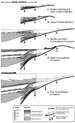 Figure
3. Development of depositional architecture and stacking patterns of
small-scale sequences in the Firkanten, Basilika and Grumantbyen
Formations.
Figure
3. Development of depositional architecture and stacking patterns of
small-scale sequences in the Firkanten, Basilika and Grumantbyen
Formations. 
