
 Print this page
 Basin
Basin -Centered
Tight Gas Sands and Thrust Faulting in Central Parker County of the Fort Worth
Basin
-Centered
Tight Gas Sands and Thrust Faulting in Central Parker County of the Fort Worth
Basin
By
Jimmy D. Thomas; Castaneda Consulting LLC, Weatherford, Texas
The Fort Worth Basin formed during Early and Middle
Pennsylvanian due to the oblique collision of the Afro-South American and North
American plates. This tectonic activity not only affected deposition at that
time but also affected the underlying formations. Depositional environments
changed from shelf carbonates to shallow marine to deep marine then back to
shallow marine during basin development. Eustatic cycles combined with tectonic
activity have complicated mapping efforts and led to many misunderstandings
about the basin. Much of the basin center is unexplored and has potential for
enormous gas reserves. Reservoir mapping of just the basin-centered tight gas
sediments indicate natural gas reserve potential in the tens of TCF. Is this
another giant reservoir that can be “gas-farmed” much like the Barnett Shale?
A four-hundred-foot throw thrust fault (Figure 1) extends
through southern Parker County with open hole logs indicating repeat sections in
the Barnett Shale, Atoka and Strawn formations. Due to the cyclicity of
sediments during this time, most of these repeat sections can be mapped as
separate deposits. It is also believed that due to the oblique collision of the
plates, lateral fault movement and faults of different orientations complicate
the understanding of tectonics during this time. This tectonic activity has the
potential to have created additional “sweet spots” in the Barnett Shale similar
to the Newark East gas field. Faulting and fracturing may have created
potential permeability enhancement and hydrocarbon traps in the Ellenburger and
Marble Falls making these formations exploration and development targets. Due to
a lack of drilling, very little is known about these formations in most of the
basin. The Fort Worth Basin is a new exploration frontier for combining the
advances in geology and engineering technologies.
is a new exploration frontier for combining the
advances in geology and engineering technologies.
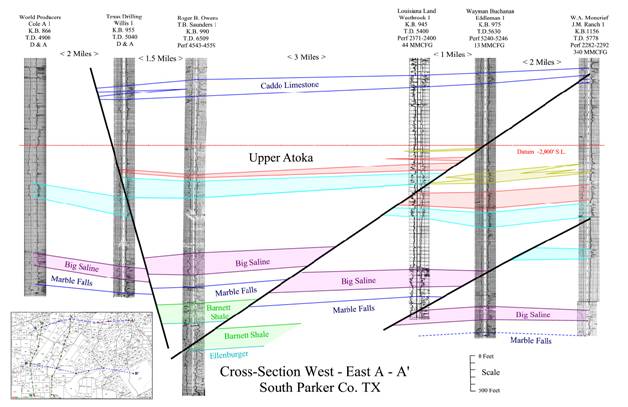
Figure 1. Cross-section, south Parker County, Texas, showing repeated intervals due to thrust faulting.
AAPG Search and Discovery Article #90010©2003 AAPG Southwest Section Meeting, Fort Worth, Texas, March 1-4, 2003