| [First Hit] |
|---|
 Click to view
presentation in PDF format.
Click to view
presentation in PDF format.
Search and Discovery Article #40317 (2008)
Posted October 30, 2008
*Adapted from oral presentation at AAPG Annual Convention, San Antonio, Texas, April 20-23, 2008
1 TICORA Geosciences, Arvada, CO ([email protected])
2 Omni Laboratories, Houston, TX
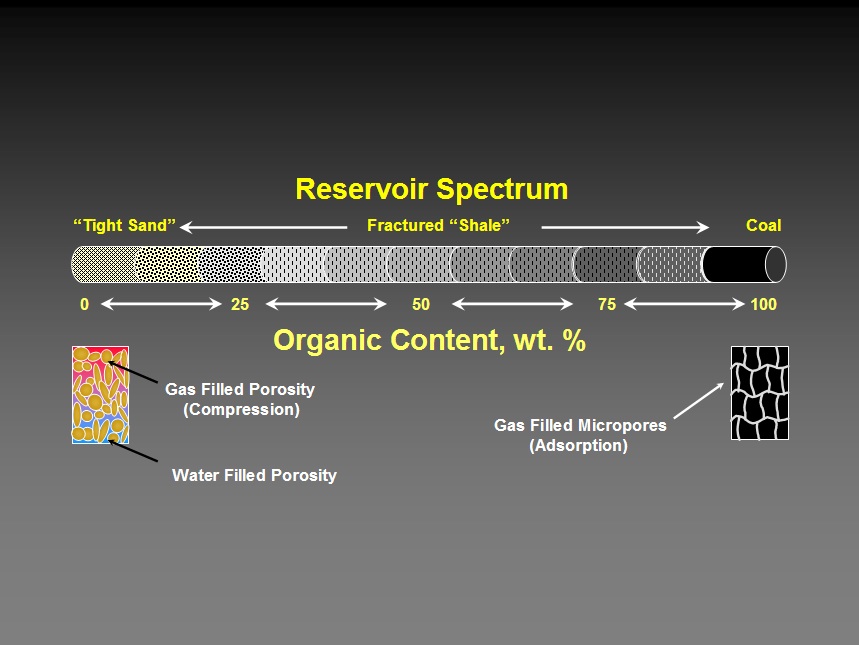
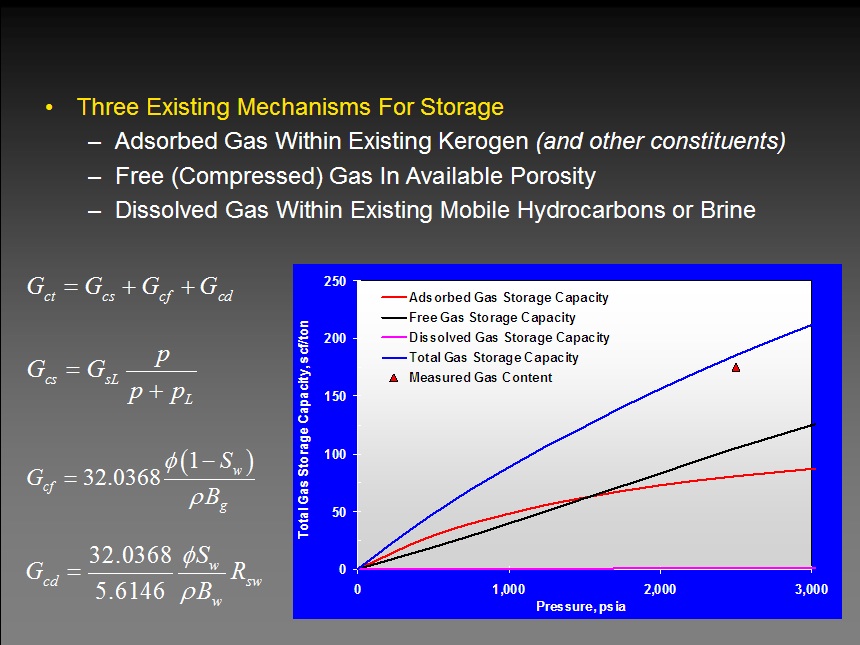
Shale gas reservoirs are a commingling between conventional (compressed) and unconventional (adsorbed;, i.e., CBM) gas reservoirs. Therefore, shale gas-in-place (GIP) evaluations require the use of analytical methods originally developed for each specific reservoir system. Unfortunately, many analytical techniques used to determine GIP and permeability for conventional and CBM reservoirs do not translate well when evaluating shale due to its complex lithology. Presented are the results of a rigorous study, conducted in an effort to improve existing shale analytical protocol to more accurately define the critical parameters necessary for shale GIP assessment.
The petrographic impact on the adsorbed phase gas storage capacity in shale was investigated to determine what, if any, gas adsorption vectors beyond available TOC exist. Research was also conducted to define the influence of liquid phase hydrocarbons on the adsorbed phase gas storage capacity (dissolution) in shale. The results provide insight into the mechanisms responsible for some of the unexplained phenomena observed when adsorption isotherm analysis is conducted on shale samples.
Improved sample  handling methods were developed to maintain in-situ moisture conditions during processing and
laboratory testing. Techniques were developed to allow the delineation of water saturations into its pore,
irreducible, and bound water components. Procedures were developed to improve shale permeability and porosity
measurements, using competent core under in-situ stress conditions. Furthermore, grain density measurements
(required for porosity determinations) were conducted using select inert gas species with molecular diameters
similar to methane to contrast and compare the results determined using the standard gas, helium, which can
potentially overestimate available porosity.
handling methods were developed to maintain in-situ moisture conditions during processing and
laboratory testing. Techniques were developed to allow the delineation of water saturations into its pore,
irreducible, and bound water components. Procedures were developed to improve shale permeability and porosity
measurements, using competent core under in-situ stress conditions. Furthermore, grain density measurements
(required for porosity determinations) were conducted using select inert gas species with molecular diameters
similar to methane to contrast and compare the results determined using the standard gas, helium, which can
potentially overestimate available porosity.
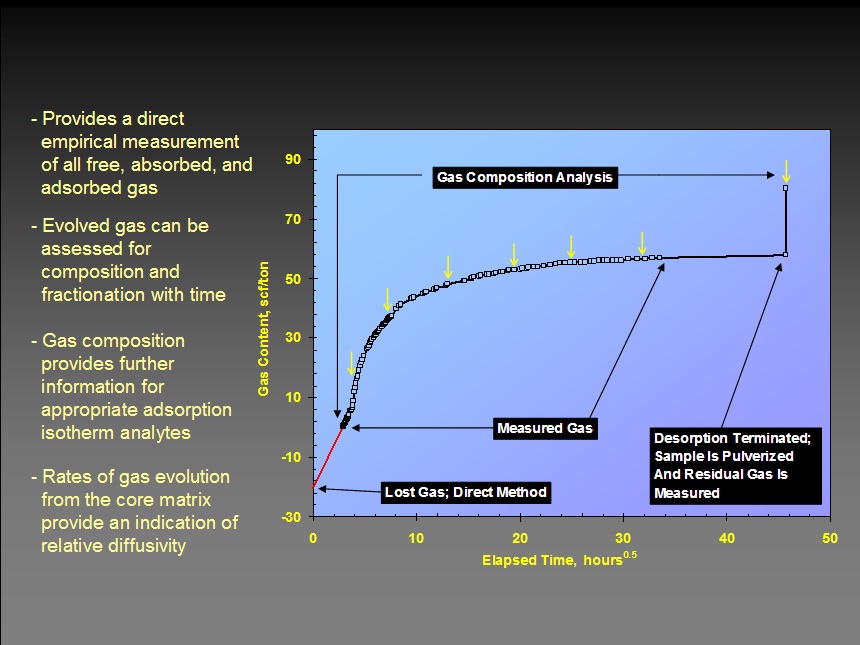
Present day in-situ GIP is a function of the geological factors which the reservoir has been subjected to since deposition (reservoir "burping", uplift, faulting, hydraulic stripping). Thus, accurate gas content data often cannot be calculated from knowledge of physical rock properties alone but instead must be directly measured from freshly cut rock samples.
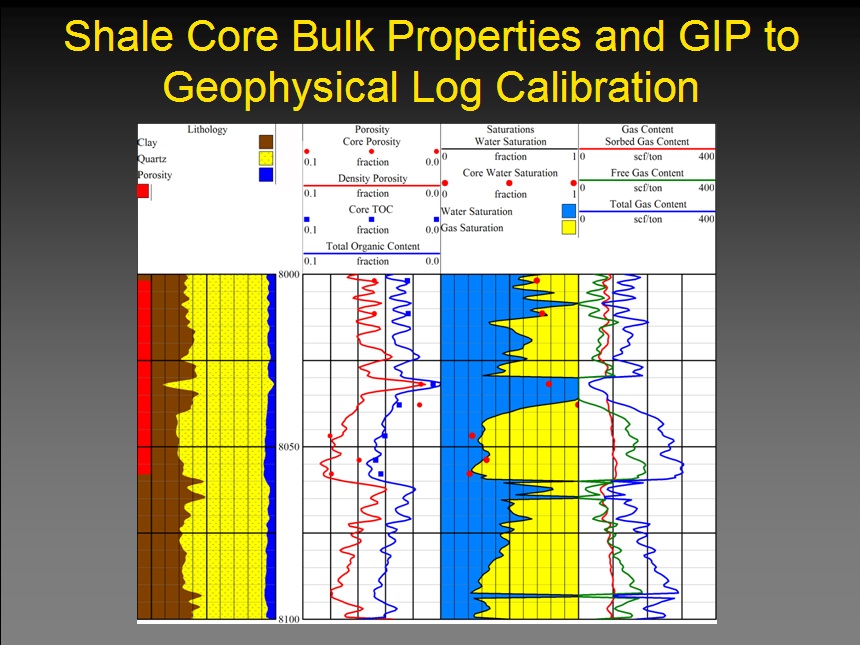
Indirect GIP determination (i.e., gas storage capacity = gas content) can still provide valuable information on resource potential.
handling protocols are critical to obtain data that accurately
represents in-situ reservoir properties.core acquisition is in itself
altering the in-situ reservoir properties. As a proactive measure, SOP's should include removal of the core rind before any analyses.