| [First Hit] |
|---|
 Click to view presentation in PDF format.
Search and Discovery Article #80015 (2008)
Posted October 24, 2008
*Adapted from oral presentation at AAPG Annual Convention, San Antonio, Texas, April 20-23, 2008
1 Petroleum & Geothermal Group, Primary Industries & Resources South Australia, Adelaide, SA, Australia ([email protected])
2 Onshore  Energy & Minerals Division, Geoscience Australia, Canberra, ACT,
Australia
Energy & Minerals Division, Geoscience Australia, Canberra, ACT,
Australia
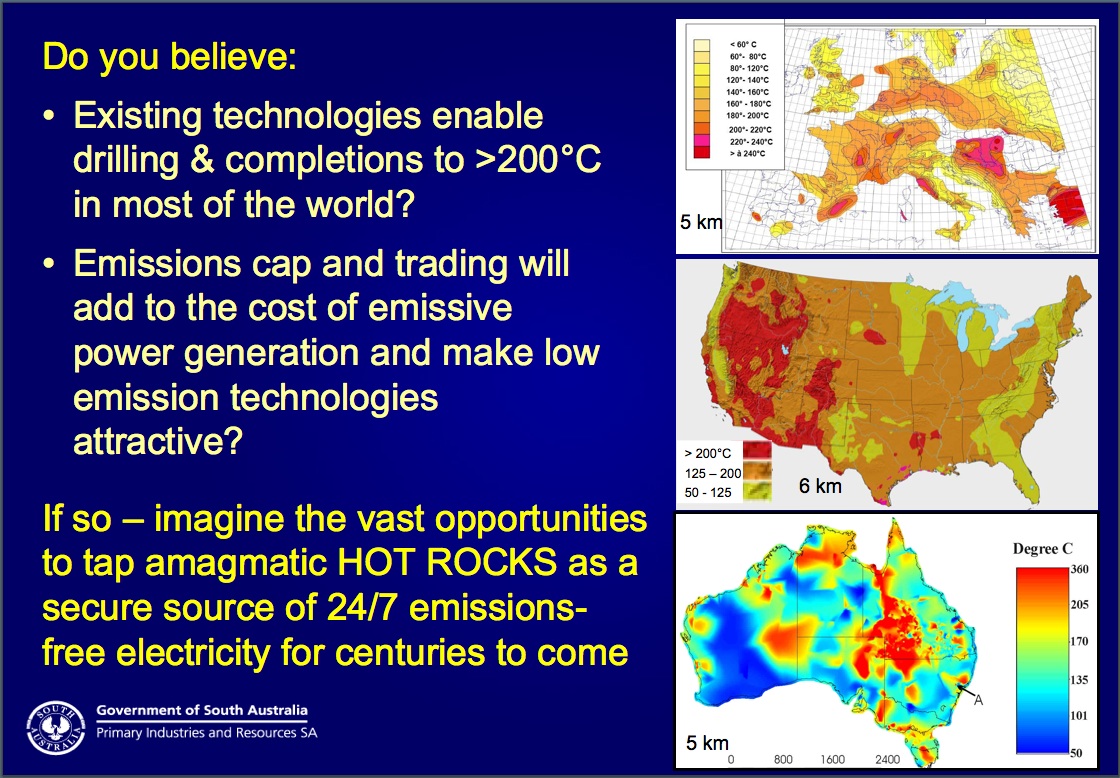
Australia's hot rock and hydrothermal resources have the potential to fuel
competitively-priced, emission-free, renewable baseload power for centuries to come. This potential and the risks
posed by climate change are stimulating geothermal energy exploration projects in Australia.
Extracting just 1 percent of the geothermal between the depth to 150°C and 5,000m would yield ~190 million PJ
or about 26,000 times Australia's primary power usage in 2005, and that does not take into account the renewable
characteristics of hot rock Enhanced Geothermal Systems (EGS) or the resource below 5,000m.
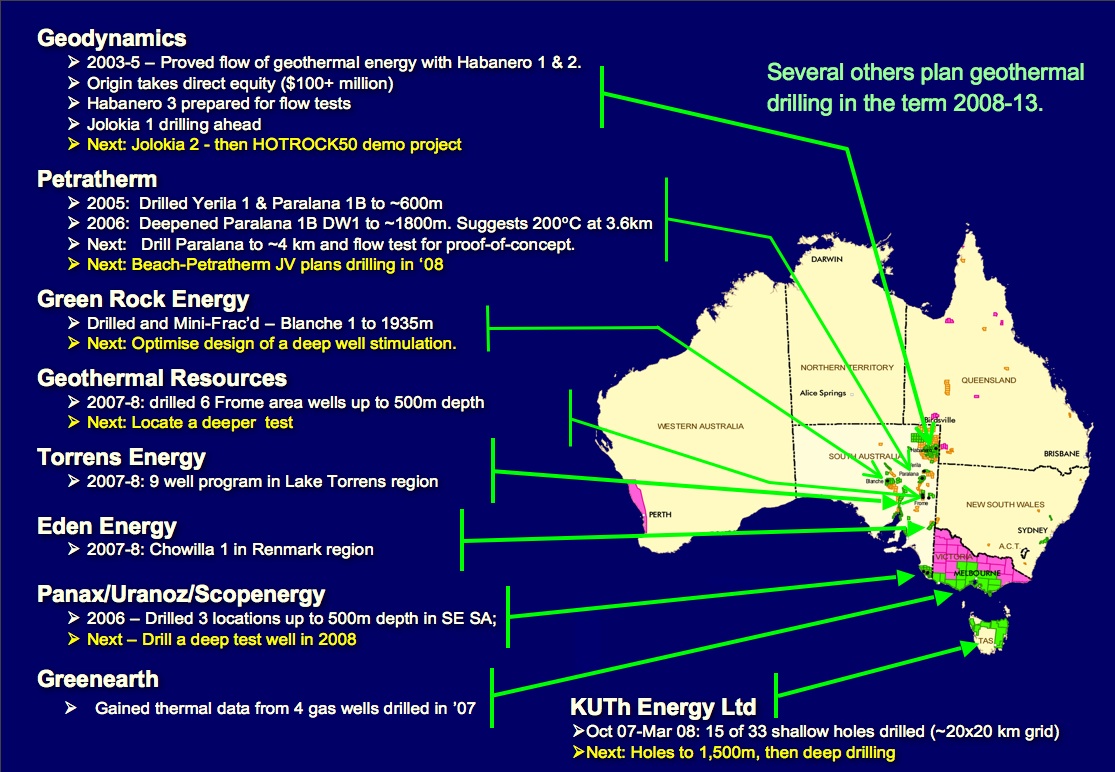
Twenty-nine companies have joined the hunt for geothermal energy resources in 204 licence application areas
covering approximately 187,000 km2 in Australia. Most exploration efforts are currently focused on hot rocks
(EGS) to fuel binary power plants. Roughly 80 percent of these projects are located in South Australia.
A considerable investment (US$170+ million) is required to prove a hot rock play, and demonstrate the reliability, scalability, and efficiency of EGS power production. The proof-of-concept phase entails the drilling of at least two deep (>3,500m) hot holes (one producer and one injector) as well as fracture stimulation, geo-fluid flow and reinjection and heat exchange to generate electricity. Up-scaling for compelling demonstration projects entails additional wells and smooth operations from a binary geothermal power plant.
Play and portfolio assessment methods currently used to manage the uncertainties in petroleum exploration can
usefully be adapted to underpin decision-making by companies and governments seeking to push and pull hot rock
energy supplies into markets.
The presentation will cover the geology, challenges, and promising future for hot-rock geothermal energy
projects in Australia.
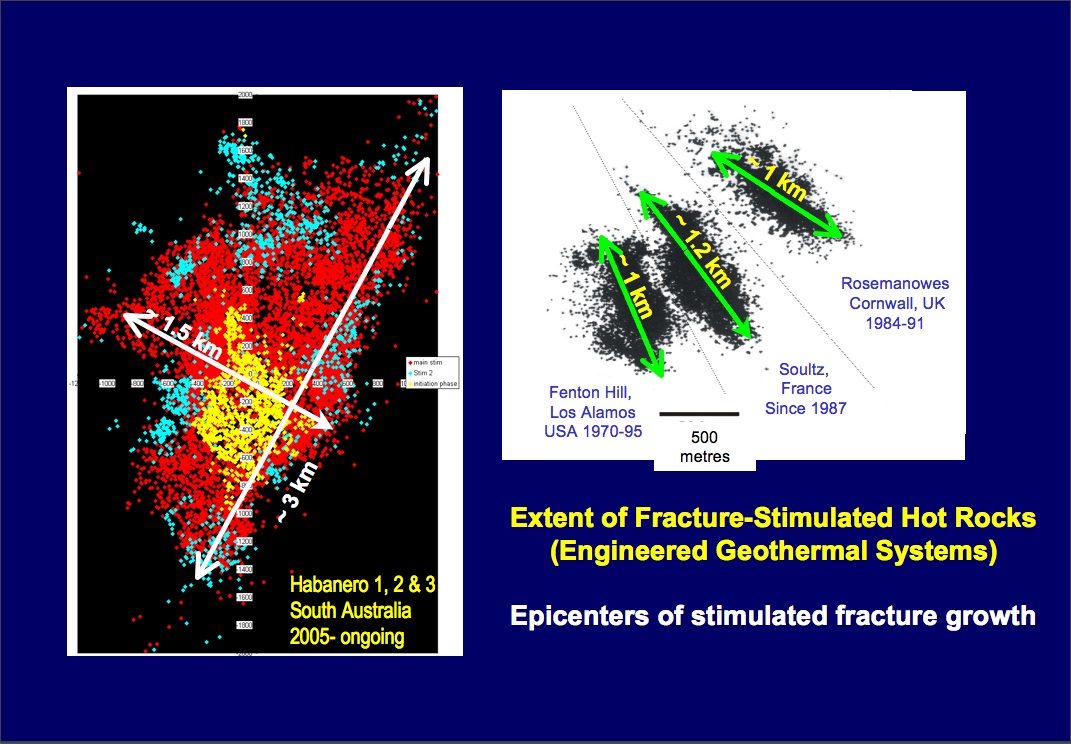
Fenton Hill, Los Alamos, NM, USA: 1970 - 1995
Fjalbacka, Sweden: 1984 - 1988
Rosemanowes, Cornwall, UK : 1984 - 1991
Hijiori, Japan: 1985 - 2000
Soultz, France: 1987 - Current
Ogachi, Japan: 1989 - 2000
Habanero & Jolokia, Australia: Current
Bad Urach, Germany: Current
Basel, Switzerland: Abeyance/Current
Landau, Germany: Current
Energyenergy is flowed) geothermal projects.
At least 10 by 2011/12.energy is real. By 2012.renewable and emissions-free base load power from geothermal
energy for centuries to come. At least 7% of base-load demand from hot rock power by 2030. More than 10% by
2050.
for centuries to come. At least 7% of base-load demand from hot rock power by 2030. More than 10% by
2050.