
| [First Hit] |
|---|
 Click to view presentation in PDF format.
Search and Discovery Article #40318 (2008)
Posted October 24, 2008
*Adapted from oral presentation at AAPG Annual Convention, San Antonio, Texas, April 20-23, 2008.
1 Petrophysical Analysis Subsurface Technology, ConocoPhillips, Houston, TX ([email protected])
The purpose of this study was to develop a method by which a detailed porosity classification
system could be used to understand the relationship between pore/pore-throat geometry, genetic porosity type, and
facies. This study also investigated the relationships between pore/pore-throat geometry, petrophysical
parameters, and reservoir performance characteristics. The focus was on the Jurassic Smackover reservoir rocks of
Grayson field, Arkansas. This three part study developed an adapted genetic carbonate pore type classification
system and used petrographic image analysis and mercury-injection  capillary pressure tests to calculate
pore/pore-throat sizes. These were compared to facies, pore type, and each other showing that pore-throat size is
controlled by pore type and that pore size is controlled primarily by facies. Pore size range can be estimated
from pore type and median pore-throat aperture. Capillary pressure data was used to understand the behavior of
the dependent rock properties. It was determined that size-reduced samples tend to show similar dependent rock
property behavior, but size-enhanced samples show dispersion. Capillary pressure
capillary pressure tests to calculate
pore/pore-throat sizes. These were compared to facies, pore type, and each other showing that pore-throat size is
controlled by pore type and that pore size is controlled primarily by facies. Pore size range can be estimated
from pore type and median pore-throat aperture. Capillary pressure data was used to understand the behavior of
the dependent rock properties. It was determined that size-reduced samples tend to show similar dependent rock
property behavior, but size-enhanced samples show dispersion. Capillary pressure data was used to understand
fluid flow behavior of pore types and facies. Oncolitic grainstone samples show unpredictable fluid flow behavior
compared to oolitic grainstone samples, yet oncolitic grainstone samples will move a higher percentage of fluid.
Size-enhanced samples showed heterogeneous fluid flow behavior while the size-reduced samples could be grouped by
the number of modes of pore-throat sizes. Finally, this study used petrographic image analysis to determine if
2-D porosity values could be compared to porosity values from 3-D porosity techniques. The heterogeneous pore
network found in the Grayson reservoir rocks prevents the use of petrographic image analysis as a porosity
calculation technique.
data was used to understand
fluid flow behavior of pore types and facies. Oncolitic grainstone samples show unpredictable fluid flow behavior
compared to oolitic grainstone samples, yet oncolitic grainstone samples will move a higher percentage of fluid.
Size-enhanced samples showed heterogeneous fluid flow behavior while the size-reduced samples could be grouped by
the number of modes of pore-throat sizes. Finally, this study used petrographic image analysis to determine if
2-D porosity values could be compared to porosity values from 3-D porosity techniques. The heterogeneous pore
network found in the Grayson reservoir rocks prevents the use of petrographic image analysis as a porosity
calculation technique.
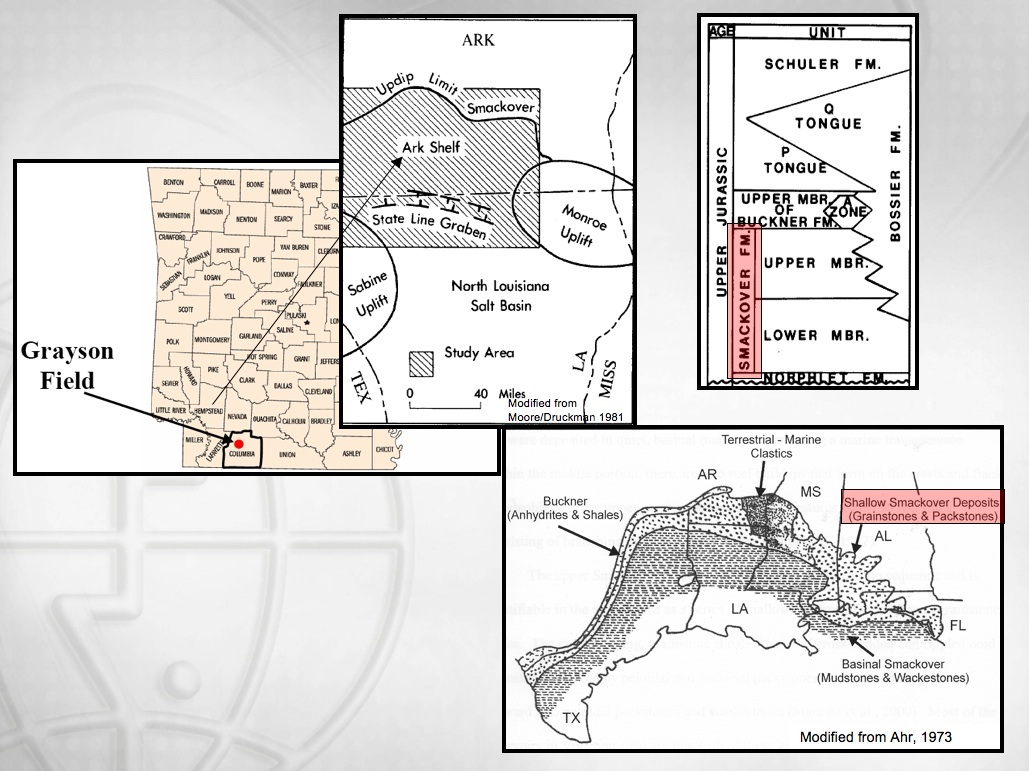 |
Location map and columnar section. |
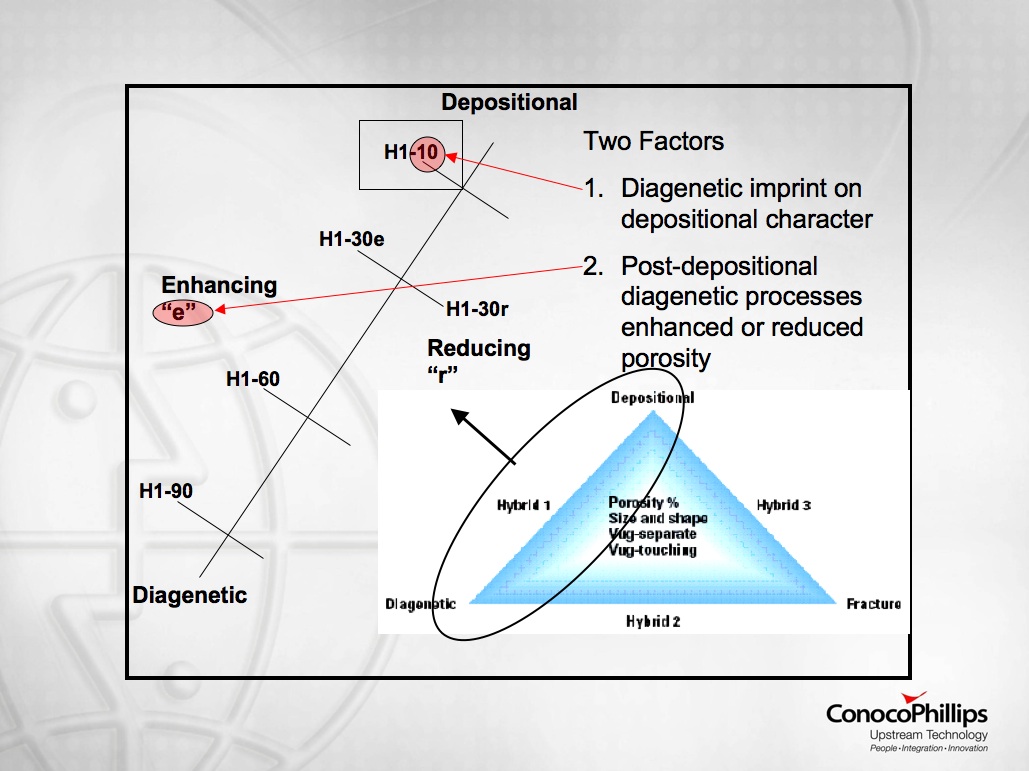 |
Pore type classification, with recommendation for a more detailed scale for Hybrid 1 pore types. |
Pore typing through descriptive characterization of the degree and type of diagenetic processes distinctly separates different rock types by their dependent rock properties, petrophysical parameters, and flow capacity.
Key is: spatial distribution.
Why? Both J-function and Lorenz curves show that enhanced and reduced pore type groups have distinctly unique dependent rock properties and fluid flow characteristics.
Goal: With the help of a detailed chronostratigraphic study, correlate pore type locations across the field (from facies) and by extension determine the spatial distribution of the dependent rock properties and fluid flow behavior.
Moore, Clyde H., and Yehezkell Druckman, 1981, Burial diagenesis and porosity evolution, Upper Jurassic Smackover, Arkansas and Louisiana: AAPG Bulletin, v. , p. 597-628.
Ahr, Wayne, M., 1973, The carbonate ramp: An alternative to the shelf model: GCAGS Transactions, v. 23, p. 221-225.
Lorenz, M.O., 1905, Methods of measuring the concentration of wealth: Publications of the American Statistical Association, v. 9, p. 209-219.
Anderson Oil & Gas and Petro-Chem Operating for research sponsorship and guidance.
Dr. Wayne Ahr for life-long mentorship.
ConocoPhillips for the opportunity to attend this meeting.